Will a Grow Light Make My Plant Flower?
Two different mechanisms decide this and they pull in opposite directions. One group of plants wants more light. The other wants fourteen hours of unbroken darkness.
By Scooter M. — An enthusiast who's genuinely into this. I read the manuals, compile the published specs, and do the math. No lab coat.
Published · How we pick
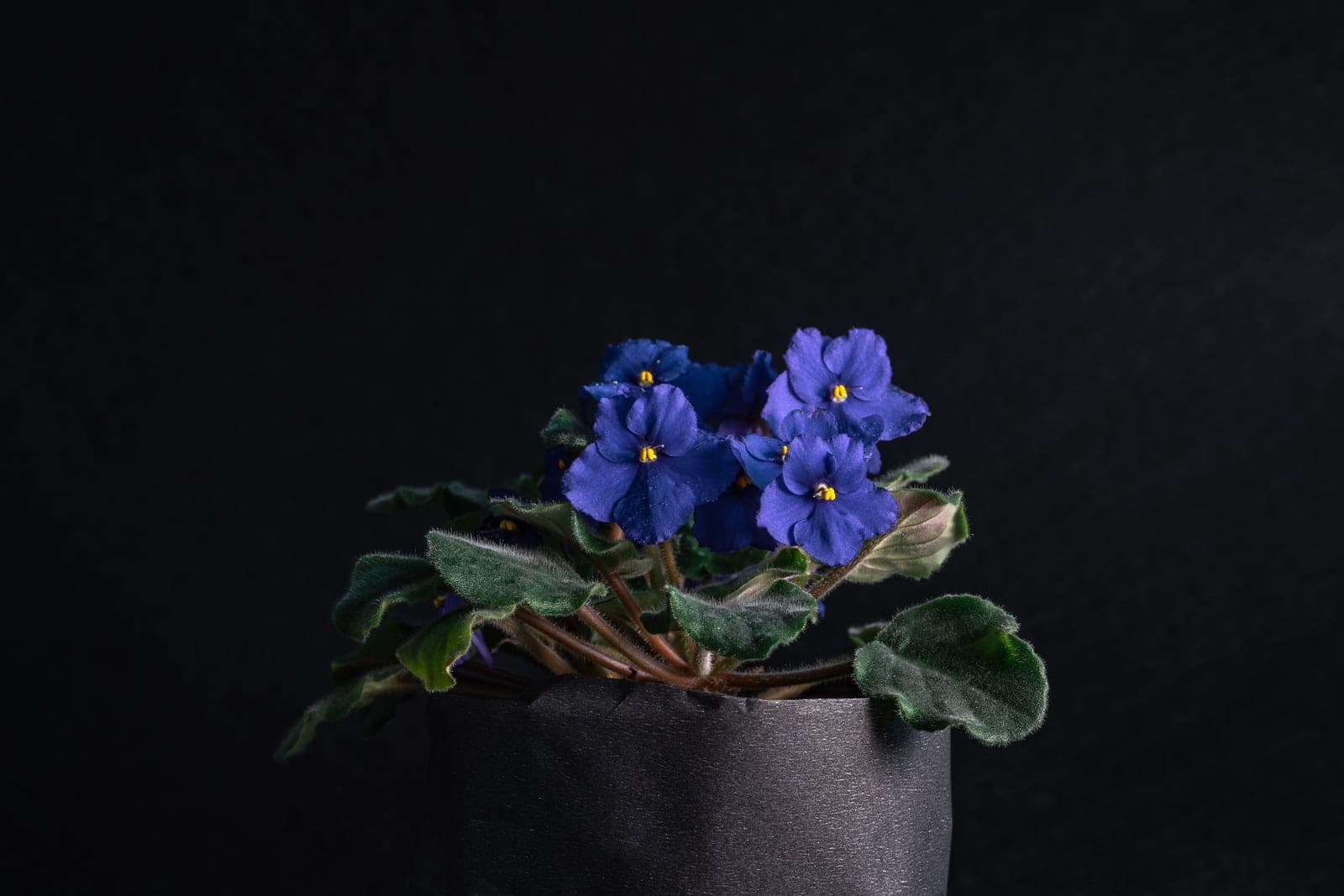
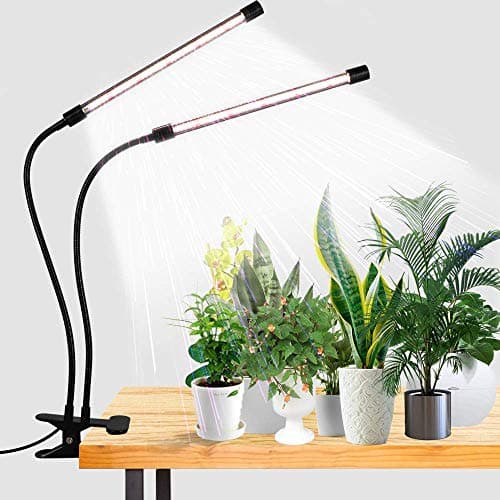
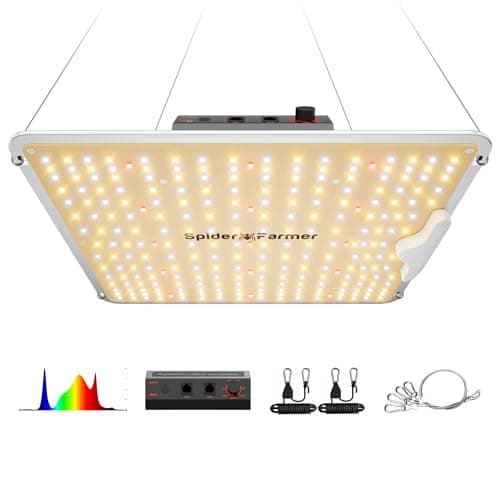
Photographs on this site are licensed stock and are illustrative of the fixture type. We do not own the units we write about.
How this page is funded: the buy links here are Amazon Associates links, and we earn a commission on qualifying purchases at no extra cost to you. We have not been paid to feature anything on this page, we accept no free product, and commission plays no part in the ranking. Full disclosure.
We have not tested these units. Everything below comes from the manufacturer’s own published specifications, or from arithmetic we have shown our working for. Where a figure is not published, we say so instead of estimating one. Read the method.
Quick picks
Efficacy is photons out per joule in. Where a manufacturer publishes it we quote theirs; where they publish photon output and wattage but not efficacy, we divide and label it as ours; where they publish neither, the cell says so rather than guessing. Tap a row for the full write-up.
| # | Product | Best for | Efficacy | Price |
|---|---|---|---|---|
| 1 | 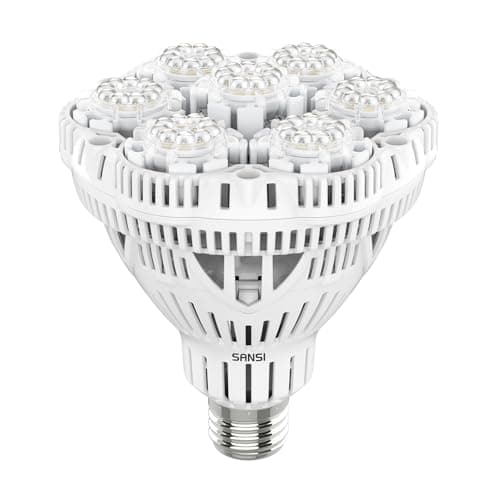 SANSI 36W BR30 Grow Light Bulb The rare grow bulb that publishes both PPF and a PPFD figure with the measurement distance attached, which is the only reason it can be sized honestly. | One bloomer, placed by published numbers | 1.82 umol/J (ours) | |
| 2 | 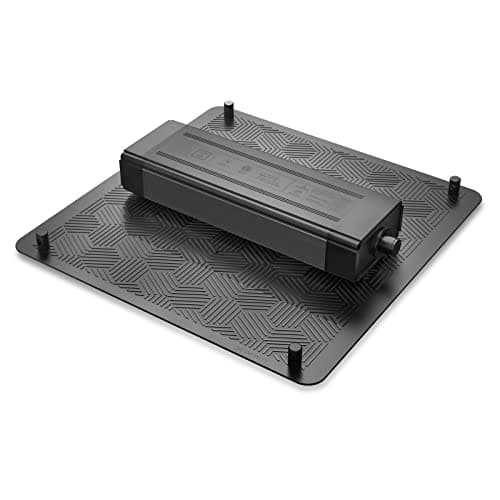 AC Infinity IONBOARD S22 The highest published efficacy of any fixture here at 2.7 umol/J, on Samsung LM301H diodes, with dimming in real 20% steps rather than a vague knob. | A shelf of bloomers, dimmable | 2.7 umol/J | |
| 3 | 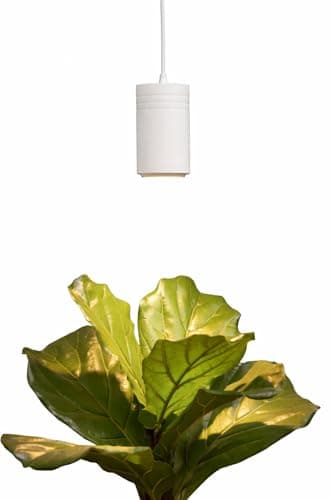 Soltech Aspect Gen 2 The only fixture here you would willingly hang in a living room, and the only one publishing PPFD at three separate distances so it can actually be placed by the numbers. | A living room, with a real dimmer | 1.39 umol/J (ours) | |
| 4 | 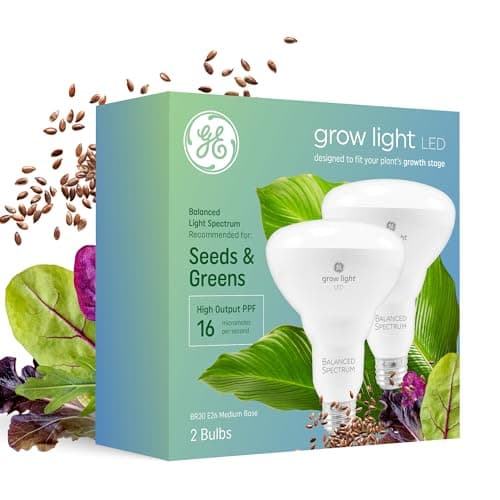 GE Grow Light BR30 Bulb, Seeds and Greens (2-pack) A mainstream-brand grow bulb that prints its photon output on the box: 16 umol/s from 9 W, which is enough for one low- or medium-light plant under a lamp you already own, and not much more. | Two plants on two separate timers | Not published |
The reasoning
If the plant is simply short of light, usually yes — flowering takes a whole band more light than surviving does, and closing that gap is what a fixture is for. If the plant is a holiday cactus, a poinsettia or a kalanchoe, the answer is the reverse: a grow light on the wrong schedule is the most common reason those plants do not bloom. Which answer applies to you depends entirely on which of two mechanisms is holding your plant back, and they are easy to tell apart.
We have not tested any fixture. The light levels below are published extension figures and the arithmetic is shown.
First, which kind of plant do you have?
Three groups, and the advice is completely different for each.
| Group | Examples | What a grow light does |
|---|---|---|
| Light-limited bloomers | African violet, orchid, peace lily, hibiscus, begonia, geranium, streptocarpus | Raises them into the flowering band. This is the case where a fixture genuinely produces flowers. |
| Photoperiod bloomers | Thanksgiving and Christmas cactus, poinsettia, kalanchoe | Can actively prevent flowering. These need long unbroken nights, and a lamp at the wrong hour stops bud set. |
| Foliage plants that do not flower indoors | Monstera, pothos, philodendron, ZZ, snake plant, fiddle-leaf fig | Produces leaves, not flowers. Adding light will not make these bloom and nothing else will either. |
That third row is worth saying plainly, because a lot of money is spent on it. A pothos under a grow light is a faster, denser pothos. It is not a pothos about to flower. If your plant is in the third group, the honest buying advice is to light it for foliage — which is a different and cheaper problem.
Mechanism one: flowering takes a band more light
For the first group, the reason a healthy plant produces no flowers is almost always that it sits below the level flowering requires, while sitting comfortably above the level survival requires. Those are two different numbers and the gap between them is large.
Iowa State University Extension places low-light foliage plants at 3 to 6 mol/m²/day and foliage and flowering houseplants at 6 to 10 — roughly a doubling. Virginia Cooperative Extension’s daily light integral table goes further for plants grown specifically for bloom: begonia and geranium at 12 to 19 mol/m²/day, and petunia at 20 to 25, which is the same band as a fruiting tomato.
8 mol/m²/day over a 12-hour day: 8,000,000 ÷ (12 × 3600) = 185 µmol/m²/s at the leaf.
Over one square foot (0.0929 m²), at the 80% capture this site assumes: 185 × 0.0929 ÷ 0.8 = about 21 µmol/s of fixture output.
Against the 3 to 6 band a foliage plant needs — about 11 µmol/s on the same arithmetic — the flowering plant wants roughly double.
The symptom is diagnostic, and it is the thing to check before buying anything. A plant that produces healthy new leaves and no flowers is below the flowering band. A plant that produces neither is below the survival band, or has a problem that is not about light at all. We work the single-plant version of this through on the peace lily page, where the survival and flowering bands are a full band apart, and on African violets, which are the clearest case in the whole category.
Mechanism two: the plants that need the dark
A smaller group of popular houseplants flower in response to night length rather than light quantity, and for these a grow light is a liability unless it is on a schedule you have thought about.
Clemson Cooperative Extension is unambiguous on the holiday cacti: “Fourteen hours or more of continuous darkness each day is required before flower bud set will occur”, and — the sentence that matters most on this page — “as little as 2 hours of interrupted lighting will inhibit flower bud set”. Street lights, car headlights and ordinary indoor lighting are all named as disruptions.
Clemson Cooperative Extension HGIC 1554. Two hours of interrupted lighting is enough to prevent bud set. Long nights started about mid-September; once the buds are set, day length no longer matters.
Put that next to a normal grow light schedule and the conflict is obvious. A shelf fixture running fourteen or sixteen hours a day — the correct setting for almost everything else on this site — gives a holiday cactus an eight-to-ten-hour night, which is four to six hours short of what it needs. The plant stays green, healthy and completely flowerless, and the owner concludes it needs more light.
14 hours of darkness means the light is on for no more than 10 hours — say 8am to 6pm.
A standard 16-hour photoperiod leaves an 8-hour night. Six hours too short.
And the room has to be dark for all fourteen. A lamp switched on at 9pm for two hours is, on Clemson’s figure, enough on its own to stop bud set.
Two practical consequences. First, a holiday cactus should not share a timer with your foliage shelf from about mid-September for six weeks — Clemson has growers start the long nights in the middle of September and continue for at least six weeks, with buds visible in three to four. Second, once buds have formed you can stop worrying: the fact sheet notes that the photoperiod has no effect on flowering once the buds are set, so the plant can go back on the normal shelf to flower.
There is one escape hatch for anyone who cannot control the light. Clemson records that plants grown with night temperatures between 50 and 59 °F “will set flower buds regardless of day length”, though growth is slower. A cool unheated room in October does the job that a timer would otherwise do — and bud drop becomes a risk at 50 °F, so it is cool rather than cold.
What about a “bloom” spectrum?
Short version: buy photons and a timer, not a label. Red-heavy “bloom” settings and separate flowering bulbs are the most heavily marketed idea in this category and the least supported by the published data.
The cleanest evidence is a manufacturer’s own. GE sells each of its grow bulb shapes in two spectra, Seeds and Greens and Flowers and Fruit, and publishes a photon figure for both: the BR30 Flowers and Fruit bulb emits 15 µmol/s against 16 µmol/s for the Seeds and Greens version of the same 9 W bulb. The bulb sold for flowering emits slightly fewer photons, and GE publishes no spectral distribution to support the claim. We take that apart in the GE review, and the broader white-versus-magenta evidence is in full spectrum vs red and blue.
The decision, in one table
| If your plant... | The cause | What to change |
|---|---|---|
| Grows healthy leaves but never flowers (violet, orchid, peace lily) | Below the flowering band | More light: aim for 6-10 mol/m²/day, 12-14 hours |
| Is a holiday cactus or poinsettia that stays green | Night too short, or interrupted | Less light: 10 hours on at most, 14+ hours of true dark from mid-September |
| Is a foliage plant (pothos, monstera, ZZ) | It does not flower indoors | Nothing. Light it for foliage instead |
| Flowered when you bought it and never again | Often forced in production | Check the species first — some are grown to flower on a schedule you cannot repeat at home |
| Drops buds before they open | Usually temperature or water, not light | Check night temperature and watering before adding a fixture |
1. SANSI 36W BR30 — one bloomer, placed by published numbers
The only grow bulb that publishes a PPFD with the measurement distance attached, which is exactly what you need when the target is a band rather than “brighter”. 265.58 µmol/m²/s at 1 ft, scaled by inverse square, lets you set the height to land inside the flowering range on purpose.
265.58 at 1 ft → 265.58 ÷ 1.5² = 118 µmol/m²/s at 18 in, and 265.58 ÷ 1.25² = 170 at 15 in.
For a violet in the medium band, 14 to 16 inches. At 12 hours, 170 µmol/m²/s is 7.3 mol/m²/day — inside Iowa State’s 6 to 10 flowering band.
Best for: a single flowering houseplant in a lamp, where you want to hit a band rather than guess at it.
The downside: no beam angle is published, so the footprint around that center figure is unknown; 1.82 µmol/J is modest; and SANSI states it is “not recommended to be used in tightly closed fixtures” and weighs a pound, so the lamp matters.
2. AC Infinity IONBOARD S22 — a shelf of bloomers, dimmable
If the plants that need the flowering band are a collection rather than one specimen, a board covering a 2 ft square is the efficient answer, and at a published 2.7 µmol/J this is the cheapest here to run. Dimming in 20% steps is the part that matters: it lets you hold a band rather than overshoot it.
Best for: a violet or orchid shelf running twelve to fourteen hours through the winter.
The downside: AC Infinity publishes no PPF in µmol/s and quotes “1098 PPFD” with no measurement distance, so you cannot compute where the flowering band sits under it — you set the height by result instead. Not a fixture to put on a holiday cactus’s schedule without a separate timer.
3. Soltech Aspect Gen 2 — a living room, with a real dimmer
Publishes PPFD at three separate distances and carries an in-line dimmer from 10 to 100%, which between them make it the easiest fixture here to park on a specific band. It also looks like a pendant light, which is why it survives in rooms where a panel would not.
Best for: a flowering plant in a room you actually sit in, where the fixture has to be furniture as well as a tool.
The downside: 50 µmol/s from 36 W is 1.39 µmol/J, the second-lowest efficacy on this site, and it costs several times what the SANSI bulb does for less light. You are paying for the industrial design and the published falloff curve, not for photons.
4. GE Grow BR30 — two plants on two separate timers
The cheap, slightly unglamorous answer to the photoperiod problem. Two bulbs at 16 µmol/s each, E26, in two ordinary lamps on two separate plug timers — one running fourteen hours for the violets, one running ten hours for the holiday cactus. Solving a schedule conflict with two $4 timers beats solving it with a second shelf.
Best for: households with plants on conflicting photoperiods, which is most households that own a Christmas cactus.
The downside: 16 µmol/s is a small amount of light — enough to lift one plant into the flowering band only at close range, and GE publishes no beam angle to check that with. Non-dimmable. And note GE’s own Flowers and Fruit variant publishes one µmol/s less than the Seeds and Greens bulb, so buy the latter.
The honest summary
A grow light makes a light-starved plant flower, and that covers most violets, orchids, peace lilies and begonias sitting in a dim winter room: find the 6 to 10 mol/m²/day band, hold it for twelve to fourteen hours, and the flowers usually follow within a season.
For a holiday cactus, a poinsettia or a kalanchoe, the fixture is not the answer and may be the problem. Give those fourteen hours of real darkness from mid-September for six weeks, on their own timer, and then put them back under the light to bloom.
And if the plant is a monstera, no amount of either will do it.
Every pick in full
SANSI 36W BR30 Grow Light Bulb
Grow bulbOne bloomer, placed by published numbers
The rare grow bulb that publishes both PPF and a PPFD figure with the measurement distance attached, which is the only reason it can be sized honestly.
What SANSI publishes
- Power draw
- 36 W (source)
- PPF (photon output)
- 65.6 umol/s (source)
- PPFD
- 265.58 umol/m2/s at 1 ft (source)
- Spectrum
- 4000 K, 400-780 nm, CRI close to 100 (source)
- Rated life
- 25,000 hours (source)
Our arithmetic
- Efficacy, computed from the published figures: 1.82 umol/J
65.6 umol/s / 36 W = 1.82 umol/J. That is roughly a third less efficient than the panels on this page — the price of a screw-in form factor. - Electricity used at 12 hours a day for 30 days: 12.96 kWh a month
36 W x 12 h x 30 d / 1000 = 12.96 kWh.
What SANSI does not publish
- Beam angle
- Fixture dimensions
Who should skip it
Skip it if you are lighting more than one plant. 65.6 umol/s is a small amount of light spread over a cone — it lights a single specimen, not a shelf.
AC Infinity IONBOARD S22
LED panelA shelf of bloomers, dimmable
The highest published efficacy of any fixture here at 2.7 umol/J, on Samsung LM301H diodes, with dimming in real 20% steps rather than a vague knob.
What AC Infinity publishes
- Power draw
- 115 W (source)
- Efficacy
- 2.7 umol/J (source)
- PPFD
- 1098 PPFD (no measurement distance published) (source)
- Stated coverage
- 2 x 2 ft (source)
- Spectrum
- Samsung LM301H, plus 660 nm, 730 nm, 3000 K, 6500 K (source)
- Diodes
- 272 diodes (source)
- Dimming
- Yes, 0-100% in 20% increments (source)
- Dimensions
- 30.0 x 30.0 cm board, 1.1 cm thick (source)
- Rated life
- 50,000 hours (source)
Our arithmetic
- Photon output implied by the published wattage and efficacy: about 311 umol/s
115 W x 2.7 umol/J = 310.5 umol/s. AC Infinity does not print PPF directly, so this is our arithmetic from two figures it does print.
What AC Infinity does not publish
- PPF in umol/s — only efficacy is given, so photon output has to be derived
- The measurement distance for the 1098 PPFD figure, without which the number cannot be compared to anything
Who should skip it
Skip it if you want to place it by the numbers. AC Infinity prints 1098 PPFD with no measurement distance attached, which makes that figure impossible to use or compare.
Soltech Aspect Gen 2
PendantA living room, with a real dimmer
The only fixture here you would willingly hang in a living room, and the only one publishing PPFD at three separate distances so it can actually be placed by the numbers.
What Soltech publishes
- Power draw
- 36 W (source)
- PPF (photon output)
- 50 umol/s (source)
- PPFD
- about 50 umol/m2/s at 1 m, 34.9 at 4 ft, 15.5 at 6 ft (source)
- Spectrum
- 3000 K warm white, CRI 98 (source)
- Dimming
- Yes, in-line dimmer 10-100% (source)
- Dimensions
- 3.5 x 3.5 x 6.2 inches (source)
- Rated life
- 50,000 hours (source)
Our arithmetic
- Efficacy, computed from the published figures: 1.39 umol/J
50 umol/s / 36 W = 1.39 umol/J. Roughly half the efficacy of a 2.7 umol/J board — the design premium is paid twice, once at purchase and again every month on the meter.
Who should skip it
Skip it if photons per watt is the metric that matters. At 50 umol/s from 36 W it is the least efficient fixture on this page, and much of the price is industrial design.
GE Grow Light BR30 Bulb, Seeds and Greens (2-pack)
Grow bulbTwo plants on two separate timers
A mainstream-brand grow bulb that prints its photon output on the box: 16 umol/s from 9 W, which is enough for one low- or medium-light plant under a lamp you already own, and not much more.
What GE Lighting publishes
- Power draw
- 9 W per bulb at 120 V; medium E26 base (source)
- PPF (photon output)
- 16 umol/s per bulb (source)
- Spectrum
- 500 lumens, CRI 90; described as full spectrum with blue and red, no spectral distribution published (source)
- Dimming
- No (source)
- Rated life
- Up to 25,000 hours; 3-year warranty (source)
Our arithmetic
- Photon efficacy, computed from the published figures: 1.78 umol/J
16 umol/s / 9 W = 1.78 umol/J. Ours, not GE's. Just below the SANSI 36W BR30 at 1.82 umol/J, which puts it with the better grow bulbs on this site. - The ceiling over one square foot: at most 172 umol/m2/s
1 sq ft = 0.0929 m2. 16 umol/s / 0.0929 m2 = 172 umol/m2/s. That average holds only if every photon the bulb emits lands inside that square foot, so the real figure is lower. GE publishes no beam angle, so the actual spread cannot be computed. - The daily light ceiling at GE's recommended 18 hours: at most 11.2 mol/m2/day
172 umol/m2/s x 18 h x 3600 / 1,000,000 = 11.2 mol/m2/day. Under an assumption that flatters the bulb, that is still short of the roughly 12 mol/m2/day the University of New Hampshire Extension gives for seedlings. - Electricity at 16 hours a day for 30 days: $0.79 a month per bulb
9 W x 16 h x 30 d / 1000 = 4.32 kWh. 4.32 x 18.34 cents = $0.79. At GE's 18 hours: 4.86 kWh = $0.89.
What GE Lighting does not publish
- PPFD at any stated distance
- Beam angle
- Color temperature and spectral distribution
- Photon efficacy in umol/J
Who should skip it
Skip it for a seed tray or a plant that wants bright light. Even if every photon it emits landed inside one square foot, which no bulb manages, the average would top out around 172 umol/m2/s.
Questions people actually ask
+Will a grow light make my plant flower?
+Why won't my Christmas cactus bloom under a grow light?
+How much light does a flowering houseplant need?
+Do I need a special bloom or red spectrum grow light for flowers?
+My plant grows leaves but no flowers. What does that mean?
Sources
- Clemson Cooperative Extension HGIC 1554 — Thanksgiving and Christmas Cacti — consulted October 30, 2026
- Iowa State University Extension — Important Considerations for Providing Supplemental Light to Indoor Plants — consulted September 2, 2026
- University of Minnesota Extension — Lighting for indoor plants and starting seeds — consulted September 2, 2026
- Virginia Cooperative Extension — Calculating and Using Daily Light Integral (DLI), SPES-720 — consulted September 2, 2026
- SANSI — BR30 36W grow light bulb product page — consulted September 2, 2026
- AC Infinity — IONBOARD S22 published specifications — consulted September 2, 2026
- Soltech — Aspect Gen 2 published specifications — consulted September 2, 2026
- GE Lighting — GE Grow Light BR30 LED bulb for Seeds and Greens, 16 PPF (specifications) — consulted September 17, 2026
- GE Lighting — GE Grow Light BR30 LED bulb for Flowers and Fruit, 15 PPF (specifications) — consulted September 17, 2026
- US Energy Information Administration — Electric Power Monthly, Table 5.3 (US residential average, June 2026) — consulted September 2, 2026
Read next
Houseplants
Grow Lights for African Violets
The medium-band target for violets, why a collection wants linear fixtures, and honest placement.
Top pick
Barrina T5 4ft Grow Light Strips

Houseplants
Grow Lights for Peace Lily
Survives at 3-6 mol/m2/day, flowers at 6-10. The distance that separates them, and why a light is not a bloom switch.
Top pick
SANSI 36W BR30 Grow Light Bulb
Houseplants
Grow Lights for Orchids
Targets by orchid type, why phalaenopsis burn easily, and what actually triggers a rebloom.
Top pick
SANSI 36W BR30 Grow Light Bulb
Coverage & Sizing
Grow Light Hours Per Day, by Plant
Published photoperiod guidance by plant, plus the cost of each additional hour.
Top pick
GooingTop Clip Grow Light
Spectrum & PPFD
Full Spectrum vs Red and Blue
White versus blue-plus-red on the published comparison, and why visibility settles it at home.
Top pick
Spider Farmer SF1000
Where this sits
This page belongs to Grow Lights for Houseplants and Winter. Every figure on it is either quoted from a named published source or derived in view — the full method is on our methodology page, and how the site is funded is on the affiliate disclosure.