Grow Lights for Peace Lily
Peace lilies are sold as low-light plants and they are, right up until you want one to bloom. Flowering happens a whole band higher.
By Scooter M. — An enthusiast who's genuinely into this. I read the manuals, compile the published specs, and do the math. No lab coat.
Published · How we pick
Photographs on this site are licensed stock and are illustrative of the fixture type. We do not own the units we write about.
How this page is funded: the buy links here are Amazon Associates links, and we earn a commission on qualifying purchases at no extra cost to you. We have not been paid to feature anything on this page, we accept no free product, and commission plays no part in the ranking. Full disclosure.
We have not tested these units. Everything below comes from the manufacturer’s own published specifications, or from arithmetic we have shown our working for. Where a figure is not published, we say so instead of estimating one. Read the method.
Quick picks
Efficacy is photons out per joule in. Where a manufacturer publishes it we quote theirs; where they publish photon output and wattage but not efficacy, we divide and label it as ours; where they publish neither, the cell says so rather than guessing. Tap a row for the full write-up.
| # | Product | Best for | Efficacy | Price |
|---|---|---|---|---|
| 1 | 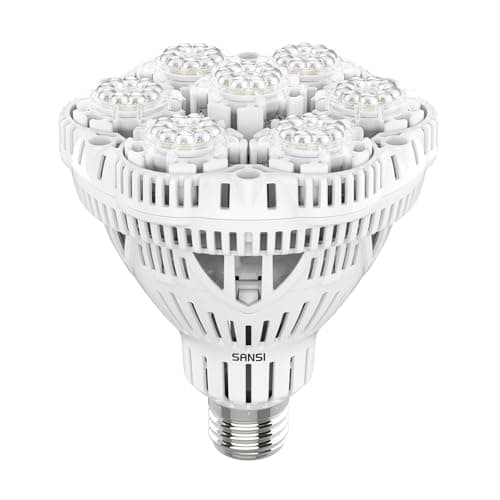 SANSI 36W BR30 Grow Light Bulb The rare grow bulb that publishes both PPF and a PPFD figure with the measurement distance attached, which is the only reason it can be sized honestly. | One plant, bright enough to bloom | 1.82 umol/J (ours) | |
| 2 | 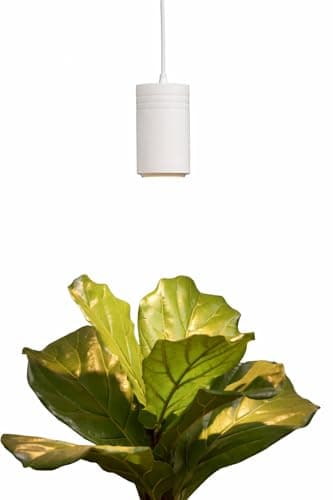 Soltech Aspect Gen 2 The only fixture here you would willingly hang in a living room, and the only one publishing PPFD at three separate distances so it can actually be placed by the numbers. | A floor specimen in a living room | 1.39 umol/J (ours) | |
| 3 | 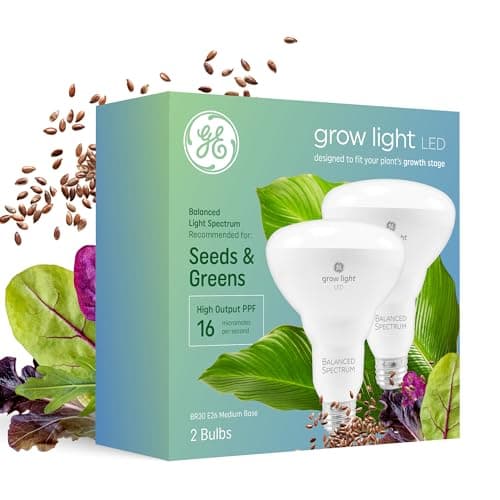 GE Grow Light BR30 Bulb, Seeds and Greens (2-pack) A mainstream-brand grow bulb that prints its photon output on the box: 16 umol/s from 9 W, which is enough for one low- or medium-light plant under a lamp you already own, and not much more. | Keeping one alive in a dark corner | Not published |
The reasoning
We have not tested these fixtures. What follows is published specification, Extension guidance, and our own arithmetic joining the two, with the working shown so you can check it.
The peace lily is the plant this site’s whole method was built for, because it is sold on a half-truth. It genuinely does tolerate low light — it is one of the few plants that survives a windowless office for years. It also flowers in response to light, and the level it needs to flower is an entire band above the level it needs to survive. Most disappointed peace lily owners are not failing to keep the plant alive. They are keeping it alive at a light level that was never going to produce a bloom.
Two targets, not one
Iowa State University Extension splits indoor plants into bands: 3 to 6 mol/m²/day for low-light foliage plants, and 6 to 10 mol/m²/day for foliage and flowering houseplants. The peace lily is the plant that sits in both, depending on what you want from it.
Iowa State University Extension's bands for low-light foliage plants and for foliage and flowering houseplants respectively. Roughly double the light for a bloom — which is why a plant that looks healthy in a dark corner never produces one.
A mature peace lily in a 10-inch pot spreads about 2 sq ft = 0.186 m².
To survive, 4.5 mol/m²/day at 12 hours = 104 µmol/m²/s, so 104 × 0.186 ÷ 0.8 = about 24 µmol/s.
To flower, 8 mol/m²/day at 12 hours = 185 µmol/m²/s, so 185 × 0.186 ÷ 0.8 = about 43 µmol/s.
That is the whole buying decision in two numbers. A 9 W grow bulb publishing 16 µmol/s can hold a peace lily in good condition. It cannot reach 43 µmol/s, so on its own it will not bloom one. The 36 W bulb publishing 65.6 µmol/s can do both, depending on how far away you hang it.
What a grow light cannot do
Before the picks, the honest caveat, because this page could otherwise sell a fixture on a promise it may not keep.
The peace lily you bought in flower was very likely made to flower. University of Florida IFAS Extension, writing about the commercial crop, records that “spathiphyllum could be induced to flower with a single foliar spray of gibberellic acid”, and that “gibberellic acid (GA3) applied to spathiphyllum initiates flower buds and produces flowers 70 to 110 days later.” That is how a foliage plant became something sold in bloom on a supermarket shelf in February.
The same publication notes that untreated plants follow a season: “plants that are not in flower in the late summer or fall do not initiate flower buds during June through August.”
Two things follow, and both are worth knowing before you spend money. Your plant may not rebloom on the schedule it arrived on, because that schedule was chemical rather than natural. And when it does flower, it will do so seasonally rather than continuously. Light is a necessary condition for a bloom and it is not a sufficient one — a grow light moves a plant from “certainly not” into “can”, which is real but is not a switch.
1. SANSI 36W BR30 — one plant, bright enough to bloom
65.6 µmol/s published, with a PPFD of 265.58 µmol/m²/s at a stated one foot. The stated distance is why this is the first pick: it is the only fixture here that can be set to either of this page’s two targets deliberately rather than by guesswork.
265.58 µmol/m²/s at 1 ft. Light falls with the square of distance, so at 15 in: 265.58 × (12 ÷ 15)² = 170 µmol/m²/s, or 7.3 mol/m²/day at 12 hours — the flowering band.
At 20 in: 265.58 × (12 ÷ 20)² = 96 µmol/m²/s, or 4.1 mol/m²/day — the survival band, which is the right setting for a plant you simply want to keep handsome.
So: 15 inches above the leaves if you want flowers, 20 or more if you do not. That is a decision you can make with a tape measure, which is rare in this category.
The downside: it lights one plant and no more, and at 36 W it is the most expensive pick here to run at about $2.38 a month. A bulb in a lamp is also a visible object beside a plant that is often chosen as furniture.
2. Soltech Aspect Gen 2 — a floor specimen in a living room
Peace lilies are frequently large floor plants in rooms people sit in, and that rules out most grow lighting on appearance alone. The Aspect is a pendant, and it publishes PPFD at three distances so it can still be placed by numbers rather than hope.
Soltech publishes about 50 µmol/m²/s at 1 m, 34.9 at 4 ft and 15.5 at 6 ft. At 1 m and 12 hours that is only 2.2 mol/m²/day — below even the survival band.
Halving the distance to about 20 in quadruples the intensity by the inverse-square relationship: 50 × 4 = 200 µmol/m²/s, or 8.6 mol/m²/day — inside the flowering band.
That is the honest instruction. Hung at the height pendants normally hang, this is a decorative light that keeps a peace lily ticking over. Hung about 20 inches above the foliage, it is a fixture that can flower one.
The downside: at 1.39 µmol/J it is among the least efficient fixtures we cover, it publishes only 50 µmol/s in total, and a great deal of the price is industrial design rather than photons. It is the right answer only when the fixture has to look like a lamp. Detail in the Aspect review.
3. GE Grow BR30 — keeping one alive in a dark corner
16 µmol/s per bulb from 9 W, CRI 90, sold in a two-pack, and a reflector shape that aims its output down at the plant rather than around the room. For the commonest peace lily situation — a plant in a hallway or an office corner that is surviving rather than thriving — this is the correct size of intervention.
16 µmol/s ÷ 0.186 m² = at most 86 µmol/m²/s, and only if every photon landed on the plant, which no bulb manages.
At 12 hours that is at most 3.7 mol/m²/day — inside the survival band, and short of the flowering one.
The downside: stated plainly, this bulb will not flower a mature peace lily, and any page telling you otherwise has not done the arithmetic. It also publishes no beam angle, so the figure above is a ceiling rather than a measurement. Buy it to keep a plant in good condition cheaply; buy pick 1 if you want blooms.
Distance, in one table
| Height above foliage | PPFD | DLI at 12 h | What it does |
|---|---|---|---|
| 12 in | 266 µmol/m²/s | 11.5 mol | Above the band; risks bleaching |
| 15 in | 170 µmol/m²/s | 7.3 mol | Flowering band |
| 18 in | 118 µmol/m²/s | 5.1 mol | Upper survival band |
| 24 in | 66 µmol/m²/s | 2.9 mol | Below the survival band |
The useful thing about this table is how narrow the window is. Six inches of height separates a plant that can flower from a plant that is merely alive, and another six takes it below what it needs. Peace lily owners often move a fixture by an inch or two and expect a result; the changes that matter are larger than that.
How many hours
Iowa State University Extension gives 12 to 14 hours as the general range for indoor plants, with 10 as a floor and 16 as a ceiling. Twelve is what every calculation on this page assumes.
Hours are the gentler of the two levers. Going from 12 to 14 hours at 170 µmol/m²/s takes the daily total from 7.3 to 8.6 mol/m²/day — further into the flowering band — without raising the peak intensity any leaf sees. If a peace lily is close to the flowering threshold and you are nervous about moving the light closer, add the hours first.
What does not help is running lights around the clock. There is no published case for it, plants use the dark period, and the electricity is wasted.
“What wattage do I need?”
This is the commonest way the question gets asked and it is the wrong unit, which is worth explaining rather than dodging.
Watts measure electricity going in, not light coming out. Two 9 W bulbs on this site publish 14.2 and 16 µmol/s — a 13% difference in what reaches the plant at identical wattage. Across the whole registry the spread is far wider: the fixtures we cover range from 1.21 to 2.75 µmol/J, so a 30 W fixture from one maker can out-deliver a 40 W fixture from another.
The number that answers the question is the one this page has used throughout: about 24 µmol/s to keep a peace lily, about 43 to flower it, measured at the plant over roughly 2 sq ft. If a product does not publish a µmol/s figure, the honest position is that you cannot size it in advance — which is a real mark against it, and the reason several popular fixtures do not appear on this page.
“What color light does it need?”
The other frequently asked version. The short answer is that white light is fine, and for a plant in a living room it is better.
Plants respond to photon count across roughly 400 to 700 nm, and a white LED delivers photons across that whole range. The purple-pink fixtures concentrate output in blue and red because that is where chlorophyll absorbs most strongly, which is a real effect and a modest one — the research comparing white against blue-plus-red is summarized in full spectrum versus red and blue.
For a peace lily specifically, two practical points settle it. The plant is usually in a room you occupy, and a purple fixture makes that room unpleasant. And the white bulbs here publish CRI 90 or better, so the foliage and the spathes look like themselves rather than gray. No peace lily has ever failed to flower because its light was white.
Reading the plant
- Too little light: no flowers for a year or more in a mature plant, new leaves smaller than old ones, long weak petioles that flop outward, and deep uniform green — peace lilies darken in shade, which is often read as health.
- Too much: pale or bleached patches on the leaves nearest the fixture, yellowing that starts on the upper surfaces rather than the lower leaves, and spathes that brown at the edges quickly after opening.
- Not a light problem: dramatic wilting that recovers within hours of watering, which is the plant’s signature and not a fault; brown leaf tips, which are usually water quality or dry air; and green spathes, which is normal as flowers age.
Running cost
GE 9 W bulb: 3.24 kWh a month = $0.59.
SANSI 36 W bulb: 12.96 kWh = $2.38.
Soltech Aspect, 36 W: 12.96 kWh = $2.38.
Over an October-to-March winter, the 36 W fixtures cost about $14 to run.
Fourteen dollars for a winter is not the reason to hesitate. The reason to hesitate, if there is one, is the gibberellic acid point above: buy the light to keep a good plant in good condition through a dark season, and treat a bloom as a likely bonus rather than the thing you paid for.
Every pick in full
SANSI 36W BR30 Grow Light Bulb
Grow bulbOne plant, bright enough to bloom
The rare grow bulb that publishes both PPF and a PPFD figure with the measurement distance attached, which is the only reason it can be sized honestly.
What SANSI publishes
- Power draw
- 36 W (source)
- PPF (photon output)
- 65.6 umol/s (source)
- PPFD
- 265.58 umol/m2/s at 1 ft (source)
- Spectrum
- 4000 K, 400-780 nm, CRI close to 100 (source)
- Rated life
- 25,000 hours (source)
Our arithmetic
- Efficacy, computed from the published figures: 1.82 umol/J
65.6 umol/s / 36 W = 1.82 umol/J. That is roughly a third less efficient than the panels on this page — the price of a screw-in form factor. - Electricity used at 12 hours a day for 30 days: 12.96 kWh a month
36 W x 12 h x 30 d / 1000 = 12.96 kWh.
What SANSI does not publish
- Beam angle
- Fixture dimensions
Who should skip it
Skip it if you are lighting more than one plant. 65.6 umol/s is a small amount of light spread over a cone — it lights a single specimen, not a shelf.
Soltech Aspect Gen 2
PendantA floor specimen in a living room
The only fixture here you would willingly hang in a living room, and the only one publishing PPFD at three separate distances so it can actually be placed by the numbers.
What Soltech publishes
- Power draw
- 36 W (source)
- PPF (photon output)
- 50 umol/s (source)
- PPFD
- about 50 umol/m2/s at 1 m, 34.9 at 4 ft, 15.5 at 6 ft (source)
- Spectrum
- 3000 K warm white, CRI 98 (source)
- Dimming
- Yes, in-line dimmer 10-100% (source)
- Dimensions
- 3.5 x 3.5 x 6.2 inches (source)
- Rated life
- 50,000 hours (source)
Our arithmetic
- Efficacy, computed from the published figures: 1.39 umol/J
50 umol/s / 36 W = 1.39 umol/J. Roughly half the efficacy of a 2.7 umol/J board — the design premium is paid twice, once at purchase and again every month on the meter.
Who should skip it
Skip it if photons per watt is the metric that matters. At 50 umol/s from 36 W it is the least efficient fixture on this page, and much of the price is industrial design.
GE Grow Light BR30 Bulb, Seeds and Greens (2-pack)
Grow bulbKeeping one alive in a dark corner
A mainstream-brand grow bulb that prints its photon output on the box: 16 umol/s from 9 W, which is enough for one low- or medium-light plant under a lamp you already own, and not much more.
What GE Lighting publishes
- Power draw
- 9 W per bulb at 120 V; medium E26 base (source)
- PPF (photon output)
- 16 umol/s per bulb (source)
- Spectrum
- 500 lumens, CRI 90; described as full spectrum with blue and red, no spectral distribution published (source)
- Dimming
- No (source)
- Rated life
- Up to 25,000 hours; 3-year warranty (source)
Our arithmetic
- Photon efficacy, computed from the published figures: 1.78 umol/J
16 umol/s / 9 W = 1.78 umol/J. Ours, not GE's. Just below the SANSI 36W BR30 at 1.82 umol/J, which puts it with the better grow bulbs on this site. - The ceiling over one square foot: at most 172 umol/m2/s
1 sq ft = 0.0929 m2. 16 umol/s / 0.0929 m2 = 172 umol/m2/s. That average holds only if every photon the bulb emits lands inside that square foot, so the real figure is lower. GE publishes no beam angle, so the actual spread cannot be computed. - The daily light ceiling at GE's recommended 18 hours: at most 11.2 mol/m2/day
172 umol/m2/s x 18 h x 3600 / 1,000,000 = 11.2 mol/m2/day. Under an assumption that flatters the bulb, that is still short of the roughly 12 mol/m2/day the University of New Hampshire Extension gives for seedlings. - Electricity at 16 hours a day for 30 days: $0.79 a month per bulb
9 W x 16 h x 30 d / 1000 = 4.32 kWh. 4.32 x 18.34 cents = $0.79. At GE's 18 hours: 4.86 kWh = $0.89.
What GE Lighting does not publish
- PPFD at any stated distance
- Beam angle
- Color temperature and spectral distribution
- Photon efficacy in umol/J
Who should skip it
Skip it for a seed tray or a plant that wants bright light. Even if every photon it emits landed inside one square foot, which no bulb manages, the average would top out around 172 umol/m2/s.
Questions people actually ask
+How much light does a peace lily need?
+Will a grow light make my peace lily flower?
+How far should a grow light be from a peace lily?
+How many hours a day should a peace lily grow light run?
+What wattage grow light does a peace lily need?
+What color grow light is best for a peace lily?
Sources
- Iowa State University Extension — Important Considerations for Providing Supplemental Light to Indoor Plants — consulted September 2, 2026
- University of Minnesota Extension — Lighting for indoor plants and starting seeds — consulted September 2, 2026
- University of Florida IFAS Extension — Henny & Chen, Spathiphyllum Flowering: Keys to the Future (ENH1047/EP320) — consulted September 21, 2026
- SANSI — BR30 36W grow light bulb product page — consulted September 2, 2026
- Soltech — Aspect Gen 2 published specifications — consulted September 2, 2026
- GE Lighting — GE Grow Light BR30 LED bulb for Seeds and Greens, 16 PPF (specifications) — consulted September 17, 2026
- Zhen & van Iersel et al., PLOS ONE — Spectral effects of LEDs on plant growth, visual color quality and photosynthetic photon efficacy: white versus blue plus red radiation — consulted September 2, 2026
- US Energy Information Administration — Electric Power Monthly, Table 5.3 (US residential average, June 2026) — consulted September 2, 2026
Read next
Houseplants
Grow Lights for Calathea
A 3-6 mol/m2/day low-band plant. Why the small bulb wins, and why crispy edges are not a light problem.
Top pick
GE Grow Light BR30 Bulb, Seeds and Greens (2-pack)
Coverage & Sizing
PPFD Targets by Plant Type
Published light bands mapped to common indoor plants, with the DLI each implies.
Top pick
GooingTop Clip Grow Light
Houseplants
What Plants Benefit From Grow Lights?
Plants ranked by how much a fixture actually changes the outcome, not by their light band.
Top pick
Barrina T5 4ft Grow Light Strips
Houseplants
How Much Light Do Houseplants Need in Winter?
Published DLI bands by plant type, and how to work out what your winter window is short by.
Top pick
SANSI 36W BR30 Grow Light Bulb
Where this sits
This page belongs to Grow Lights for Houseplants and Winter. Every figure on it is either quoted from a named published source or derived in view — the full method is on our methodology page, and how the site is funded is on the affiliate disclosure.