Grow Lights for Calathea
Calathea are the plant most often killed with kindness under a grow light, because the fixture that suits them is smaller than the one people buy.
By Scooter M. — An enthusiast who's genuinely into this. I read the manuals, compile the published specs, and do the math. No lab coat.
Published · How we pick
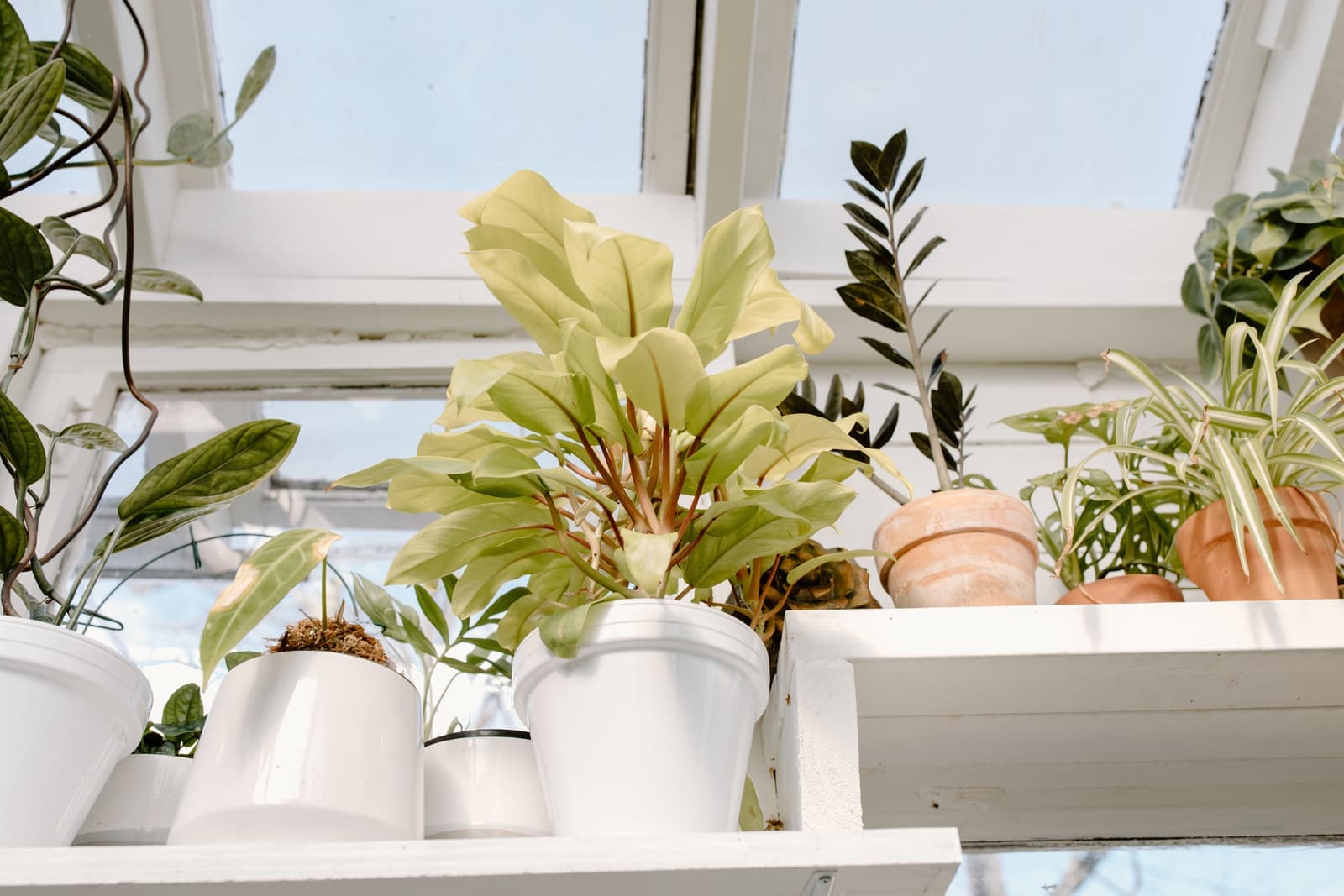
Photographs on this site are licensed stock and are illustrative of the fixture type. We do not own the units we write about.
How this page is funded: the buy links here are Amazon Associates links, and we earn a commission on qualifying purchases at no extra cost to you. We have not been paid to feature anything on this page, we accept no free product, and commission plays no part in the ranking. Full disclosure.
We have not tested these units. Everything below comes from the manufacturer’s own published specifications, or from arithmetic we have shown our working for. Where a figure is not published, we say so instead of estimating one. Read the method.
Quick picks
Efficacy is photons out per joule in. Where a manufacturer publishes it we quote theirs; where they publish photon output and wattage but not efficacy, we divide and label it as ours; where they publish neither, the cell says so rather than guessing. Tap a row for the full write-up.
| # | Product | Best for | Efficacy | Price |
|---|---|---|---|---|
| 1 | 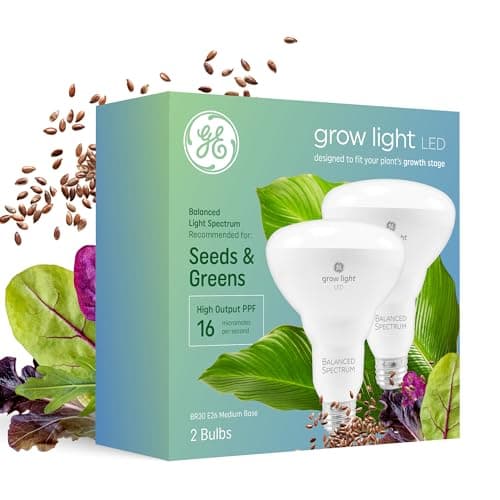 GE Grow Light BR30 Bulb, Seeds and Greens (2-pack) A mainstream-brand grow bulb that prints its photon output on the box: 16 umol/s from 9 W, which is enough for one low- or medium-light plant under a lamp you already own, and not much more. | One or two plants, correctly sized | Not published | |
| 2 | 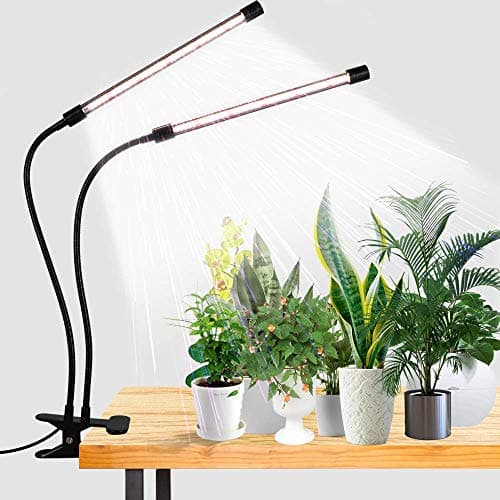 GooingTop Clip Grow Light The cheapest way to put real light on one plant on one desk, and honest about being exactly that — a 10 W clip lamp with a repeating timer. | A plant you want to dial down | Not published | |
| 3 | 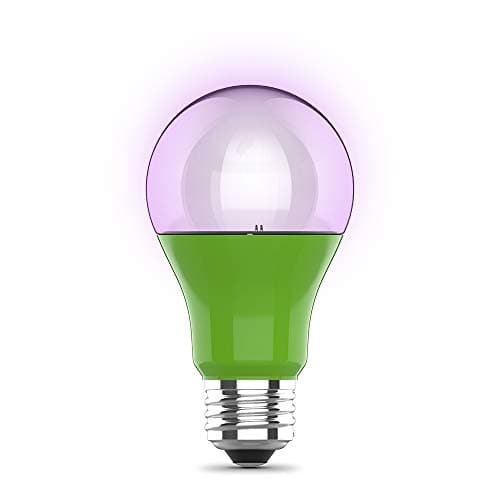 Feit Electric 9W A19 Grow Bulb A cheap household-shape grow bulb with a published photon figure, once you correct the unit Feit prints beside it. | The cheapest bulb with a number | Not published |
The reasoning
We have not tested these fixtures. What follows is published specification, Extension guidance and our own arithmetic, with the working shown.
Most pages on this site help you find enough light. This one mostly helps you avoid too much. Calathea — and the closely related marantas sold as prayer plants — are rainforest floor species, and the fixture that suits them is smaller, cheaper and further away than the one most people buy.
The target
Iowa State University Extension puts low-light foliage plants at 3 to 6 mol/m²/day. Calathea belong squarely in that band, alongside ferns and peace lilies, and this site already groups them there in its PPFD targets by plant type.
Take 4.5 mol/m²/day at 12 hours: 4,500,000 ÷ (12 × 3600) = 104 µmol/m²/s.
A calathea canopy of about one square foot = 0.0929 m². Delivering 104 across it at 0.8 uniformity needs 104 × 0.0929 ÷ 0.8 = about 12 µmol/s.
Twelve micromoles per second. For comparison, the 36 W bulb this site recommends for herbs and monstera publishes 65.6 µmol/s and delivers 265 µmol/m²/s at a foot — more than five times what a calathea wants. Putting that bulb a foot above a calathea is the commonest way to bleach one.
For 4.5 mol/m²/day at 12 hours with a 0.8 uniformity factor, from Iowa State University Extension's 3-6 mol/m²/day low-light band. A single 9 W grow bulb publishes 14-16 µmol/s, which is why this is one of the few pages here where the cheapest fixture is the correct one.
1. GE Grow BR30 — one or two plants, correctly sized
16 µmol/s per bulb from 9 W, published, CRI 90, and a reflector shape that sends its output downward rather than at the walls. Against a 12 µmol/s target it is the right size — slightly over, which distance resolves.
The two-pack matters here more than usual, because calathea are rarely kept singly and because a low-band plant does not need a big shared fixture. Two bulbs over two plants is tidier and cheaper than one panel dimmed down.
The downside: GE publishes no beam angle, so you cannot compute what reaches the leaves, only the ceiling of 172 µmol/m²/s that would apply if every photon landed inside one square foot. It also does not dim, so distance is your only control — start at about 18 inches and move it closer only if the plant asks.
2. GooingTop clip light — a plant you want to dial down
Five brightness levels and a repeating 4/8/12-hour timer built into the cable. On a plant this easy to overdo, being able to turn the light down rather than move the fixture is worth real money, and the built-in timer removes the commonest failure of all, which is leaving it on.
It clips to a shelf edge and bends, so it suits a calathea on a bookcase or a side table where there is nowhere to hang anything.
The downside: no published photon data of any kind — no PPF, no PPFD, no efficacy — so none of the arithmetic on this page applies to it. For a low-band plant that is a more tolerable gap than it would be for seedlings, but it is still a gap: you are dialing by eye.
3. Feit Electric 9W A19 — the cheapest bulb with a number
14.2 µmol/s from 9 W, which is almost exactly the 12 µmol/s this page calls for, at the lowest price of anything we cover. In an ordinary table lamp beside a calathea, it is enough and not more.
The downside: the A19 shape throws light in every direction, and Feit publishes no beam angle for it, so a fair share lights the ceiling instead of the plant. Feit also prints this bulb’s photon figure as “14.2 mol/s”, a unit that is wrong by a factor of a million — we work through that in the Feit Electric review.
Distance, which is the real control
| Height above canopy | Approx. PPFD | DLI at 12 h | Verdict |
|---|---|---|---|
| 12 in | up to 172 µmol/m²/s | up to 7.4 mol | Top of the band or past it |
| 18 in | up to 76 µmol/m²/s | up to 3.3 mol | Comfortable |
| 24 in | up to 43 µmol/m²/s | up to 1.9 mol | Too little on its own |
These are ceilings rather than measurements, because no manufacturer here publishes a beam angle for a BR30 grow bulb. The useful conclusion survives anyway: 18 inches is the sensible starting height, and the window between too little and too much is narrower for this plant than for almost anything else on the site.
The thing a grow light will not fix
Crispy brown edges are the single most-searched calathea complaint, and they are usually not a light problem. The common causes are dry air, inconsistent watering and mineral content in tap water — none of which a fixture changes. Buying a brighter light to fix crisping reliably makes it worse, because the extra intensity increases water demand in a plant that is already struggling to keep up.
What light genuinely does control in a calathea is leaf size, the spacing of new growth, and how strongly the patterning holds. If the leaves are well-marked and appearing at a reasonable rate and the edges are still crisping, the fixture is not the variable to change.
Reading the plant
- Too little light: new leaves smaller than the old ones, long stretches of bare stem, patterning fading toward plain green, and the nightly prayer movement becoming sluggish or stopping.
- Too much: washed-out, faded patches on the leaves facing the fixture, the pattern contrast dropping away, and in bad cases bleached areas that do not recover. This is the failure mode this page exists to prevent.
- Not light: crisp brown margins, which is humidity and water; yellowing lower leaves in wet soil, which is watering.
Hours beat intensity here
With low-band plants, adding hours is safer than adding intensity. Iowa State University Extension gives 12 to 14 hours generally, with 10 as a floor and 16 as a ceiling. Running 14 hours at 104 µmol/m²/s delivers 5.2 mol/m²/day — the top of the calathea band — without ever raising the peak intensity the leaves see.
That is the whole strategy for this plant in one sentence: keep the fixture small and far, and buy the extra light in time rather than in watts.
Running cost
Any 9 W bulb here: 9 × 12 × 30 ÷ 1000 = 3.24 kWh a month = $0.59.
Two of them, for two plants: $1.18 a month.
Under a dollar a month per plant. Calathea are a cheap plant to light correctly and an easy one to light expensively and badly.
The rest of the family behaves the same way
The plants sold as calathea, maranta, stromanthe and ctenanthe are all marantaceae, and for lighting purposes they can be treated as one group: low-band, pattern-bearing, and easy to bleach.
- Maranta (prayer plant). The most tolerant of the group and the best first choice. Its nightly leaf movement is a useful indicator: it weakens when light is far too low.
- Stromanthe triostar. The variegated pink and cream forms carry less chlorophyll per leaf area, so they need the top of the band rather than the middle — but they also scorch faster, which is a narrow window.
- Ctenanthe. Broadly as calathea, and the larger species tolerate slightly more.
- Calathea orbifolia and white fusion. The two most complained-about plants in the family, and both are firmly at the bottom of the band. If either is your plant, set the fixture further back than this page's default and be patient.
The variegation point generalizes: a leaf with white or pink sections has less photosynthetic area, so it needs a little more light to do the same work and burns a little sooner when it gets too much.
Lighting a group on a shelf
Calathea are collected, and once there are four or five a bulb per plant becomes silly. The bar arithmetic is gentler than you might expect, because the band is so low.
A 4 ft × 1 ft shelf is 0.3716 m². For 4.5 mol/m²/day at 12 hours you need 104 µmol/m²/s, so 104 × 0.3716 ÷ 0.8 = about 48 µmol/s across the shelf.
One 4 ft bar publishing 52 µmol/s delivers about 112 µmol/m²/s, or 4.8 mol/m²/day at 12 hours — the middle of the band, from a single fixture.
This is the rare case where one bar is not merely adequate but correct, and where adding a second would take the shelf out of the band rather than improving it. Seed starters need two bars over the same shelf; a calathea shelf needs one, hung at a normal height.
Confirming you are in the band
A PAR meter is not a sensible purchase for a plant that wants 12 µmol/s. Two cheaper checks work.
The first is the pattern itself. Calathea patterning is the most sensitive light gauge in common houseplant cultivation: contrast fades in both directions, going washed-out under too much and dull-uniform under too little, and it responds over weeks rather than months.
The second is the leaf-size sequence. Measure a new leaf against the one before it. Steady or slightly increasing size means the light is adequate; a run of progressively smaller leaves means it is not, and that is the signal to move the fixture closer by a few inches rather than to buy a bigger one. The general method is in how to measure PPFD without a meter.
Low light does not mean no light
The phrase “low light plant” does more damage to calathea than any grow light does. It is a relative statement — low compared with a succulent — and it gets read as an absolute one, which is how these plants end up in windowless corners with nothing added.
The band this page targets, 3 to 6 mol/m²/day, is genuinely low against the 12 to 16 a herb wants. It is not low against what an interior corner delivers. A spot several feet from a window, out of the line of sight of the sky, can sit well under 1 mol/m²/day through winter — a small fraction of the bottom of this band, and a level at which a calathea does not die so much as stop.
That is the situation a grow light fixes, and it is the reason this page recommends buying one at all. The distinction to hold on to is between low and none: a 9 W bulb 18 inches above the plant is not intensive horticulture, it is the difference between a plant that produces two leaves a year and one that produces two leaves a season.
The same logic, worked through for a whole collection rather than a single plant, is in how much light houseplants need in winter.
A window and a fixture are not interchangeable
Calathea are often described as wanting to be set back from a window, which is good advice that gets misapplied to grow lights.
The reason to set one back from glass is direct exposure: a beam of midday sun crossing a leaf is enormously more intense than the ambient light in the same room, and it scorches. A grow light at the distances this page recommends produces nothing comparable — 104 µmol/m²/s spread across a canopy is a fraction of what direct sun delivers to the patch it lands on.
So the rule transfers as a principle rather than as a distance. Keep the plant out of direct sun through glass, and keep the fixture far enough away that no part of the canopy is much brighter than the rest. Those are the same goal — even, moderate light — reached by different means, and a plant that has both an unobstructed fixture overhead and a shaft of afternoon sun on one side is getting neither.
Every pick in full
GE Grow Light BR30 Bulb, Seeds and Greens (2-pack)
Grow bulbOne or two plants, correctly sized
A mainstream-brand grow bulb that prints its photon output on the box: 16 umol/s from 9 W, which is enough for one low- or medium-light plant under a lamp you already own, and not much more.
What GE Lighting publishes
- Power draw
- 9 W per bulb at 120 V; medium E26 base (source)
- PPF (photon output)
- 16 umol/s per bulb (source)
- Spectrum
- 500 lumens, CRI 90; described as full spectrum with blue and red, no spectral distribution published (source)
- Dimming
- No (source)
- Rated life
- Up to 25,000 hours; 3-year warranty (source)
Our arithmetic
- Photon efficacy, computed from the published figures: 1.78 umol/J
16 umol/s / 9 W = 1.78 umol/J. Ours, not GE's. Just below the SANSI 36W BR30 at 1.82 umol/J, which puts it with the better grow bulbs on this site. - The ceiling over one square foot: at most 172 umol/m2/s
1 sq ft = 0.0929 m2. 16 umol/s / 0.0929 m2 = 172 umol/m2/s. That average holds only if every photon the bulb emits lands inside that square foot, so the real figure is lower. GE publishes no beam angle, so the actual spread cannot be computed. - The daily light ceiling at GE's recommended 18 hours: at most 11.2 mol/m2/day
172 umol/m2/s x 18 h x 3600 / 1,000,000 = 11.2 mol/m2/day. Under an assumption that flatters the bulb, that is still short of the roughly 12 mol/m2/day the University of New Hampshire Extension gives for seedlings. - Electricity at 16 hours a day for 30 days: $0.79 a month per bulb
9 W x 16 h x 30 d / 1000 = 4.32 kWh. 4.32 x 18.34 cents = $0.79. At GE's 18 hours: 4.86 kWh = $0.89.
What GE Lighting does not publish
- PPFD at any stated distance
- Beam angle
- Color temperature and spectral distribution
- Photon efficacy in umol/J
Who should skip it
Skip it for a seed tray or a plant that wants bright light. Even if every photon it emits landed inside one square foot, which no bulb manages, the average would top out around 172 umol/m2/s.
GooingTop Clip Grow Light
Clip lightA plant you want to dial down
The cheapest way to put real light on one plant on one desk, and honest about being exactly that — a 10 W clip lamp with a repeating timer.
What GooingTop publishes
- Power draw
- About 10 W (source)
- Spectrum
- 6000 K, 74 white plus 10 red LEDs, CRI 95 (source)
- Dimming
- Five brightness levels; repeating 4 / 8 / 12 hour timer (source)
What GooingTop does not publish
- PPF in umol/s
- PPFD at any distance
- Photon efficacy in umol/J
- The manufacturer publishes no spec sheet at all; the figures above come from the retail listing
Who should skip it
Skip it if the plant is more than about a foot across, or if you want any number at all before you buy — nobody publishes photon data for this fixture.
Feit Electric 9W A19 Grow Bulb
Grow bulbThe cheapest bulb with a number
A cheap household-shape grow bulb with a published photon figure, once you correct the unit Feit prints beside it.
What Feit Electric publishes
- Power draw
- 9 W at 120 V; medium E26 base (source)
- PPF (photon output)
- 14.2 umol/s, printed by Feit as "14.2 mol/s" (source)
- Spectrum
- 680 lumens, 3300 K, CRI 80; stated to emit between 449 nm blue and 630 nm red, with no distribution curve published (source)
- Dimming
- No; damp-location rated (source)
- Rated life
- 25,000 hours; 2-year warranty (source)
Our arithmetic
- Which unit the published figure must actually be: micromoles per second, not moles
Feit's own page prints 14.2 mol/s. Photons between 449 and 630 nm carry roughly 190 to 266 kJ per mole, so 14.2 mol/s would be 2.7 to 3.8 megawatts of radiant power out of a 9 W bulb. Read as 14.2 umol/s it is about 3 W of light from 9 W of electricity, which is what an LED of this type should produce. The figure is usable; the unit beside it is not. - Photon efficacy, computed from the corrected figure: 1.58 umol/J
14.2 umol/s / 9 W = 1.58 umol/J. Below the GE Grow A19 at 1.78 umol/J, which draws the same 9 W. - The ceiling over one square foot: at most 153 umol/m2/s
1 sq ft = 0.0929 m2. 14.2 umol/s / 0.0929 m2 = 153 umol/m2/s, and only if every photon lands inside that square foot, which no bare bulb manages. With no published beam angle, the real spread cannot be computed. - Electricity at 16 hours a day for 30 days: $0.79 a month
9 W x 16 h x 30 d / 1000 = 4.32 kWh. 4.32 x 18.34 cents = $0.79.
What Feit Electric does not publish
- PPFD at any stated distance
- Beam angle
- Photon efficacy in umol/J
- A spectral distribution — two peak wavelengths are named, no curve
Who should skip it
Skip it if the lamp will take a reflector bulb. An A19 throws light in every direction, and Feit publishes no beam angle for this one, so where its 14.2 umol/s lands cannot be computed.
Questions people actually ask
+How much light does a calathea need?
+Can a grow light burn a calathea?
+Will a grow light stop calathea leaves going crispy?
+How far should a grow light be from a calathea?
Sources
- Iowa State University Extension — Important Considerations for Providing Supplemental Light to Indoor Plants — consulted September 2, 2026
- University of Minnesota Extension — Lighting for indoor plants and starting seeds — consulted September 2, 2026
- GE Lighting — GE Grow Light BR30 LED bulb for Seeds and Greens, 16 PPF (specifications) — consulted September 17, 2026
- Feit Electric — 9 W LED Grow Light Bulb, A19/GROW/LEDG2/BX (specifications) — consulted September 19, 2026
- GooingTop clip grow light — retail listing specifications (no manufacturer spec sheet published) — consulted September 2, 2026
- US Energy Information Administration — Electric Power Monthly, Table 5.3 (US residential average, June 2026) — consulted September 2, 2026
Read next
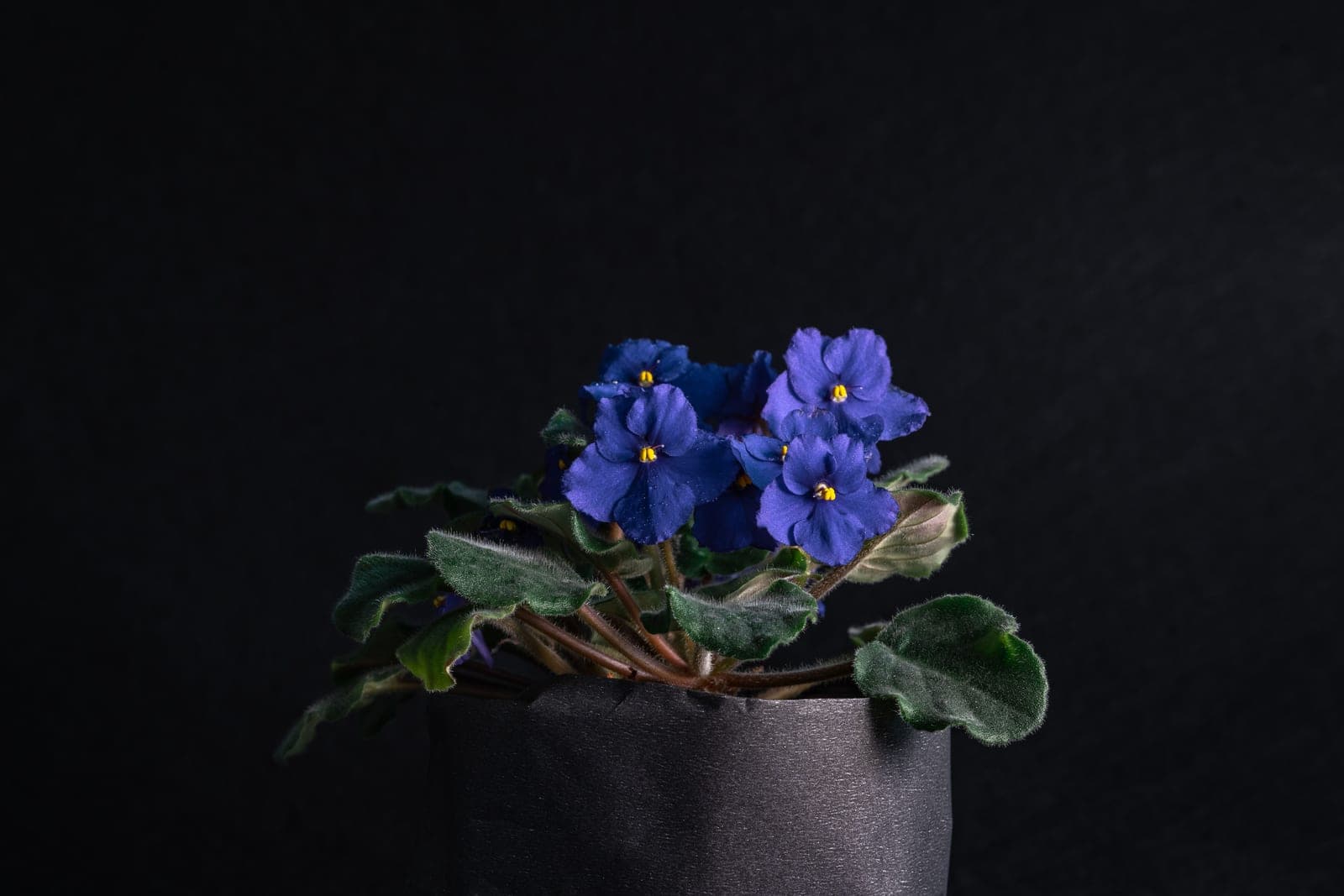
Houseplants
Grow Lights for African Violets
The medium-band target for violets, why a collection wants linear fixtures, and honest placement.
Top pick
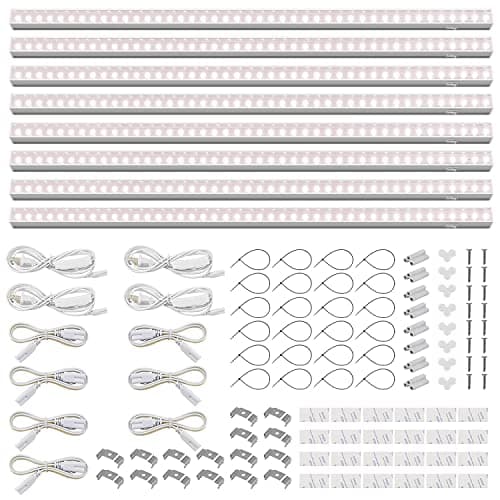
Barrina T5 4ft Grow Light Strips
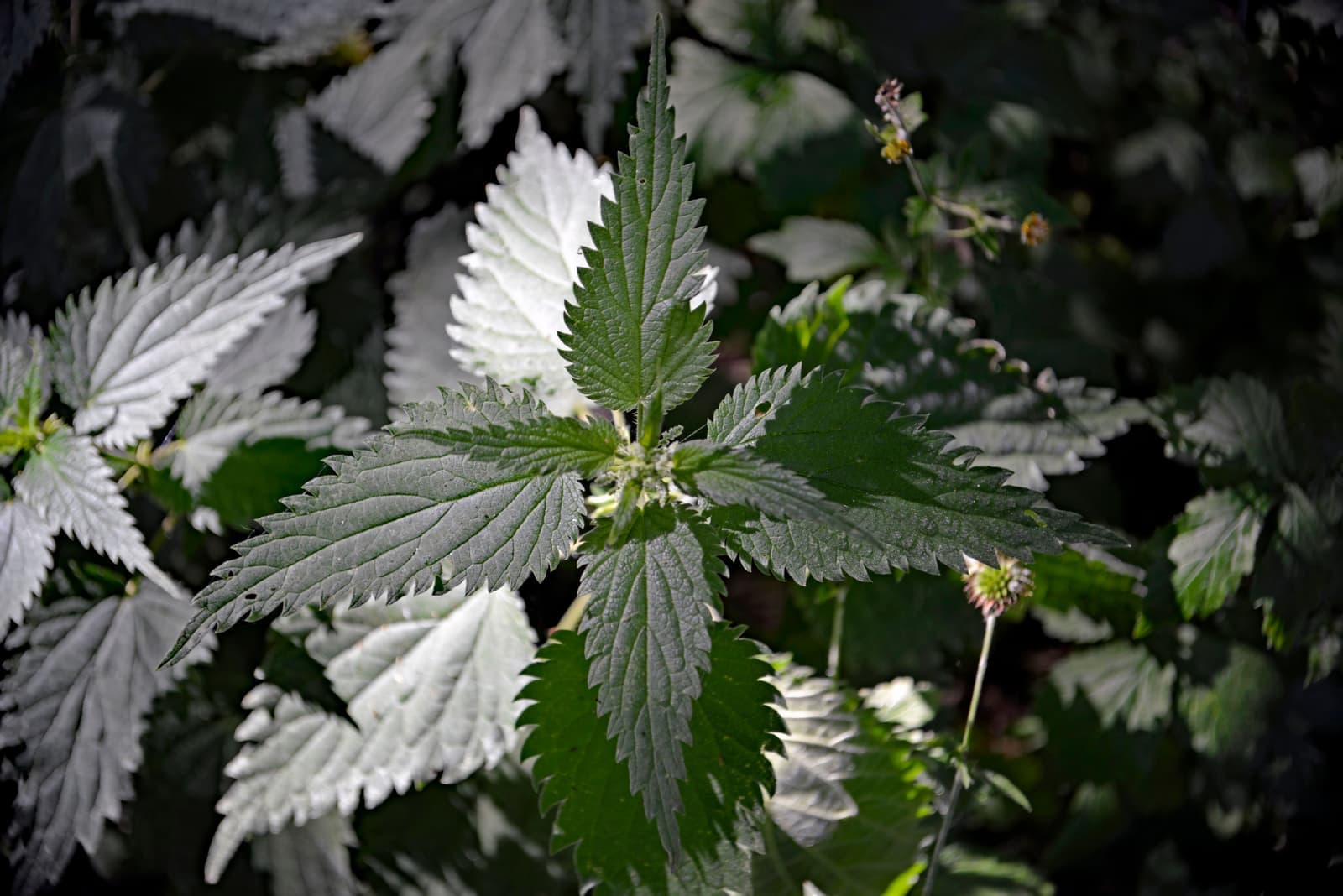
Coverage & Sizing
PPFD Targets by Plant Type
Published light bands mapped to common indoor plants, with the DLI each implies.
Top pick
GooingTop Clip Grow Light

Houseplants
Grow Lights for Pothos
When a pothos needs a fixture, the lamp distance that hits the low band, and the variegation exception.
Top pick
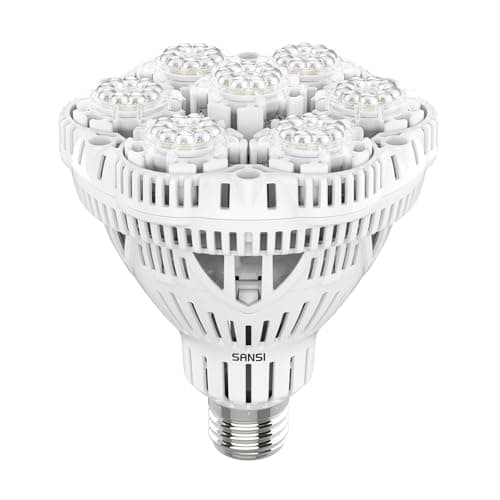
SANSI 36W BR30 Grow Light Bulb

Reviews
Best Grow Lights Under $50
What $50 buys: bulbs, not bars. Five picks ranked on published output, and the honest ceiling.
Top pick
SANSI 36W BR30 Grow Light Bulb
Where this sits
This page belongs to Grow Lights for Houseplants and Winter. Every figure on it is either quoted from a named published source or derived in view — the full method is on our methodology page, and how the site is funded is on the affiliate disclosure.