Grow Lights for African Violets
The plant most associated with growing under lights, sized with the same arithmetic as everything else — plus the reason a shelf of them wants a strip rather than a bulb.
By Scooter M. — An enthusiast who's genuinely into this. I read the manuals, compile the published specs, and do the math. No lab coat.
Published · How we pick
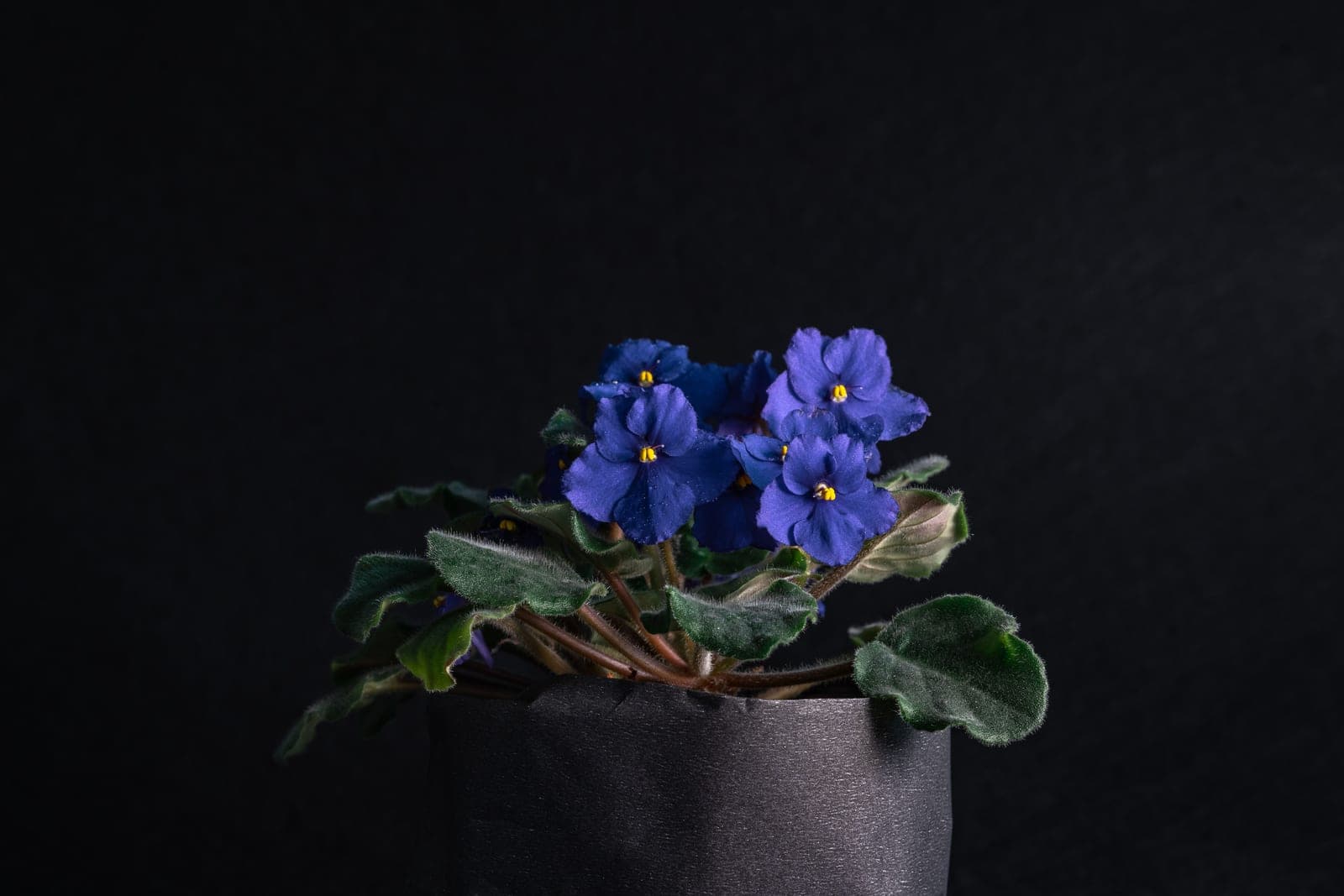
Photographs on this site are licensed stock and are illustrative of the fixture type. We do not own the units we write about.
How this page is funded: the buy links here are Amazon Associates links, and we earn a commission on qualifying purchases at no extra cost to you. We have not been paid to feature anything on this page, we accept no free product, and commission plays no part in the ranking. Full disclosure.
We have not tested these units. Everything below comes from the manufacturer’s own published specifications, or from arithmetic we have shown our working for. Where a figure is not published, we say so instead of estimating one. Read the method.
Quick picks
Efficacy is photons out per joule in. Where a manufacturer publishes it we quote theirs; where they publish photon output and wattage but not efficacy, we divide and label it as ours; where they publish neither, the cell says so rather than guessing. Tap a row for the full write-up.
| # | Product | Best for | Efficacy | Price |
|---|---|---|---|---|
| 1 | 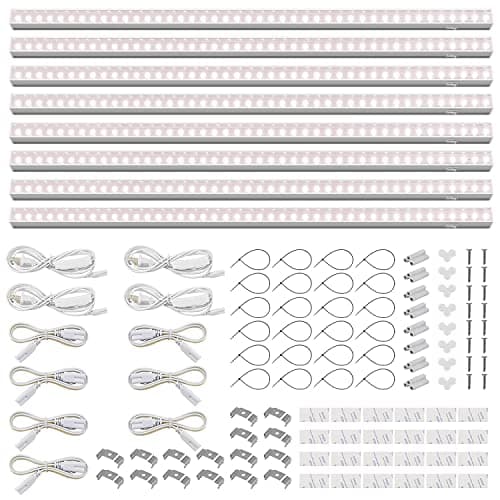 Barrina T5 4ft Grow Light Strips The default seed-starting bar for good reasons — 4 ft long, linkable in series, cheap per foot — and the reason we built a coverage calculator, because Barrina publishes no photon data whatsoever. | A shelf of violets | Not published | |
| 2 | 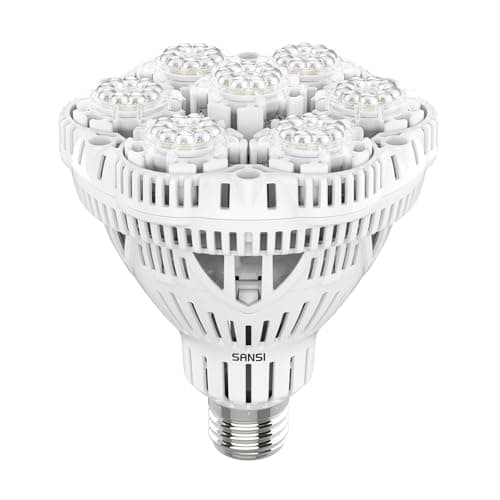 SANSI 36W BR30 Grow Light Bulb The rare grow bulb that publishes both PPF and a PPFD figure with the measurement distance attached, which is the only reason it can be sized honestly. | One plant on a table | 1.82 umol/J (ours) | |
| 3 | 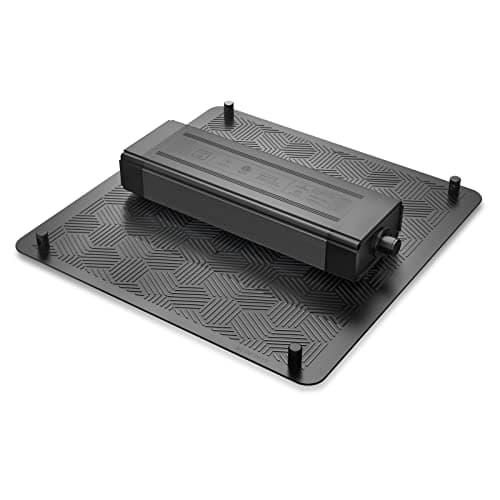 AC Infinity IONBOARD S22 The highest published efficacy of any fixture here at 2.7 umol/J, on Samsung LM301H diodes, with dimming in real 20% steps rather than a vague knob. | A dense tray, dimmed | 2.7 umol/J |
The reasoning
If there is one houseplant people picture growing under a lit shelf, it is the African violet. The association is old and it is earned: violets are compact, they bloom repeatedly, they resent direct sun, and they respond well to steady artificial light — which makes them one of the few houseplants that genuinely does better under a fixture than on most windowsills.
That said, the arithmetic is the same as for anything else on this site. The violet is not magic; it just sits in a band a shelf light hits easily.
µmol/m²/s — University of Minnesota Extension's medium band. Direct sun scorches them; the bottom of the low band leaves them leafy and flowerless.
Why violets and shelves go together
Three things about the plant line up with the fixture:
- They are small and flat. A mature violet is a rosette a few inches high. A dozen fit on a 4 ft shelf, and they all sit at the same height — which is what a linear fixture is designed for.
- They dislike direct sun. A south window is too much; a fixture at the medium band is exactly right and never changes with the weather.
- Flowering tracks light. A violet that has stopped blooming is usually below the band. It will keep growing leaves in low light; it will not flower there.
Sizing a violet shelf
Area = 4 sq ft ÷ 10.7639 = 0.372 m².
200 × 0.372 ÷ 0.8 = 93 µmol/s.
That is a modest requirement, and it is spread along a 4 ft line — which is the case for bars rather than a panel. A square panel over a 4 ft shelf lights the middle violets and starves the ones at the ends.
The geometry argument is the same as for any shelf, and it is made in full in the best grow lights for a shelf or rack.
The honest complication with bars
Barrina strips are the natural fit — 4 ft long, linkable up to 8 on one plug, 20 W each, and they run cool enough to sit close over a low plant. They are our first pick. But Barrina publishes no photon flux, no light density and no efficiency figure for any strip in the range; we checked the product page directly. So the 93 µmol/s above tells you what the shelf needs, and nothing tells you what the strips deliver.
In practice, violets tell you quickly. Two strips per shelf at 8 to 12 inches is the common starting point; if the plants go leafy and stop flowering, add a strip or drop the height. If the leaves bleach or curl, raise it. That is a slower loop than arithmetic, and for violets it works.
Placing a single bulb, computed
For one plant, SANSI publishes light density with the distance attached — 265.58 µmol/m²/s at 1 ft — which makes the bulb placeable on paper:
At 14 in: 265.58 × (1 ÷ 1.167)² = ~195 µmol/m²/s — the top of the medium band. This is the setting we would use.
At 16 in: ~150. At 12 in: 265, which is above the band and risks scorching the fuzzy leaves.
Hours
Iowa State University Extension suggests 12 to 14 hours generally for indoor plants under supplemental light. For violets we would run 12 to 14 on a timer and keep it consistent — a regular photoperiod matters for a plant grown for its flowers.
195 µmol/m²/s for 13 hours: 195 × 13 × 3600 ÷ 1,000,000 = 9.1 mol/m²/day.
Comfortably inside what a medium-band plant uses, and below the seedling target of about 12 published by University of New Hampshire Extension.
The picks and their honest limits
| Fixture | Suits | The catch |
|---|---|---|
| Barrina T5 4ft strips | A shelf or rack of violets — the classic setup | No photon data published at all; sized by result, not in advance. No dimming; run fewer strips instead |
| SANSI 36W BR30 | One plant on a table, in a lamp you own | 1.82 µmol/J — a third less efficient than a panel; lights one pot |
| AC Infinity IONBOARD S22 | A dense 2 × 2 ft tray, dimmed to the medium band | Square, so it suits a block rather than a long shelf; publishes a PPFD figure with no distance, which is unusable |
Running cost
2 × 20 W = 40 W. 40 × 13 h ÷ 1000 = 0.52 kWh a day.
0.52 × 365 = 190 kWh a year. At 18.34 cents per kWh: $34.79 a year, or about $2.90 a month — for a whole shelf, year-round.
Signs to read
- Leaves but no flowers: below the band. Add light or lower the fixture.
- Leaf stems stretching upward, rosette opening out: the plant is reaching. Same fix.
- Leaves tight, pale or bleached, curling down: too much. Raise it.
- Crown rot, mushy center: water on the leaves or in the crown — not a light problem.
The honest summary
A shelf of violets under two linked strips at 8 to 12 inches, 13 hours a day, is the setup this plant was practically made for, and it costs about $3 a month to run. You cannot size the strips in advance because nobody publishes their output — but violets report fast, and the adjustment is a strip or an inch. For one plant on a table, the bulb at 14 inches is the placeable answer.
Every pick in full
Barrina T5 4ft Grow Light Strips
LED barA shelf of violets
The default seed-starting bar for good reasons — 4 ft long, linkable in series, cheap per foot — and the reason we built a coverage calculator, because Barrina publishes no photon data whatsoever.
What Barrina publishes
- Power draw
- 20 W per fixture; an 8-pack draws 160 W (source)
- Spectrum
- 5000 K (source)
- Dimming
- No; on/off switch per fixture, linkable up to 8 in series (source)
- Dimensions
- 4 ft strip, 120-degree beam angle, 120 V AC (source)
What Barrina does not publish
- PPF in umol/s — for any strip in the range
- PPFD at any stated distance
- Photon efficacy in umol/J
- LED count per strip, and rated lifespan
Who should skip it
Skip it if you need to know what you are getting before it arrives. There is no published PPF, no PPFD and no efficacy figure, so nothing about its output can be verified in advance.
SANSI 36W BR30 Grow Light Bulb
Grow bulbOne plant on a table
The rare grow bulb that publishes both PPF and a PPFD figure with the measurement distance attached, which is the only reason it can be sized honestly.
What SANSI publishes
- Power draw
- 36 W (source)
- PPF (photon output)
- 65.6 umol/s (source)
- PPFD
- 265.58 umol/m2/s at 1 ft (source)
- Spectrum
- 4000 K, 400-780 nm, CRI close to 100 (source)
- Rated life
- 25,000 hours (source)
Our arithmetic
- Efficacy, computed from the published figures: 1.82 umol/J
65.6 umol/s / 36 W = 1.82 umol/J. That is roughly a third less efficient than the panels on this page — the price of a screw-in form factor. - Electricity used at 12 hours a day for 30 days: 12.96 kWh a month
36 W x 12 h x 30 d / 1000 = 12.96 kWh.
What SANSI does not publish
- Beam angle
- Fixture dimensions
Who should skip it
Skip it if you are lighting more than one plant. 65.6 umol/s is a small amount of light spread over a cone — it lights a single specimen, not a shelf.
AC Infinity IONBOARD S22
LED panelA dense tray, dimmed
The highest published efficacy of any fixture here at 2.7 umol/J, on Samsung LM301H diodes, with dimming in real 20% steps rather than a vague knob.
What AC Infinity publishes
- Power draw
- 115 W (source)
- Efficacy
- 2.7 umol/J (source)
- PPFD
- 1098 PPFD (no measurement distance published) (source)
- Stated coverage
- 2 x 2 ft (source)
- Spectrum
- Samsung LM301H, plus 660 nm, 730 nm, 3000 K, 6500 K (source)
- Diodes
- 272 diodes (source)
- Dimming
- Yes, 0-100% in 20% increments (source)
- Dimensions
- 30.0 x 30.0 cm board, 1.1 cm thick (source)
- Rated life
- 50,000 hours (source)
Our arithmetic
- Photon output implied by the published wattage and efficacy: about 311 umol/s
115 W x 2.7 umol/J = 310.5 umol/s. AC Infinity does not print PPF directly, so this is our arithmetic from two figures it does print.
What AC Infinity does not publish
- PPF in umol/s — only efficacy is given, so photon output has to be derived
- The measurement distance for the 1098 PPFD figure, without which the number cannot be compared to anything
Who should skip it
Skip it if you want to place it by the numbers. AC Infinity prints 1098 PPFD with no measurement distance attached, which makes that figure impossible to use or compare.
Questions people actually ask
+Are grow lights good for African violets?
+How far should a grow light be from African violets?
+Why won't my African violet bloom?
+How many hours a day for African violets?
+Have you grown African violets under these lights?
Sources
- University of Minnesota Extension — Lighting for indoor plants and starting seeds — consulted September 2, 2026
- Iowa State University Extension — Important Considerations for Providing Supplemental Light to Indoor Plants — consulted September 2, 2026
- University of New Hampshire Extension — Growing Seedlings Under Lights — consulted September 2, 2026
- Barrina — T5 ML20 4ft 20W product page — consulted September 2, 2026
- SANSI — BR30 36W grow light bulb product page — consulted September 2, 2026
- AC Infinity — IONBOARD S22 published specifications — consulted September 2, 2026
- US Energy Information Administration — Electric Power Monthly, Table 5.3 (US residential average, June 2026) — consulted September 2, 2026
Read next
Coverage & Sizing
The Best Grow Lights for a Shelf or Rack
Picks chosen on footprint match first, because a square panel over a long shelf wastes its edges.
Top pick
Barrina T5 4ft Grow Light Strips
Coverage & Sizing
PPFD Targets by Plant Type
Published light bands mapped to common indoor plants, with the DLI each implies.
Top pick
GooingTop Clip Grow Light
Houseplants
Grow Lights for Orchids
Targets by orchid type, why phalaenopsis burn easily, and what actually triggers a rebloom.
Top pick
SANSI 36W BR30 Grow Light Bulb
Coverage & Sizing
Grow Light Hours Per Day, by Plant
Published photoperiod guidance by plant, plus the cost of each additional hour.
Top pick
GooingTop Clip Grow Light
Houseplants
Grow Lights for Calathea
A 3-6 mol/m2/day low-band plant. Why the small bulb wins, and why crispy edges are not a light problem.
Top pick
GE Grow Light BR30 Bulb, Seeds and Greens (2-pack)
Where this sits
This page belongs to Grow Lights for Houseplants and Winter. Every figure on it is either quoted from a named published source or derived in view — the full method is on our methodology page, and how the site is funded is on the affiliate disclosure.