Grow Lights for Orchids
Most orchids people own want less light than most orchids people read about. Getting that distinction right is the whole job.
By Scooter M. — An enthusiast who's genuinely into this. I read the manuals, compile the published specs, and do the math. No lab coat.
Published · How we pick
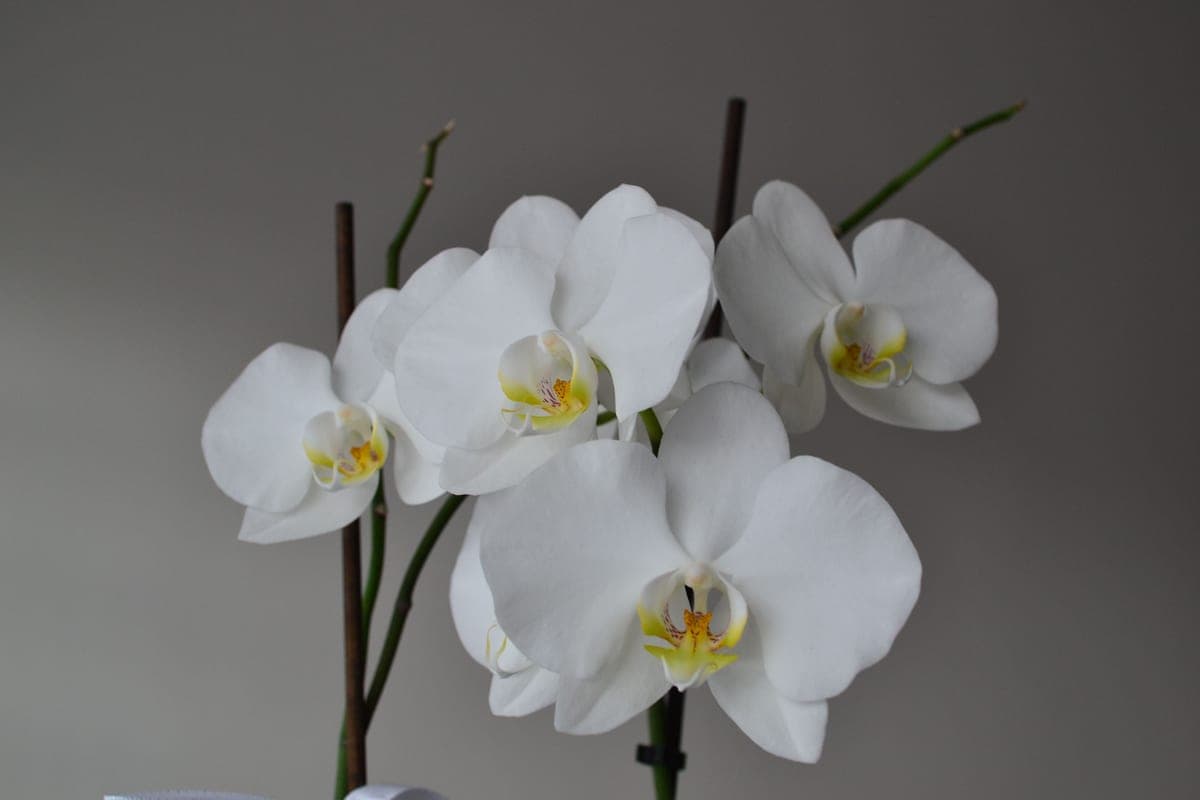
Photographs on this site are licensed stock and are illustrative of the fixture type. We do not own the units we write about.
How this page is funded: the buy links here are Amazon Associates links, and we earn a commission on qualifying purchases at no extra cost to you. We have not been paid to feature anything on this page, we accept no free product, and commission plays no part in the ranking. Full disclosure.
We have not tested these units. Everything below comes from the manufacturer’s own published specifications, or from arithmetic we have shown our working for. Where a figure is not published, we say so instead of estimating one. Read the method.
Quick picks
Efficacy is photons out per joule in. Where a manufacturer publishes it we quote theirs; where they publish photon output and wattage but not efficacy, we divide and label it as ours; where they publish neither, the cell says so rather than guessing. Tap a row for the full write-up.
| # | Product | Best for | Efficacy | Price |
|---|---|---|---|---|
| 1 | 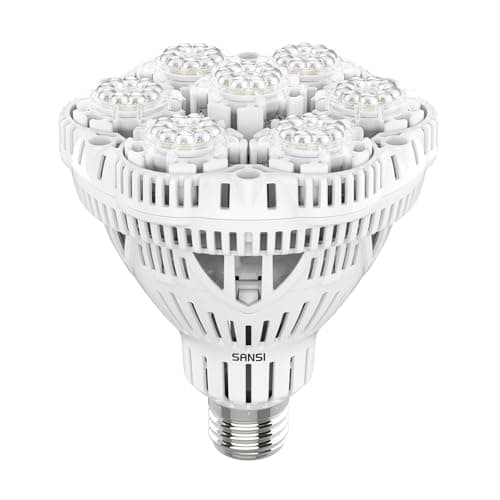 SANSI 36W BR30 Grow Light Bulb The rare grow bulb that publishes both PPF and a PPFD figure with the measurement distance attached, which is the only reason it can be sized honestly. | One or two orchids | 1.82 umol/J (ours) | |
| 2 | 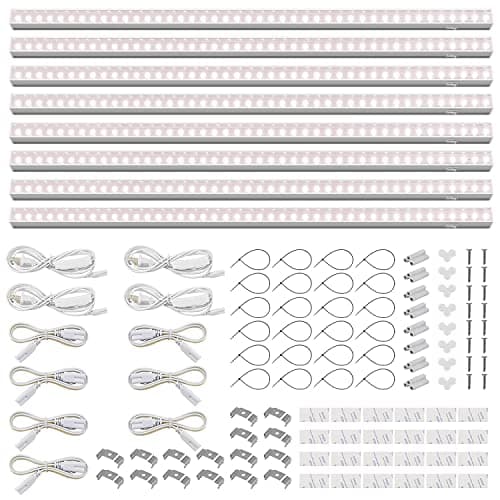 Barrina T5 4ft Grow Light Strips The default seed-starting bar for good reasons — 4 ft long, linkable in series, cheap per foot — and the reason we built a coverage calculator, because Barrina publishes no photon data whatsoever. | An orchid shelf | Not published | |
| 3 | 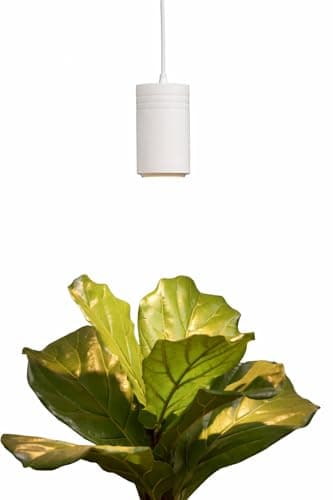 Soltech Aspect Gen 2 The only fixture here you would willingly hang in a living room, and the only one publishing PPFD at three separate distances so it can actually be placed by the numbers. | A display specimen | 1.39 umol/J (ours) |
The reasoning
“Orchid” covers an enormous family with wildly different light requirements, and most orchid lighting advice online is written for genera most people do not own. The orchid in almost every home is a phalaenopsis, and phalaenopsis are among the lowest light-requiring orchids there are.
| Orchid | Light band | Approximate DLI |
|---|---|---|
| Phalaenopsis (moth orchid) | Low to medium | 4–8 mol/m²/day |
| Paphiopedilum (slipper) | Low to medium | 4–8 mol/m²/day |
| Oncidium | Medium | 8–12 mol/m²/day |
| Cattleya | Medium to high | 12–16 mol/m²/day |
| Vanda | High | 16+ mol/m²/day |
The DLI figures map these onto Iowa State University Extension’s published bands for houseplant categories — 3 to 6 for low-light foliage, 6 to 10 for foliage and flowering houseplants, 12 to 16 for flowering houseplants and high-light plants. The band assignments by genus reflect standard horticultural practice; treat them as orientation rather than as measured requirements.
Why phalaenopsis burn so easily
They grow as epiphytes under a forest canopy, so their leaves are adapted to filtered light and have no protective adaptations for direct sun. Two consequences for a grow light:
- Distance is a safety margin, not just a dosage control. University of Minnesota Extension recommends 6 to 12 inches for flowering houseplants; for phalaenopsis, err to the far end of that.
- Leaf color is your meter. A well-lit phalaenopsis has mid-green leaves. Dark, deep green leaves mean too little light — the plant is making extra chlorophyll to compensate. Yellowish or reddish leaves mean too much.
Target 6 mol/m²/day at 12 hours. PPFD = 6 × 1,000,000 ÷ (12 × 3600) = 139 µmol/m²/s.
Two orchids occupy roughly 1.5 × 1 ft, so 0.139 m². 139 × 0.139 = 19 µmol/s landing on them; at 0.8 uniformity the fixture needs about 24 µmol/s.
The SANSI BR30 publishes 65.6 µmol/s — comfortably more than required, which means mounting it further away rather than closer, and that suits phalaenopsis well.
What actually triggers reblooming
This is where most orchid lighting advice goes wrong, and it is worth being precise. For phalaenopsis, the standard horticultural trigger for a new flower spike is a drop in night temperature — a period of cooler nights, typically in autumn. Light matters because a plant needs adequate energy reserves to produce a spike at all, but adding light alone does not reliably trigger one.
So the honest sequence is: keep the plant well lit year-round so it has the reserves, then give it cooler nights in autumn. A grow light is part one of that, not the whole of it, and anyone selling a fixture as a reblooming trigger is overstating what light does.
Practical setup
- 12 to 14 hours on a timer. University of Minnesota Extension gives 14 to 16 hours for flowering houseplants; for low-light phalaenopsis, the lower end is plenty.
- Mount well back — 12 inches or more for a bulb, and further for anything brighter. With orchids, under-lighting is recoverable and burning is not.
- Watch the leaves for a fortnight after any change. Mid-green is the target. Adjust distance rather than hours if the color drifts.
- Do not aim a fixture at the flower spike. Blooms last longer out of intense light, and the spike does not need it.
The complete target table is at PPFD targets by plant type.
Every pick in full
SANSI 36W BR30 Grow Light Bulb
Grow bulbOne or two orchids
The rare grow bulb that publishes both PPF and a PPFD figure with the measurement distance attached, which is the only reason it can be sized honestly.
What SANSI publishes
- Power draw
- 36 W (source)
- PPF (photon output)
- 65.6 umol/s (source)
- PPFD
- 265.58 umol/m2/s at 1 ft (source)
- Spectrum
- 4000 K, 400-780 nm, CRI close to 100 (source)
- Rated life
- 25,000 hours (source)
Our arithmetic
- Efficacy, computed from the published figures: 1.82 umol/J
65.6 umol/s / 36 W = 1.82 umol/J. That is roughly a third less efficient than the panels on this page — the price of a screw-in form factor. - Electricity used at 12 hours a day for 30 days: 12.96 kWh a month
36 W x 12 h x 30 d / 1000 = 12.96 kWh.
What SANSI does not publish
- Beam angle
- Fixture dimensions
Who should skip it
Skip it if you are lighting more than one plant. 65.6 umol/s is a small amount of light spread over a cone — it lights a single specimen, not a shelf.
Barrina T5 4ft Grow Light Strips
LED barAn orchid shelf
The default seed-starting bar for good reasons — 4 ft long, linkable in series, cheap per foot — and the reason we built a coverage calculator, because Barrina publishes no photon data whatsoever.
What Barrina publishes
- Power draw
- 20 W per fixture; an 8-pack draws 160 W (source)
- Spectrum
- 5000 K (source)
- Dimming
- No; on/off switch per fixture, linkable up to 8 in series (source)
- Dimensions
- 4 ft strip, 120-degree beam angle, 120 V AC (source)
What Barrina does not publish
- PPF in umol/s — for any strip in the range
- PPFD at any stated distance
- Photon efficacy in umol/J
- LED count per strip, and rated lifespan
Who should skip it
Skip it if you need to know what you are getting before it arrives. There is no published PPF, no PPFD and no efficacy figure, so nothing about its output can be verified in advance.
Soltech Aspect Gen 2
PendantA display specimen
The only fixture here you would willingly hang in a living room, and the only one publishing PPFD at three separate distances so it can actually be placed by the numbers.
What Soltech publishes
- Power draw
- 36 W (source)
- PPF (photon output)
- 50 umol/s (source)
- PPFD
- about 50 umol/m2/s at 1 m, 34.9 at 4 ft, 15.5 at 6 ft (source)
- Spectrum
- 3000 K warm white, CRI 98 (source)
- Dimming
- Yes, in-line dimmer 10-100% (source)
- Dimensions
- 3.5 x 3.5 x 6.2 inches (source)
- Rated life
- 50,000 hours (source)
Our arithmetic
- Efficacy, computed from the published figures: 1.39 umol/J
50 umol/s / 36 W = 1.39 umol/J. Roughly half the efficacy of a 2.7 umol/J board — the design premium is paid twice, once at purchase and again every month on the meter.
Who should skip it
Skip it if photons per watt is the metric that matters. At 50 umol/s from 36 W it is the least efficient fixture on this page, and much of the price is industrial design.
Questions people actually ask
+How much light does a phalaenopsis orchid need?
+How can I tell if my orchid is getting the right amount of light?
+Will a grow light make my orchid rebloom?
+How far should a grow light be from an orchid?
Sources
- Iowa State University Extension — Important Considerations for Providing Supplemental Light to Indoor Plants — consulted September 2, 2026
- University of Minnesota Extension — Lighting for indoor plants and starting seeds — consulted September 2, 2026
- SANSI — BR30 36W grow light bulb product page — consulted September 2, 2026
Read next
Houseplants
Grow Lights for African Violets
The medium-band target for violets, why a collection wants linear fixtures, and honest placement.
Top pick
Barrina T5 4ft Grow Light Strips
Coverage & Sizing
PPFD Targets by Plant Type
Published light bands mapped to common indoor plants, with the DLI each implies.
Top pick
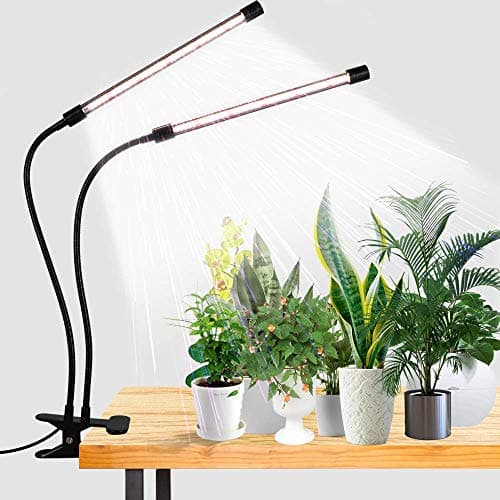
GooingTop Clip Grow Light
Houseplants
How Much Light Do Houseplants Need in Winter?
Published DLI bands by plant type, and how to work out what your winter window is short by.
Top pick
SANSI 36W BR30 Grow Light Bulb
Houseplants
The Best Grow Lights for Indoor Plants
Sized to a 3-10 mol/m2/day houseplant target rather than a grow-tent target, with running cost for each.
Top pick
SANSI 36W BR30 Grow Light Bulb
Coverage & Sizing
Grow Light Hours Per Day, by Plant
Published photoperiod guidance by plant, plus the cost of each additional hour.
Top pick
GooingTop Clip Grow Light
Where this sits
This page belongs to Grow Lights for Houseplants and Winter. Every figure on it is either quoted from a named published source or derived in view — the full method is on our methodology page, and how the site is funded is on the affiliate disclosure.