Do Grow Lights Emit UV?
Mostly no, on the published numbers — and the ones that go lower say so. Here is what each spec sheet we could find actually states.
By Scooter M. — An enthusiast who's genuinely into this. I read the manuals, compile the published specs, and do the math. No lab coat.
Published · How we pick
The reasoning
No product recommendations on this page either. It is a safety question and the answer should not be paid for.
Where UV sits, and where grow light spectra start
Ultraviolet is light below about 400 nanometers. Visible light runs from roughly 400 nm (violet) to roughly 700 nm (deep red), and the photosynthetically active range used in horticultural specification — PAR — is conventionally that same 400 to 700 nm band. Far red, around 730 nm, sits just past the top edge.
That matters because when a manufacturer publishes a spectral range starting at 400 nm, they are describing a fixture whose stated output begins at the bottom of visible light: above the UV band, not inside it.
What each fixture we cover actually publishes
| Fixture | Published spectrum | UV mentioned? |
|---|---|---|
| SANSI 36W BR30 | 4000 K, 400–780 nm, CRI close to 100 | No — the stated range begins at 400 nm |
| VIVOSUN VS1000 | 380–780 nm, including 660 nm and 730 nm; 3000 K and 5000 K | The stated range starts at 380 nm, just inside UV-A; VIVOSUN does not characterize it further |
| Mars Hydro TS 1000 | 660–665 nm, 730–740 nm, 3000 K, 5000 K | No UV band published |
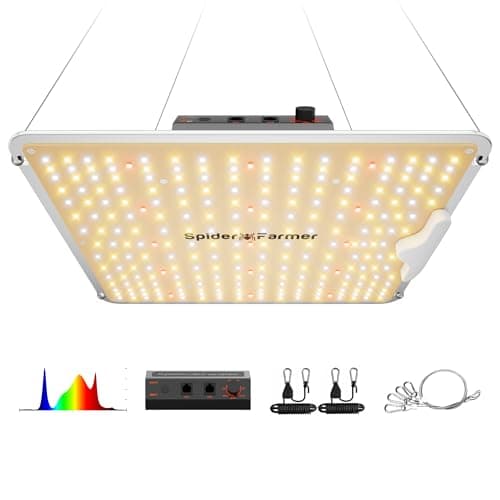
| Spider Farmer SF1000 | 650–665 nm, 730–740 nm, 2800–3000 K, 4800–5000 K | No UV band published |
| AC Infinity IONBOARD S22 | Samsung LM301H, plus 660 nm, 730 nm, 3000 K, 6500 K | No UV band published |
| Soltech Aspect Gen 2 | 3000 K warm white, CRI 98 | No UV band published |
| Barrina T5 4ft | 5000 K | No spectral detail published at all |
The pattern is consistent: consumer white-LED grow lights are overwhelmingly specified as visible-range fixtures. Where a range dips to 380 nm, as VIVOSUN’s does, that is the very edge of UV-A and the manufacturer publishes no intensity figure for that portion — so we can report the stated range and nothing more.
Why white LEDs mostly do not produce UV
A white LED is a blue emitter — typically around 450 nm, comfortably inside visible light — under a phosphor coating that converts some of that blue into longer wavelengths. Neither half of that arrangement produces meaningful ultraviolet. Producing UV requires a dedicated UV-emitting diode, which is a separate component a manufacturer would have every commercial reason to advertise, since UV supplementation is sold as a premium feature.
That is the strongest inference available from the published data: if a fixture had UV diodes, the marketing would say so.
Not one of the nine fixtures on this site publishes a UV diode or a UV output figure. Several publish no spectral detail at all, which is its own kind of answer.
What we cannot tell you
We have not measured any of these fixtures, and no manufacturer we checked publishes a full spectral power distribution chart. So the honest limit of this page is: on the published specifications, these are visible-range fixtures with no advertised ultraviolet component. That is a statement about documents, not about a spectrometer reading, and we are not going to dress it up as one.
If UV output specifically matters to you — for a plant that needs it, or because of a health concern — buy from a manufacturer that publishes a spectral chart, and treat the absence of one as the absence of information.
The related safety question
The hazard people are usually thinking about when they ask about UV is eye exposure, and for white LEDs that question is about blue light and cumulative exposure rather than ultraviolet. That is handled in are grow lights safe for eyes and pets, which walks through what the IEC/EN 62471 photobiological safety framework actually classifies.
Questions people actually ask
+Do LED grow lights emit UV light?
+Do plants need UV light?
+Does 'full spectrum' mean UV is included?
+How would I know if a light emits UV?
Sources
- SANSI — BR30 36W grow light bulb product page — consulted September 2, 2026
- VIVOSUN — VS1000 product page — consulted September 2, 2026
- Mars Hydro — TS 1000 published specification table — consulted September 2, 2026
- Spider Farmer — SF1000 published specification table — consulted September 2, 2026
- AC Infinity — IONBOARD S22 published specifications — consulted September 2, 2026
- Soltech — Aspect Gen 2 published specifications — consulted September 2, 2026
- Barrina — T5 ML20 4ft 20W product page — consulted September 2, 2026
- ams OSRAM — Details on photobiological safety of LED light sources (IEC/EN 62471 risk groups) — consulted September 2, 2026
Read next
Spectrum & PPFD
Are Grow Lights Safe for Eyes and Pets?
What IEC 62471 risk groups mean, the one real hazard, and sensible home precautions.
Spectrum & PPFD
What “Full Spectrum” Actually Means
The phrase is unregulated and carries no threshold. These are the numbers that replace it.
Top pick
Spider Farmer SF1000
Spectrum & PPFD
Full Spectrum vs Red and Blue
White versus blue-plus-red on the published comparison, and why visibility settles it at home.
Top pick
Spider Farmer SF1000
Spectrum & PPFD
PAR, PPFD and DLI, Explained
The three photon units, what each measures, and the conversions between them, shown.
Top pick
Spider Farmer SF1000
Where this sits
This page belongs to Spectrum and PPFD, Honestly. Every figure on it is either quoted from a named published source or derived in view — the full method is on our methodology page, and how the site is funded is on the affiliate disclosure.