Spider Farmer SF1000 vs AC Infinity IONBOARD S22
Two boards at nearly the same size and price, and the honest difference is which numbers each company is willing to stand behind.
By Scooter M. — An enthusiast who's genuinely into this. I read the manuals, compile the published specs, and do the math. No lab coat.
Published · How we pick
Photographs on this site are licensed stock and are illustrative of the fixture type. We do not own the units we write about.
How this page is funded: the buy links here are Amazon Associates links, and we earn a commission on qualifying purchases at no extra cost to you. We have not been paid to feature anything on this page, we accept no free product, and commission plays no part in the ranking. Full disclosure.
We have not tested these units. Everything below comes from the manufacturer’s own published specifications, or from arithmetic we have shown our working for. Where a figure is not published, we say so instead of estimating one. Read the method.
Quick picks
Efficacy is photons out per joule in. Where a manufacturer publishes it we quote theirs; where they publish photon output and wattage but not efficacy, we divide and label it as ours; where they publish neither, the cell says so rather than guessing. Tap a row for the full write-up.
| # | Product | Best for | Efficacy | Price |
|---|---|---|---|---|
| 1 | 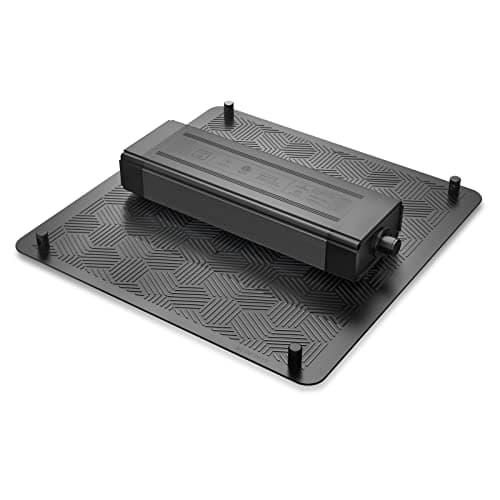 AC Infinity IONBOARD S22 The highest published efficacy of any fixture here at 2.7 umol/J, on Samsung LM301H diodes, with dimming in real 20% steps rather than a vague knob. | More photons, fewer watts | 2.7 umol/J | |
| 2 | 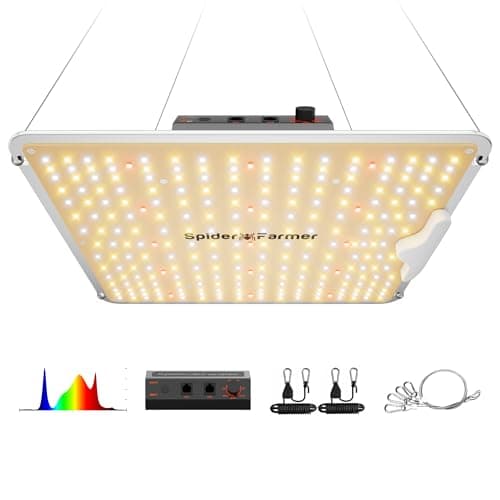 Spider Farmer SF1000 Publishes PPF to two decimal places and an efficacy figure that actually divides out of it. That internal consistency is rarer in this category than it should be. | Figures that check out against each other | 2.5 umol/J |
The reasoning
We have not tested either board. What follows is each manufacturer’s published specification, our arithmetic on those figures, and a note about one number that cannot be used at all.
These two get cross-shopped constantly and they deserve to be. Both are flat LED boards without a fan, both are sized for a 2 ft square, both dim, and both sit in the same part of the market. The specifications are close enough that the decision turns on details.
What each publishes
| Spider Farmer SF1000 | AC Infinity IONBOARD S22 | |
|---|---|---|
| Power | 100 W ±5% | 115 W |
| PPF | 249.21 µmol/s published | Not published — about 311 µmol/s derived |
| Efficacy | 2.5 µmol/J published | 2.7 µmol/J published |
| Coverage | 2 × 2 ft core, 3 × 3 ft maximum | 2 × 2 ft |
| Diodes | Bridgelux | Samsung LM301H, 272 diodes |
| Spectrum | 650-665 nm, 730-740 nm, 2800-3000 K, 4800-5000 K | 660 nm, 730 nm, 3000 K, 6500 K |
| Dimming | Knob, continuous | 0-100% in 20% increments |
| Rated life | 55,000 hours | 50,000 hours |
The two companies publish opposite halves of the same sum
This is the heart of the comparison. Photon output, wattage and efficacy are three numbers where any two give you the third. Spider Farmer publishes PPF and efficacy. AC Infinity publishes efficacy and wattage. Neither publishes all three, and what you can check differs as a result.
249.21 µmol/s ÷ 100 W = 2.4921 µmol/J, against a published 2.5.
The two headline claims agree. That is rarer in this category than it should be, and it is the strongest thing on the SF1000’s spec sheet — not the output, but the fact that the output and the efficiency are consistent.
2.7 µmol/J × 115 W = about 311 µmol/s.
That is our figure, not AC Infinity’s. It follows necessarily from the two numbers the company does publish, but it has not been stated by the manufacturer and cannot be checked against anything.
Taken at face value, the IONBOARD emits about 25% more photons than the SF1000 for 15% more power. That is a real advantage, and it is the reason it is ranked first here.
The AC Infinity number you should ignore
AC Infinity publishes “1098 PPFD” as a headline figure with no measurement distance attached. A PPFD is an intensity at a point, and intensity falls with the square of distance, so a PPFD without a distance describes nothing. It could be measured at two inches or at two feet and the number would differ by a factor of more than a hundred.
We do not use it anywhere on this site, and neither should you when comparing boards. Compare the efficacy figures, which both companies publish and which mean the same thing on both spec sheets.
Both publish efficacy in µmol/J and both publish wattage. Spider Farmer also publishes PPF. AC Infinity's headline '1098 PPFD' carries no measurement distance, which makes it unusable for comparison or for placement.
What each delivers over a 2 ft square
2 × 2 ft = 4 sq ft = 0.3716 m².
SF1000: 249.21 ÷ 0.3716 × 0.8 = about 536 µmol/m²/s, or 23.2 mol/m²/day at 12 hours.
IONBOARD S22: 311 ÷ 0.3716 × 0.8 = about 670 µmol/m²/s, or 28.9 mol/m²/day at 12 hours.
Both are far above what any houseplant wants and squarely in the range for seedlings, herbs and high-light plants — which is the point of a board rather than a bulb. Both dim, and for most of this site’s readers both will spend their lives turned down. That is worth saying before the specification difference is allowed to decide anything.
Dimming, which matters more than the 25%
The SF1000 has a continuous knob. The IONBOARD dims in 20% steps.
For a grower running a board flat out at flowering, this is irrelevant. For this site’s typical reader — someone putting a board over a shelf of houseplants or a seed tray — it matters more than the 25% output difference, because the useful setting is somewhere between 20% and 60% and a knob lands on it exactly.
Against that, 20% steps are repeatable in a way a knob is not: you can return to 40% precisely after moving the fixture, which a knob position does not guarantee.
Coverage: the SF1000’s quiet advantage
Spider Farmer publishes two footprints — a 2 × 2 ft core and a 3 × 3 ft maximum — while AC Infinity publishes one 2 × 2 ft figure.
The honest reading is that both boards are 2 ft square devices and the 3 ft figure describes the area over which the SF1000 still does something useful rather than the area it lights well. But if your shelf is wider than two feet, the fixture publishing a maximum footprint is giving you more information about the falloff, and that is worth something.
Running cost
SF1000, 100 W: 36.0 kWh a month = $6.60.
IONBOARD S22, 115 W: 41.4 kWh = $7.59.
A dollar a month apart at full output — and because the IONBOARD emits about 25% more for that, it is delivering photons slightly more cheaply, which is what its higher efficacy figure means.
The honest downside of each
AC Infinity IONBOARD S22: it does not publish a PPF at all, so its output on this site is derived rather than quoted, and its one headline photon figure is unusable. It is also the more expensive of the two, and its dimming is coarser.
Spider Farmer SF1000: about 25% fewer photons for 15% fewer watts, so on pure efficiency it loses. Its published efficacy of 2.5 µmol/J is good rather than class-leading, and its Bridgelux diodes are a less-marketed brand than the Samsung LM301H in the IONBOARD — though neither company publishes anything that would let you verify what difference that makes.
The short answer
Buy the IONBOARD S22 if you want the most photons per watt and you are comfortable that its output figure is derived rather than published. Buy the SF1000 if you would rather have a manufacturer whose two headline numbers agree with each other, if you want a continuous dimmer, or if your shelf is wider than the two feet both are rated for. On plants, either will do the same job.
If the third board in this conversation is the Mars Hydro TS 1000, that comparison is in Mars Hydro versus AC Infinity.
What neither of them publishes
Both spec sheets are better than the category average, and both stop short in the same places.
- Neither publishes a usable PPFD. Spider Farmer publishes no PPFD at all; AC Infinity publishes one with no distance, which amounts to the same thing. So neither board can be placed by arithmetic the way a fixture with a stated measurement distance can — you are relying on the coverage rating and your own judgment of height.
- Neither publishes a spectral distribution. Both list peak wavelengths and color temperatures — 650-665 nm and 730-740 nm for the SF1000, 660 nm and 730 nm for the IONBOARD — but a list of peaks is not a curve, and the proportion of the output sitting at each is unstated.
- Neither publishes a location rating. For a board going over a propagation dome or a hydroponic reservoir that absence is worth weighing, and it is one place a third fixture beats both — see the VIVOSUN LumaLight review, which publishes an IP65 rating.
Diode brands, and how much to read into them
AC Infinity names Samsung LM301H diodes and a count of 272. Spider Farmer names Bridgelux. Samsung’s horticultural diodes have a strong reputation, and the IONBOARD’s higher published efficacy is consistent with that.
Be careful how far you take it. Neither company publishes the drive current, and efficacy depends on how hard the diodes are driven as much as on which diodes they are — the same emitter run gently is more efficient than the same emitter run hard. The published 2.7 against 2.5 µmol/J already contains whatever the diode difference amounts to, so the sensible approach is to compare the efficacy figures and treat the diode branding as marketing that happens to be true.
Which to buy for the job you actually have
| Situation | Pick | Why |
|---|---|---|
| A 2 ft square shelf or tent | IONBOARD S22 | About 25% more photons for 15% more watts |
| A shelf wider than 2 ft | SF1000 | Publishes a 3 x 3 ft maximum footprint as well as the core |
| Houseplants that need it turned well down | SF1000 | A continuous knob lands exactly on a low setting |
| A setting you need to return to precisely | IONBOARD S22 | 20% steps are repeatable in a way a knob is not |
| You want figures that check against each other | SF1000 | 249.21 ÷ 100 W = 2.49 against a published 2.5 |
| Lowest running cost per photon | IONBOARD S22 | 2.7 µmol/J against 2.5 |
If your shelf is longer than it is deep
Both of these are square fixtures, and a fair number of people buy one for a shelf that is four feet long and a foot deep. That is the wrong shape of light for the space, and no amount of choosing between them fixes it.
A square board over a long shelf lights the middle well and the ends poorly, because intensity falls with distance from the center in both directions. Two boards fix it at the cost of two boards. A single 4 ft bar fixes it for less money and less power, because its emitters run the length of the thing being lit — the argument is set out in bar versus panel coverage.
Buy either of these boards when the area is roughly square: a 2 ft shelf section, a tent footprint, a tote, one large plant. For a long run, the honest recommendation is that neither is the right product.
Emitter count, and why it is not just marketing
AC Infinity publishes a diode count of 272; Spider Farmer publishes none. Counts are easy to dismiss as a spec-sheet flourish, but they do describe something real about how light arrives.
Spreading a given output across more emitters produces a more even wash across the footprint and less intense hot-spotting directly beneath any single diode. Fewer, harder-driven emitters concentrate more light at each point, which shows up as brighter spots close to the board. At the heights either of these is used, both are diffuse enough that it rarely matters — but it matters more the closer you hang the fixture, which is exactly what people do over seedlings.
Every pick in full
AC Infinity IONBOARD S22
LED panelMore photons, fewer watts
The highest published efficacy of any fixture here at 2.7 umol/J, on Samsung LM301H diodes, with dimming in real 20% steps rather than a vague knob.
What AC Infinity publishes
- Power draw
- 115 W (source)
- Efficacy
- 2.7 umol/J (source)
- PPFD
- 1098 PPFD (no measurement distance published) (source)
- Stated coverage
- 2 x 2 ft (source)
- Spectrum
- Samsung LM301H, plus 660 nm, 730 nm, 3000 K, 6500 K (source)
- Diodes
- 272 diodes (source)
- Dimming
- Yes, 0-100% in 20% increments (source)
- Dimensions
- 30.0 x 30.0 cm board, 1.1 cm thick (source)
- Rated life
- 50,000 hours (source)
Our arithmetic
- Photon output implied by the published wattage and efficacy: about 311 umol/s
115 W x 2.7 umol/J = 310.5 umol/s. AC Infinity does not print PPF directly, so this is our arithmetic from two figures it does print.
What AC Infinity does not publish
- PPF in umol/s — only efficacy is given, so photon output has to be derived
- The measurement distance for the 1098 PPFD figure, without which the number cannot be compared to anything
Who should skip it
Skip it if you want to place it by the numbers. AC Infinity prints 1098 PPFD with no measurement distance attached, which makes that figure impossible to use or compare.
Spider Farmer SF1000
LED panelFigures that check out against each other
Publishes PPF to two decimal places and an efficacy figure that actually divides out of it. That internal consistency is rarer in this category than it should be.
What Spider Farmer publishes
- Power draw
- 100 W +/-5% at 100-277 V AC (source)
- PPF (photon output)
- 249.21 umol/s (source)
- Efficacy
- 2.5 umol/J (source)
- Stated coverage
- 2 x 2 ft core, 3 x 3 ft maximum (source)
- Spectrum
- 650-665 nm, 730-740 nm, 2800-3000 K, 4800-5000 K (source)
- Diodes
- Bridgelux (source)
- Dimming
- Yes, dimming knob (source)
- Dimensions
- 32.5 x 29.0 x 5.9 cm (source)
- Rated life
- 55,000 hours (source)
Our arithmetic
- Does the published efficacy check out against the published PPF?: Yes — 2.49 umol/J computed against 2.5 umol/J published
249.21 umol/s / 100 W = 2.4921 umol/J. The published 2.5 umol/J is that number rounded. Not every brand's two figures agree like this, which is exactly why we divide them. - Average PPFD across its 2 x 2 ft core footprint: about 536 umol/m2/s
2 ft x 2 ft = 4 sq ft = 0.372 m2. 249.21 / 0.372 = 670 umol/m2/s at perfect uniformity; at a 0.8 uniformity factor, about 536 umol/m2/s.
Who should skip it
Skip it if raw output is what you are buying — the TS 1000 delivers 38% more photons per second, at the cost of 50 W more draw.
Questions people actually ask
+Is the AC Infinity IONBOARD S22 brighter than the Spider Farmer SF1000?
+What is AC Infinity's 1098 PPFD figure?
+Which one has better dimming?
+Do Spider Farmer's numbers add up?
Sources
- Spider Farmer — SF1000 published specification table — consulted September 2, 2026
- AC Infinity — IONBOARD S22 published specifications — consulted September 2, 2026
- University of Minnesota Extension — Lighting for indoor plants and starting seeds — consulted September 2, 2026
- US Energy Information Administration — Electric Power Monthly, Table 5.3 (US residential average, June 2026) — consulted September 2, 2026
Read next
Reviews
Spider Farmer SF1000
249.21 µmol/s from 100 W, and a 2.5 µmol/J claim that divides out correctly.
Top pick
Spider Farmer SF1000
Reviews
AC Infinity IONBOARD S22
2.7 µmol/J on Samsung LM301H, and a PPFD claim with no measurement distance.
Top pick
AC Infinity IONBOARD S22
Reviews
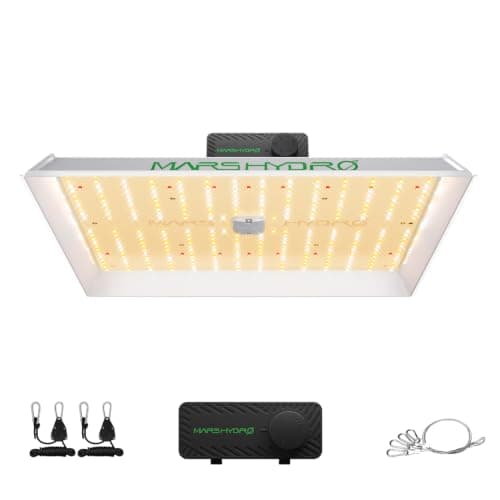
Mars Hydro TS 1000 vs Spider Farmer SF1000
343 vs 249 µmol/s, 2.3 vs 2.5 µmol/J, 150 vs 100 W — coverage, cost and the gaps, computed.
Top pick
Mars Hydro TS 1000
Reviews
The Best LED Grow Light Panels
The 100 W panel class compared on published output, efficacy and internal consistency.
Top pick
Spider Farmer SF1000
Where this sits
This page belongs to Fixture Reviews and Roundups. Every figure on it is either quoted from a named published source or derived in view — the full method is on our methodology page, and how the site is funded is on the affiliate disclosure.