VIVOSUN LumaLight 100W
Almost every panel publishes photon output and hides the intensity. This one does the reverse, and the consequences run through the whole review.
By Scooter M. — An enthusiast who's genuinely into this. I read the manuals, compile the published specs, and do the math. No lab coat.
Published · How we pick
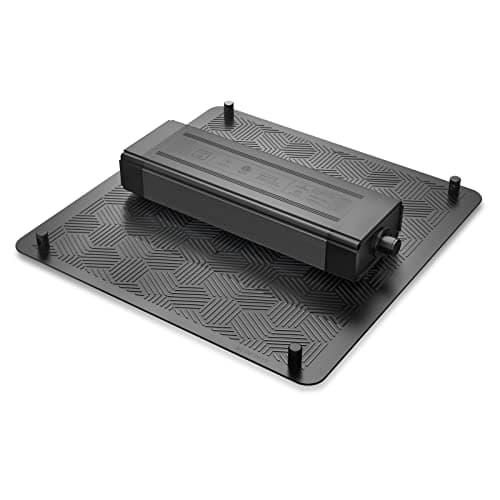
Photographs on this site are licensed stock and are illustrative of the fixture type. We do not own the units we write about.
How this page is funded: the buy links here are Amazon Associates links, and we earn a commission on qualifying purchases at no extra cost to you. We have not been paid to feature anything on this page, we accept no free product, and commission plays no part in the ranking. Full disclosure.
We have not tested these units. Everything below comes from the manufacturer’s own published specifications, or from arithmetic we have shown our working for. Where a figure is not published, we say so instead of estimating one. Read the method.
The reasoning
We have not tested this board. We do not own one and have measured nothing. What follows is VIVOSUN’s published specification, our arithmetic on it, and a clear account of what its spec sheet makes impossible to work out.
Most LED boards on this site publish a PPF in micromoles per second and an efficacy in micromoles per joule, and then either skip PPFD altogether or print one with no measurement distance, which makes it useless. The LumaLight does the opposite. It publishes a PPFD with the distance attached and publishes neither a PPF nor an efficacy figure. That inversion is the whole review.
What VIVOSUN publishes
Published by VIVOSUN for the LumaLight 100W, alongside a 2 x 2 ft coverage rating, a four-step dimmer, an IP65 rating and 36,000 hours to Q90. No PPF in µmol/s and no efficacy in µmol/J appear anywhere on the specification.
A PPFD figure is worth having only if you know where it was measured, because intensity falls with the square of distance. A great many manufacturers publish a large PPFD number with no distance at all — AC Infinity’s “1098 PPFD” is the example this site keeps returning to — and those numbers cannot be used for anything. VIVOSUN attaching “at 12 in” to its figure puts it in a small group alongside SANSI and Soltech.
The number it does not publish, and what that costs
This site ranks fixtures on photon efficacy, in micromoles per joule, because that single figure tells you how much plant light you get for your electricity and it is comparable across every form factor. It requires a PPF.
The LumaLight publishes no PPF, so it has no efficacy figure, so it cannot appear in the µmol/J ranking at all. Not at the bottom — absent. That is a real cost to a buyer trying to compare it against the boards that do publish one, and it is the main mark against it here.
Why we will not back a PPF out of the PPFD
There is a tempting calculation, and it is worth walking through it in order to reject it.
The rated coverage is 2 × 2 ft = 0.3716 m². Multiply the published intensity by that area: 521 × 0.3716 = about 194 µmol/s.
That figure is not the PPF, and it is not a bound on it either. It assumes every square meter of the footprint receives the same 521 µmol/m²/s that was measured at one point, which no board achieves — intensity falls toward the edges. It also ignores every photon that lands outside the rated footprint, which is not nothing.
One error pushes the estimate up and the other pushes it down, by amounts nobody has published. So the honest position is that the PPF of this board is unknown.
This is the same discipline the site applies elsewhere: we do not carry an efficacy figure across models, and we do not convert lumens into PPFD. A number that looks computed but rests on an assumption nobody has tested is worse than no number, because it travels.
What can be computed
521 µmol/m²/s × 12 h × 3600 ÷ 1,000,000 = 22.5 mol/m²/day.
At 16 hours: 30.0 mol/m²/day.
Both figures describe the single point 12 inches below the center of the board, not the average across the footprint. Treat them as the ceiling directly underneath.
For context, the University of New Hampshire Extension puts seedlings at about 12 mol/m²/day and Iowa State University Extension puts high-light plants at 12 to 16. Directly beneath this board at a foot, on a 12-hour schedule, you are well past both — which is why a board like this spends most of its life dimmed or hung higher when it is lighting houseplants rather than a crop.
Against the one fixture it can be compared with directly
Because SANSI publishes a PPFD at a stated one foot as well, the two figures can be set side by side without any conversion or assumption — a rare thing on this site.
| Fixture | Power | PPFD at 1 ft | PPF published? |
|---|---|---|---|
| VIVOSUN LumaLight 100W | 100 W | 521 µmol/m²/s | No |
| SANSI 36W BR30 | 36 W | 265.58 µmol/m²/s | Yes, 65.6 µmol/s |
The board delivers roughly twice the intensity of the bulb at the same distance, from a little under three times the wattage. That is a fair summary of what a 100 W board buys over a 36 W bulb: more light over a wider area, at a worse ratio than the wattage alone suggests — though without a PPF we cannot say how much worse, and we are not going to guess.
The IP65 rating is the genuinely unusual feature
VIVOSUN publishes an IP65 rating for this board. Almost nothing else on this site publishes an ingress rating at all: most manufacturers say nothing, and the ones that do go as far as “damp” or “wet” location.
IP65 means dust-tight and protected against water jets. That is a meaningful claim for a fixture hung over a propagation dome, a hydroponic reservoir or a humid grow space — the situations where this site otherwise has to tell readers that the manufacturer published no rating and the absence should be treated as information. It is the clearest advantage this board has over the alternatives in the hydroponics guide.
It is not a license to get it wet. An ingress rating describes resistance to water arriving from outside, not immersion, and it says nothing about the mains connection you have made at the other end of the cord.
Dimming, and a cost the listing does not show
The board dims in four steps — 25, 50, 75 and 100% — with an off position. Four steps is coarser than the continuous knob on the Spider Farmer SF1000 and comparable to the 20% increments on the AC Infinity IONBOARD S22.
For houseplant use, four steps is enough: 25% of a board this strong is still a great deal of light. For a grower trying to hold a precise DLI through a crop cycle, a knob is easier to land on the right setting.
VIVOSUN also advertises app control and scheduling — but that requires the GrowHub controller, which is sold separately. Bought for the app, this is a two-purchase fixture, and the listing price is not the whole cost. Bought for the manual dimmer, it is one purchase and the app is irrelevant.
A lifespan claim worth reading properly
Most fixtures here publish a bare hours figure: 50,000 for the IONBOARD, 55,000 for the SF1000, 25,000 for the SANSI bulb. VIVOSUN publishes 36,000 hours to Q90.
That is a smaller number and a better disclosure. Q90 means the point at which output has fallen to 90% of its original value — a maintained output claim rather than a time-to-failure one. LEDs rarely fail outright; they fade, and a fixture quietly delivering 70% of its original light is a real problem for a grower relying on a DLI calculation. A manufacturer stating the hours to 90% maintenance is telling you something more useful than a larger number with no criterion attached.
Whether 36,000 hours to Q90 is better or worse than 55,000 unqualified hours cannot be determined, because the second figure does not say what it is measuring. That is not VIVOSUN’s fault.
It has replaced the VS1000, and swapped which numbers it gives
VIVOSUN’s previous 100 W board, the VS1000, is the version this site has covered until now. When we searched Amazon’s catalog on September 27, 2026, the VS1000 did not appear; VIVOSUN’s current 100 W boards are the LumaLight and the AeroLight A100.
The interesting part is what changed on the spec sheet. The VS1000 published an efficacy of 2.75 µmol/J — the highest figure on this site — and no PPF. The LumaLight publishes a PPFD at a stated distance and no efficacy. Between two generations of the same 100 W board from the same company, the one number this site ranks on has disappeared, and a different useful number has appeared in its place.
We have no way to know whether the new board is more or less efficient than the old one, and we are not going to assume it inherited 2.75 µmol/J. It is a different product with a different specification.
Running cost
12 hours a day: 100 W × 12 × 30 ÷ 1000 = 36.0 kWh a month = $6.60.
16 hours a day: 48.0 kWh = $8.80.
At 25% output, which is where a houseplant shelf would run it: roughly $1.65 a month on the 12-hour schedule.
Who should buy it
- Anyone lighting a humid space — a propagation bench, a hydroponic tote, a misted setup. The published IP65 rating is the best ingress disclosure on this site, and the alternatives mostly publish nothing.
- Anyone who wants to place a board by arithmetic rather than trust a coverage claim. A PPFD at a stated foot lets you work out what any other height delivers.
- Not anyone comparing efficiency. Without a published PPF there is no efficacy figure, and a buyer who wants to know photons per watt should choose a board that publishes one.
- Not anyone buying for the app without budgeting for the GrowHub, which is a separate purchase.
The verdict
A capable 100 W board with an unusually honest intensity figure, an unusually informative lifespan claim, and an ingress rating almost nobody else publishes — wrapped around a specification that omits the one number this site uses to rank fixtures.
If you are choosing between boards on efficiency, buy one that publishes a PPF. If you are choosing on placement, humidity tolerance or honest lifespan disclosure, this is a better-documented fixture than most of its competitors, and the missing efficacy figure is the price of admission.
The fixture in full
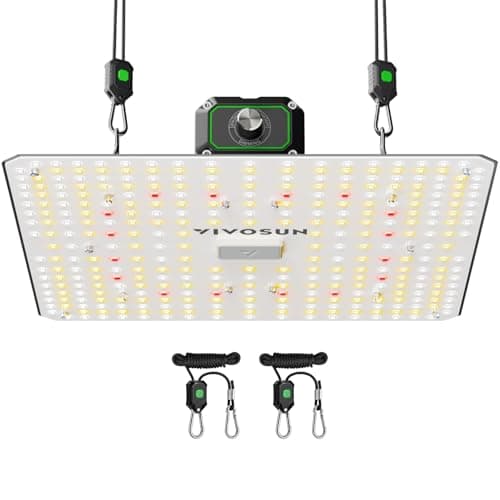
VIVOSUN LumaLight 100W
LED panelPublishes a PPFD with the measurement distance attached, which most panels do not, and then publishes neither a PPF nor an efficacy figure, which most panels do.
What VIVOSUN publishes
- Power draw
- 100 W at 120-240 V AC (source)
- PPFD
- 521 umol/m2/s at 12 in (source)
- Stated coverage
- 2 x 2 ft (source)
- Spectrum
- White, blue, red and far-red: 3000 K, 5000 K, 660 nm, 750 nm (source)
- Dimming
- Yes, four steps: 25 / 50 / 75 / 100%, plus app control with the GrowHub sold separately (source)
- Dimensions
- 12 x 12 x 4 in (30 x 30 x 6.1 cm), 4.4 lb; IP65 rated (source)
- Rated life
- 36,000 hours to Q90; up to 5-year after-sale service (source)
Our arithmetic
- Daily light integral directly under the board at 12 in: 22.5 mol/m2/day at 12 hours
521 umol/m2/s x 12 h x 3600 / 1,000,000 = 22.5 mol/m2/day. That is the figure at the single point VIVOSUN measured, not an average across the footprint, so treat it as the ceiling directly beneath the board rather than what the whole 2 x 2 ft receives. - Electricity at 12 hours a day for 30 days: $6.60 a month
100 W x 12 h x 30 d / 1000 = 36.0 kWh. 36.0 x 18.34 cents = $6.60.
What VIVOSUN does not publish
- PPF in umol/s
- Photon efficacy in umol/J
- Diode manufacturer
- PPFD anywhere other than the single 12 in figure, so the falloff across the footprint is unknown
Who should skip it
Skip it if you rank fixtures by photons per watt. Without a published PPF there is no efficacy figure to compute, so this board cannot be placed in this site's umol/J table at all.
Questions people actually ask
+What is the PPF of the VIVOSUN LumaLight 100W?
+How efficient is the VIVOSUN LumaLight?
+Is the LumaLight the same as the VIVOSUN VS1000?
+What does the IP65 rating mean for a grow light?
+How much does the LumaLight cost to run?
Sources
- VIVOSUN — LumaLight 100W LED Grow Light product specifications — consulted September 27, 2026
- SANSI — BR30 36W grow light bulb product page — consulted September 2, 2026
- AC Infinity — IONBOARD S22 published specifications — consulted September 2, 2026
- Spider Farmer — SF1000 published specification table — consulted September 2, 2026
- University of New Hampshire Extension — Growing Seedlings Under Lights — consulted September 2, 2026
- Iowa State University Extension — Important Considerations for Providing Supplemental Light to Indoor Plants — consulted September 2, 2026
- US Energy Information Administration — Electric Power Monthly, Table 5.3 (US residential average, June 2026) — consulted September 2, 2026
Read next
Reviews
The Best LED Grow Light Panels
The 100 W panel class compared on published output, efficacy and internal consistency.
Top pick
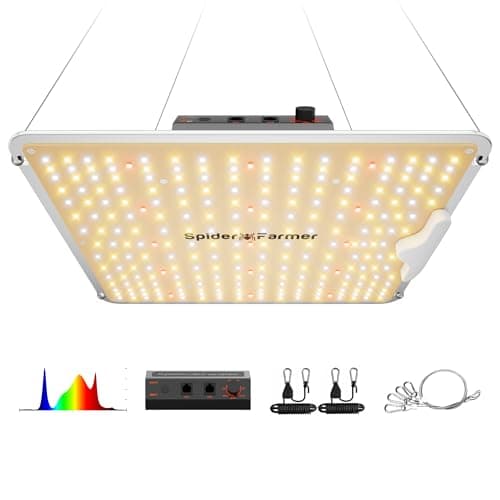
Spider Farmer SF1000
Reviews
Spider Farmer SF1000 vs AC Infinity IONBOARD S22
249.21 umol/s published against about 311 derived. One brand's figures check out; the other's headline number is unusable.
Top pick
AC Infinity IONBOARD S22
Running Cost
The Most Efficient Grow Lights by µmol/J
Every fixture we cover ranked on published photon efficacy, with derivations shown.
Reviews
Best Grow Lights for Hydroponics
Leafy greens want 12-16 mol/m2/day. Four fixtures sized to that, and the damp ratings water changes.
Top pick
GE Grow Light 48in LED Fixture, Seeds and Greens
Where this sits
This page belongs to Fixture Reviews and Roundups. Every figure on it is either quoted from a named published source or derived in view — the full method is on our methodology page, and how the site is funded is on the affiliate disclosure.