Mars Hydro TS 1000 vs AC Infinity IONBOARD S22
One of these is the most photons we can point you at. The other gets nearly as many out of a third less electricity. The area you are lighting decides it.
By Scooter M. — An enthusiast who's genuinely into this. I read the manuals, compile the published specs, and do the math. No lab coat.
Published · How we pick
Photographs on this site are licensed stock and are illustrative of the fixture type. We do not own the units we write about.
How this page is funded: the buy links here are Amazon Associates links, and we earn a commission on qualifying purchases at no extra cost to you. We have not been paid to feature anything on this page, we accept no free product, and commission plays no part in the ranking. Full disclosure.
We have not tested these units. Everything below comes from the manufacturer’s own published specifications, or from arithmetic we have shown our working for. Where a figure is not published, we say so instead of estimating one. Read the method.
Quick picks
Efficacy is photons out per joule in. Where a manufacturer publishes it we quote theirs; where they publish photon output and wattage but not efficacy, we divide and label it as ours; where they publish neither, the cell says so rather than guessing. Tap a row for the full write-up.
| # | Product | Best for | Efficacy | Price |
|---|---|---|---|---|
| 1 | 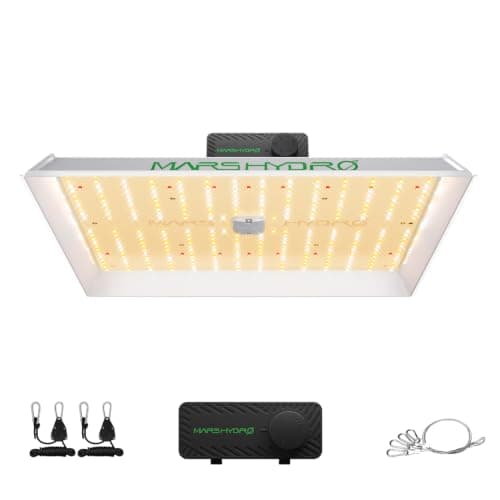 Mars Hydro TS 1000 The most photons of anything on this list, and one of only three fixtures here that publishes both PPF and efficacy so the claim can be checked against itself. | A wider footprint, most photons | 2.3 umol/J | |
| 2 | 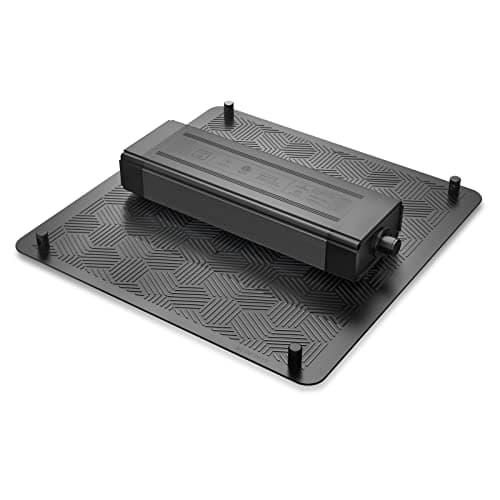 AC Infinity IONBOARD S22 The highest published efficacy of any fixture here at 2.7 umol/J, on Samsung LM301H diodes, with dimming in real 20% steps rather than a vague knob. | A 2 ft square, less on the meter | 2.7 umol/J |
The reasoning
We have not tested either fixture. What follows is published specification, our arithmetic, and the one figure on each spec sheet that has to be treated carefully.
This is the clearest efficiency-against-output comparison on the site. The Mars Hydro TS 1000 emits more photons than anything else we cover. The AC Infinity IONBOARD S22 converts electricity into photons more efficiently than anything else we cover. They are not the same virtue, and which one you want depends on a question most buyers skip: how big is the area, really?
What each publishes
| Mars Hydro TS 1000 | AC Infinity IONBOARD S22 | |
|---|---|---|
| Power | 150 W ±5% | 115 W |
| PPF | 343 µmol/s published | Not published — about 311 µmol/s derived |
| Efficacy | 2.3 µmol/J published | 2.7 µmol/J published |
| Coverage | 2.5 × 2.5 ft vegetative, 2.3 × 2.3 ft flowering | 2 × 2 ft |
| Diodes | Bridgelux | Samsung LM301H, 272 diodes |
| Dimming | Knob, 0-100% | 0-100% in 20% increments |
| Rated life | Not published | 50,000 hours |
The trade, in one calculation
Mars Hydro: 343 µmol/s at 150 W = 2.29 µmol/J, matching its published 2.3.
AC Infinity: 2.7 µmol/J × 115 W = about 311 µmol/s — ours, since AC Infinity does not publish a PPF.
So the TS 1000 delivers about 10% more photons for 30% more electricity.
Put like that the IONBOARD looks like the obvious answer, and for a 2 ft square it is. But raw output is not a vanity metric — it is what determines how wide an area you can cover before the intensity at the edges falls below what the plants need.
The area question, which actually decides this
TS 1000 over its 2.5 × 2.5 ft vegetative footprint: 6.25 sq ft = 0.581 m². 343 ÷ 0.581 × 0.8 = about 472 µmol/m²/s.
IONBOARD S22 over its 2 × 2 ft footprint: 4 sq ft = 0.3716 m². 311 ÷ 0.3716 × 0.8 = about 670 µmol/m²/s.
Both over the same 2.5 ft square: the TS 1000 gives about 472; the IONBOARD gives 311 ÷ 0.581 × 0.8 = about 428 µmol/m²/s.
That last line is the comparison worth having. Asked to light the same 2.5 ft square, the two are within 10% of each other — and the IONBOARD does it on 35 W less. Asked to light a 2 ft square, the IONBOARD is the stronger fixture outright.
The TS 1000 wins when the area is genuinely wider than the IONBOARD is rated for, because it has more total light to spread. It is not a brighter fixture at a point so much as a larger one.
Across a 2.5 ft square the TS 1000 averages about 472 µmol/m²/s and the IONBOARD about 428, from 150 W and 115 W respectively. Over a 2 ft square the IONBOARD is ahead outright at about 670.
What that costs over a year
TS 1000, 150 W: 54.0 kWh a month = $9.90, or about $119 a year.
IONBOARD S22, 115 W: 41.4 kWh = $7.59, or about $91 a year.
A $28 a year difference for roughly 10% more light, which over the IONBOARD’s 50,000 rated hours is a substantial sum.
This is the argument the whole µmol/J ranking exists to make. Efficiency is not an abstraction; it is a monthly line item that continues for the life of the fixture.
Two spec-sheet problems, one on each side
AC Infinity does not publish a PPF. Its output on this page is derived from its published efficacy and wattage. That is sound arithmetic, but it is ours rather than the manufacturer’s, and it cannot be checked against a second figure the way Mars Hydro’s can. AC Infinity also publishes a “1098 PPFD” headline with no measurement distance, which makes that number unusable.
Mars Hydro does not publish a rated life. Every other panel on this site states one — 50,000 hours for the IONBOARD, 55,000 for the Spider Farmer SF1000. Its absence here is worth noticing on a fixture that costs this much to run.
Dimming and physical form
The TS 1000 is a hooded panel with a reflective surround and a continuous dimmer knob; it wants hanging from a ceiling hook and it looks like equipment. The IONBOARD is a flat aluminum board a centimeter thick with 20% dimming steps, and it reads as a fixture rather than a machine.
For a grow tent this is irrelevant. For a shelf in a room someone lives in — which is most of this site’s readership — the flat board is far easier to live with, and that is a legitimate reason to choose it even before the efficiency argument.
The honest downside of each
Mars Hydro TS 1000: the least efficient of the three panels we cover at 2.3 µmol/J, 30% more electricity for 10% more light, no published rated life, and a physical presence that suits a tent better than a living room. Over a small area it is simply more fixture than the job needs.
AC Infinity IONBOARD S22: no published PPF, an unusable headline PPFD, the smaller rated footprint of the two, and the higher purchase price. If the area you need to cover is genuinely 2.5 ft or wider, it is being asked to do something it is not rated for.
The short answer
For a 2 ft square, or anything smaller, buy the IONBOARD S22: more light where you need it, 35 W less on the meter, and a shape you can put in a room. For a footprint genuinely wider than that — a 2.5 ft square, a wide shelf, a big plant — buy the TS 1000, because total output is what covers area, and it has the most of anything here.
If the SF1000 is also on your list, the board-against-board version of this comparison is in Spider Farmer versus AC Infinity.
What neither of them publishes
Both are better documented than most of this category, and both leave the same gaps.
- Neither publishes a usable PPFD. Mars Hydro publishes none; AC Infinity publishes one with no measurement distance. Neither board can be placed by arithmetic, so the coverage rating and your own judgment of height are what you have.
- Neither publishes a spectral distribution. Both list peaks — 660-665 nm and 730-740 nm for the TS 1000, 660 nm and 730 nm for the IONBOARD, plus color temperatures — without stating how much of the output sits at each.
- Neither publishes a location rating, which matters for anything hung over water or in a humid space.
- Mars Hydro publishes no rated life at all, where the IONBOARD states 50,000 hours. On a fixture drawing 150 W, that is the more conspicuous omission of the two.
A tent and a shelf are different problems
Much of the disagreement about these two fixtures comes from people solving different problems with them.
In a grow tent, reflective walls return a good deal of the light that misses the canopy, the fixture is out of sight, and the constraint is usually total output over the tent’s footprint. That favors the TS 1000: more photons, a hooded reflector that suits a closed space, and no penalty for looking like equipment.
On an open shelf in a room, there are no walls to bounce anything back, the fixture is visible, and the area is usually narrower than a tent. That favors the IONBOARD: a flat board, better efficacy, and a footprint that matches a typical shelf. The wider geometry argument is in bar versus panel coverage.
Both will spend most of their lives dimmed
It is worth saying plainly, because the output difference between these two is what people argue about and it rarely decides anything for this site’s readers.
Over a 2 ft square, the IONBOARD at full output delivers about 670 µmol/m²/s and the TS 1000 about 738 over its own smaller stated footprint. Iowa State University Extension puts foliage and flowering houseplants at 6 to 10 mol/m²/day, which at 12 hours is about 185 to 230 µmol/m²/s. Either board reaches that at roughly a third of its output.
So unless you are running seedlings hard or trying to fruit something indoors, you are buying a fixture to turn down — and in that case the efficiency figure matters more than the peak, because you will be paying for the watts either way.
If you are weighing all three panels
These two and the Spider Farmer SF1000 are the three panels this site covers, and the pairwise comparisons can obscure the simple summary.
On published output the order is Mars Hydro TS 1000 at 343 µmol/s, AC Infinity IONBOARD S22 at about 311 derived, then Spider Farmer SF1000 at 249.21. On published efficacy it is the IONBOARD at 2.7 µmol/J, the SF1000 at 2.5, then the TS 1000 at 2.3 — the reverse order. On whether the figures can be checked against each other, only the SF1000 qualifies.
So: most light, the TS 1000. Most light per watt, the IONBOARD. Most trustworthy spec sheet, the SF1000. The board-against-board version of this is in Spider Farmer versus AC Infinity.
Dimming turns down the heat as well as the light
One practical consequence of running either board turned down, which gets forgotten in output comparisons.
Most of the wattage a fixture draws leaves as heat rather than light, so a board at 40% is not only emitting less — it is warming the space less and drawing proportionally less power. On the TS 1000 that is the difference between 150 W and roughly 60 W of load in the room, which in a small closed space in summer is noticeable on the thermometer as well as the meter. If the fixture shares a room with you, the efficient board run low is the more comfortable object as well as the cheaper one.
Every pick in full
Mars Hydro TS 1000
LED panelA wider footprint, most photons
The most photons of anything on this list, and one of only three fixtures here that publishes both PPF and efficacy so the claim can be checked against itself.
What Mars Hydro publishes
- Power draw
- 150 W +/-5% at 100-277 V AC (source)
- PPF (photon output)
- 343 umol/s (source)
- Efficacy
- 2.3 umol/J (source)
- Stated coverage
- 2.5 x 2.5 ft vegetative, 2.3 x 2.3 ft flowering (source)
- Spectrum
- 660-665 nm, 730-740 nm, 3000 K, 5000 K (source)
- Diodes
- Bridgelux (source)
- Dimming
- Yes, 0-100% dimmer knob (source)
- Dimensions
- 406 x 326 x 50 mm (source)
Our arithmetic
- Average PPFD across its stated 2.5 x 2.5 ft vegetative footprint: about 470 umol/m2/s
2.5 ft x 2.5 ft = 6.25 sq ft = 0.581 m2. 343 umol/s divided by 0.581 m2 = 590 umol/m2/s at perfect uniformity; applying a 0.8 uniformity factor gives about 472 umol/m2/s average. - Electricity used at 14 hours a day for 30 days: 63.0 kWh a month
150 W x 14 h x 30 d / 1000 = 63.0 kWh.
Who should skip it
Skip it if you are lighting a bookshelf. 343 umol/s concentrated into a 2.5 ft square is far more light than a monstera wants, and you pay 150 W to deliver it.
AC Infinity IONBOARD S22
LED panelA 2 ft square, less on the meter
The highest published efficacy of any fixture here at 2.7 umol/J, on Samsung LM301H diodes, with dimming in real 20% steps rather than a vague knob.
What AC Infinity publishes
- Power draw
- 115 W (source)
- Efficacy
- 2.7 umol/J (source)
- PPFD
- 1098 PPFD (no measurement distance published) (source)
- Stated coverage
- 2 x 2 ft (source)
- Spectrum
- Samsung LM301H, plus 660 nm, 730 nm, 3000 K, 6500 K (source)
- Diodes
- 272 diodes (source)
- Dimming
- Yes, 0-100% in 20% increments (source)
- Dimensions
- 30.0 x 30.0 cm board, 1.1 cm thick (source)
- Rated life
- 50,000 hours (source)
Our arithmetic
- Photon output implied by the published wattage and efficacy: about 311 umol/s
115 W x 2.7 umol/J = 310.5 umol/s. AC Infinity does not print PPF directly, so this is our arithmetic from two figures it does print.
What AC Infinity does not publish
- PPF in umol/s — only efficacy is given, so photon output has to be derived
- The measurement distance for the 1098 PPFD figure, without which the number cannot be compared to anything
Who should skip it
Skip it if you want to place it by the numbers. AC Infinity prints 1098 PPFD with no measurement distance attached, which makes that figure impossible to use or compare.
Questions people actually ask
+Is the Mars Hydro TS 1000 better than the AC Infinity IONBOARD S22?
+Which is cheaper to run?
+Does AC Infinity publish a PPF figure?
+Which one suits a living room?
Sources
- Mars Hydro — TS 1000 published specification table — consulted September 2, 2026
- AC Infinity — IONBOARD S22 published specifications — consulted September 2, 2026
- Spider Farmer — SF1000 published specification table — consulted September 2, 2026
- University of Minnesota Extension — Lighting for indoor plants and starting seeds — consulted September 2, 2026
- US Energy Information Administration — Electric Power Monthly, Table 5.3 (US residential average, June 2026) — consulted September 2, 2026
Read next
Reviews
Mars Hydro TS 1000
343 µmol/s published at 150 W. The most photons here, and the numbers are checkable.
Top pick
Mars Hydro TS 1000
Reviews
AC Infinity IONBOARD S22
2.7 µmol/J on Samsung LM301H, and a PPFD claim with no measurement distance.
Top pick
AC Infinity IONBOARD S22
Reviews
Spider Farmer SF1000 vs AC Infinity IONBOARD S22
249.21 umol/s published against about 311 derived. One brand's figures check out; the other's headline number is unusable.
Top pick
AC Infinity IONBOARD S22
Running Cost
The Most Efficient Grow Lights by µmol/J
Every fixture we cover ranked on published photon efficacy, with derivations shown.
Where this sits
This page belongs to Fixture Reviews and Roundups. Every figure on it is either quoted from a named published source or derived in view — the full method is on our methodology page, and how the site is funded is on the affiliate disclosure.