Mars Hydro TS 1000
The highest published photon output of any fixture we cover, and one of the few whose spec sheet gives you enough to check the coverage claim yourself.
By Scooter M. — An enthusiast who's genuinely into this. I read the manuals, compile the published specs, and do the math. No lab coat.
Published · How we pick
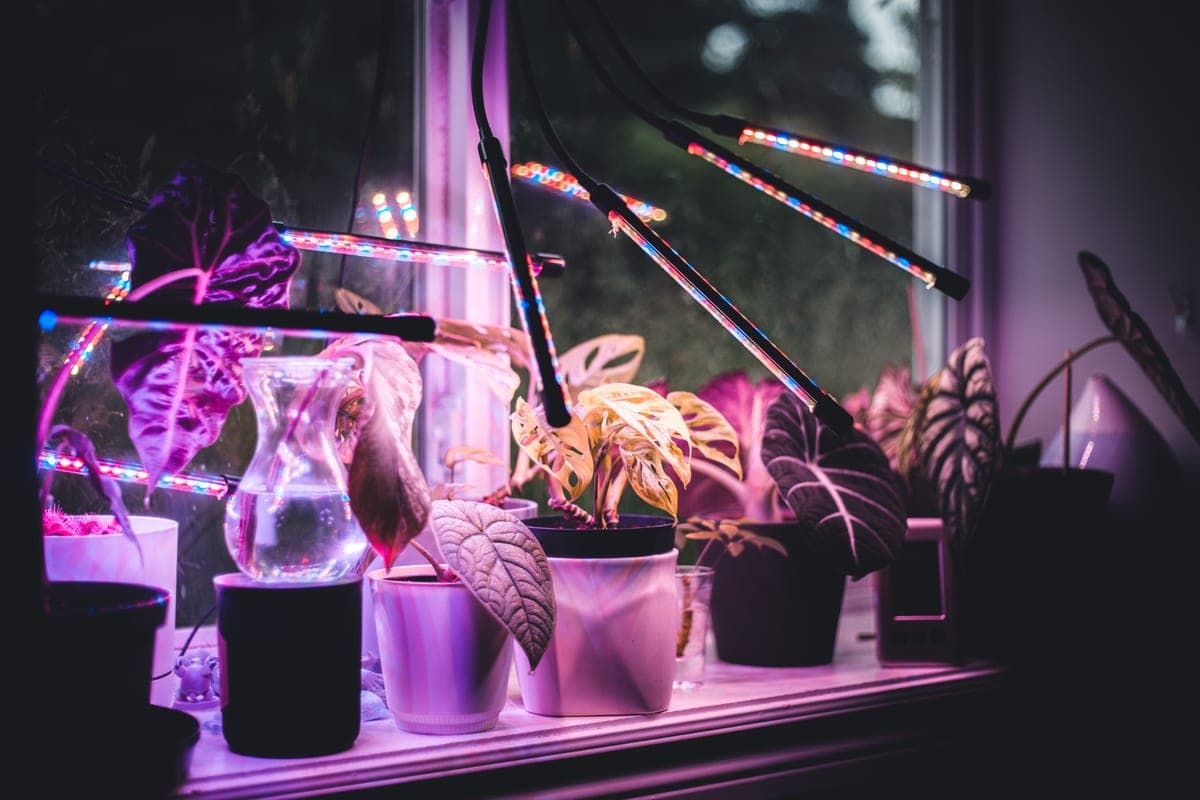
Photographs on this site are licensed stock and are illustrative of the fixture type. We do not own the units we write about.
How this page is funded: the buy links here are Amazon Associates links, and we earn a commission on qualifying purchases at no extra cost to you. We have not been paid to feature anything on this page, we accept no free product, and commission plays no part in the ranking. Full disclosure.
We have not tested these units. Everything below comes from the manufacturer’s own published specifications, or from arithmetic we have shown our working for. Where a figure is not published, we say so instead of estimating one. Read the method.
The reasoning
We have not tested this fixture. We have not owned one, plugged one in, or measured anything about it. What follows is every figure Mars Hydro publishes for the TS 1000, our arithmetic on those figures with the working shown, and a list of what the spec sheet leaves out.
What it publishes, and why that matters
Mars Hydro publishes 343 µmol/s of photon flux, 150 W ±5% at 100–277 V AC, and 2.3 µmol/J of efficacy. Three figures, related to each other, which means the claim can be tested against itself.
343 µmol/s ÷ 150 W = 2.29 µmol/J.
Mars Hydro publishes 2.3. That is the same number to the precision given.
Internal consistency is not proof of accuracy — all three could be optimistic together — but a spec sheet whose numbers contradict each other tells you something is wrong, and this one does not.
What 343 µmol/s actually buys you
Mars Hydro states a 2.5 × 2.5 ft vegetative footprint. Taking both published figures together:
2.5 × 2.5 ft = 6.25 sq ft = 0.581 m².
343 ÷ 0.581 = 590 µmol/m²/s at perfect uniformity; at a 0.8 uniformity factor, about 472 µmol/m²/s average.
That is above University of Minnesota Extension’s high-light band of 250–450. For seedlings, herbs or greens it is more than the target; for a monstera it is far more than the plant will use.
The useful conclusion is not that the fixture is too bright. It is that the TS 1000 over 6.25 sq ft is over-specified for most home situations, and the sensible response is to spread it over more area or dim it. Both are free.
343 ÷ 250 × 0.8 = 1.097 m², which is 11.8 sq ft. Nearly double its stated vegetative footprint, because that footprint is quoted at a much higher light level.
Running cost
150 W × 14 h ÷ 1000 = 2.1 kWh a day.
2.1 × 30 = 63.0 kWh a month = $11.56 at 18.34 cents per kWh.
Across 150 days: 315 kWh = about $57.77 for the season.
The same photons from a 2.7 µmol/J fixture would draw about 127 W and cost roughly $49 — a $9 difference over a winter, which is the honest size of the efficacy gap here.
What Mars Hydro does not publish
A PPFD figure at any stated distance. That is the notable gap: with 343 µmol/s and a footprint you can compute an area average, but you cannot know how the light is distributed within that footprint, or what a plant directly beneath the center actually receives. For a panel — which concentrates output at a point — that is exactly where the interesting variation lives.
Soltech, a far smaller fixture, publishes PPFD at three distances. It is not a technically difficult thing to measure.
Who should buy it
- Yes if you are lighting a genuinely large area — 2 × 4 ft or more — and want a single fixture to do it.
- Yes if you want a fixture whose output claim divides correctly out of its own wattage.
- No for a bookshelf or a single plant. 343 µmol/s over a small area is light you pay 150 W to produce and then throw away.
- No if you want to place it by published PPFD, because there is not one.
Head to head against the other fixture in its class, see Mars Hydro versus ViparSpectra. To size it against your own space, use the coverage calculator.
The fixture in full
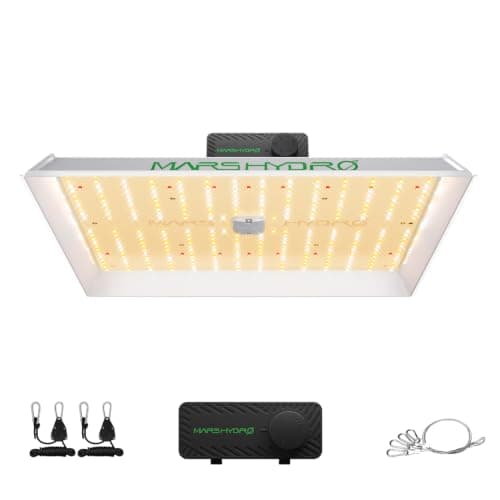
Mars Hydro TS 1000
LED panelThe most photons of anything on this list, and one of only three fixtures here that publishes both PPF and efficacy so the claim can be checked against itself.
What Mars Hydro publishes
- Power draw
- 150 W +/-5% at 100-277 V AC (source)
- PPF (photon output)
- 343 umol/s (source)
- Efficacy
- 2.3 umol/J (source)
- Stated coverage
- 2.5 x 2.5 ft vegetative, 2.3 x 2.3 ft flowering (source)
- Spectrum
- 660-665 nm, 730-740 nm, 3000 K, 5000 K (source)
- Diodes
- Bridgelux (source)
- Dimming
- Yes, 0-100% dimmer knob (source)
- Dimensions
- 406 x 326 x 50 mm (source)
Our arithmetic
- Average PPFD across its stated 2.5 x 2.5 ft vegetative footprint: about 470 umol/m2/s
2.5 ft x 2.5 ft = 6.25 sq ft = 0.581 m2. 343 umol/s divided by 0.581 m2 = 590 umol/m2/s at perfect uniformity; applying a 0.8 uniformity factor gives about 472 umol/m2/s average. - Electricity used at 14 hours a day for 30 days: 63.0 kWh a month
150 W x 14 h x 30 d / 1000 = 63.0 kWh.
Who should skip it
Skip it if you are lighting a bookshelf. 343 umol/s concentrated into a 2.5 ft square is far more light than a monstera wants, and you pay 150 W to deliver it.
Questions people actually ask
+Is the Mars Hydro TS 1000 good for seedlings?
+How big an area does the TS 1000 cover?
+What does the TS 1000 cost to run?
+Have you tested the Mars Hydro TS 1000?
Sources
- Mars Hydro — TS 1000 published specification table — consulted September 2, 2026
- University of Minnesota Extension — Lighting for indoor plants and starting seeds — consulted September 2, 2026
- University of New Hampshire Extension — Growing Seedlings Under Lights — consulted September 2, 2026
- US Energy Information Administration — Electric Power Monthly, Table 5.3 (US residential average, June 2026) — consulted September 2, 2026
- Soltech — Aspect Gen 2 published specifications — consulted September 2, 2026
Read next
Reviews
Mars Hydro TS 1000 vs Spider Farmer SF1000
343 vs 249 µmol/s, 2.3 vs 2.5 µmol/J, 150 vs 100 W — coverage, cost and the gaps, computed.
Top pick
Mars Hydro TS 1000
Reviews
The Best Dimmable Grow Lights
Which fixtures dim in repeatable steps versus an unmarked knob, and when dimming actually matters.
Top pick
AC Infinity IONBOARD S22

Reviews
Mars Hydro TS 1000 vs ViparSpectra P1000
Two panels in the same segment: one publishes photon data, the other publishes none.
Top pick
Mars Hydro TS 1000
Reviews
The Best LED Grow Light Panels
The 100 W panel class compared on published output, efficacy and internal consistency.
Top pick
Spider Farmer SF1000
Coverage & Sizing
PPFD Targets by Plant Type
Published light bands mapped to common indoor plants, with the DLI each implies.
Top pick
GooingTop Clip Grow Light
Running Cost
The Most Efficient Grow Lights by µmol/J
Every fixture we cover ranked on published photon efficacy, with derivations shown.
Reviews
Mars Hydro TS 1000 vs AC Infinity IONBOARD S22
343 umol/s at 150 W against about 311 at 115 W. More light, or more light per watt.
Top pick
Mars Hydro TS 1000
Where this sits
This page belongs to Fixture Reviews and Roundups. Every figure on it is either quoted from a named published source or derived in view — the full method is on our methodology page, and how the site is funded is on the affiliate disclosure.