AC Infinity IONBOARD S22
The highest efficacy we can attribute to a named diode, paired with a PPFD figure published without the one detail that would make it mean anything.
By Scooter M. — An enthusiast who's genuinely into this. I read the manuals, compile the published specs, and do the math. No lab coat.
Published · How we pick

Photographs on this site are licensed stock and are illustrative of the fixture type. We do not own the units we write about.
How this page is funded: the buy links here are Amazon Associates links, and we earn a commission on qualifying purchases at no extra cost to you. We have not been paid to feature anything on this page, we accept no free product, and commission plays no part in the ranking. Full disclosure.
We have not tested these units. Everything below comes from the manufacturer’s own published specifications, or from arithmetic we have shown our working for. Where a figure is not published, we say so instead of estimating one. Read the method.
The reasoning
We have not tested this board. What AC Infinity publishes is more specific than most of this category — a named diode, a step-dimming spec, a thickness — and it also contains the single clearest example on this site of a number that looks informative and is not.
The good part: 2.7 µmol/J on a named diode
AC Infinity publishes 115 W, 2.7 µmol/J, 272 diodes, and Samsung LM301H as the white emitter with 660 nm and 730 nm reds and 3000 K / 6500 K whites. Naming the diode matters: it is a checkable claim about a component with published characteristics, rather than an unattributable assertion about a finished product.
115 W × 2.7 µmol/J = 310.5 µmol/s.
AC Infinity does not publish PPF directly, so that is our arithmetic on their numbers rather than their measurement — and we label it as such everywhere it appears on this site.
For context, that sits between the Spider Farmer SF1000’s published 249.21 and the Mars Hydro TS 1000’s published 343.
The bad part: “1098 PPFD”
AC Infinity publishes a PPFD figure of 1098 with no measurement distance attached. Photon density falls with roughly the square of distance, so a reading at 4 inches and a reading at 24 inches would differ by a factor of about 36. Without the distance, 1098 cannot be compared to another fixture, cannot be used to place this one, and cannot be checked against anything.
Its derived output is about 310.5 µmol/s. For an average of 1098 µmol/m²/s you would need to concentrate all of it into 310.5 ÷ 1098 = 0.283 m², which is 3.0 sq ft — and that assumes perfect uniformity with nothing spilling outside.
Its stated coverage is 2 × 2 ft, which is 4 sq ft. So 1098 is not an area average over the stated footprint; it must be a peak reading at a close distance.
That is a perfectly legitimate thing to measure. It is not a legitimate thing to publish without saying where you measured it.
Which makes the number unusable for placement or comparison. Our derived area average over its stated 2 × 2 ft footprint is about 668 µmol/m²/s at 0.8 uniformity.
Dimming that is actually specified
0 to 100% in 20% increments, which is a genuinely better specification than “dimmer knob.” With steps you can reproduce a setting; a knob position is a guess you make again every time you touch it. On a fixture that produces more light than most home shelves need, repeatable dimming is worth more than it sounds.
Form factor
At 30 × 30 cm and 1.1 cm thick, passively cooled, this is a board rather than a panel — designed to mount flat rather than hang. On a wire shelf that is the right shape, and it means no fan noise and no moving part to fail. It also means it needs air behind it, so pressing it flush to a solid wooden shelf works against the cooling it depends on.
Running cost
115 W at 14 hours is 48.3 kWh a month, about $8.86 at the US residential average — the highest monthly figure of the 100 W class here, because it is the largest draw. Per photon it is the cheapest, which is the point of buying on efficacy.
Who should buy it
- Yes if efficiency is your criterion and you are running it long hours for months.
- Yes if you are mounting flat under a shelf and want no fan.
- No if you intend to place it by the published PPFD, because that figure cannot be used.
Its position in the efficiency field is in the µmol/J ranking.
The fixture in full
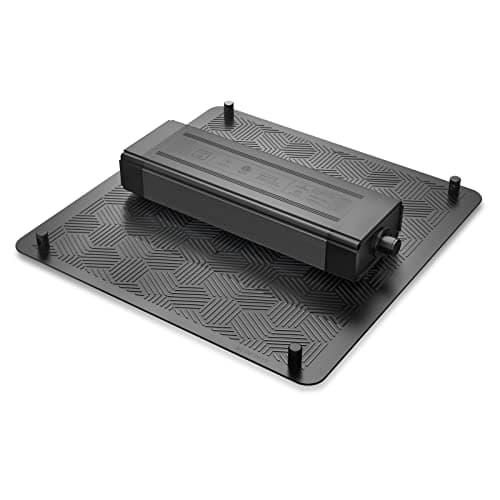
AC Infinity IONBOARD S22
LED panelThe highest published efficacy of any fixture here at 2.7 umol/J, on Samsung LM301H diodes, with dimming in real 20% steps rather than a vague knob.
What AC Infinity publishes
- Power draw
- 115 W (source)
- Efficacy
- 2.7 umol/J (source)
- PPFD
- 1098 PPFD (no measurement distance published) (source)
- Stated coverage
- 2 x 2 ft (source)
- Spectrum
- Samsung LM301H, plus 660 nm, 730 nm, 3000 K, 6500 K (source)
- Diodes
- 272 diodes (source)
- Dimming
- Yes, 0-100% in 20% increments (source)
- Dimensions
- 30.0 x 30.0 cm board, 1.1 cm thick (source)
- Rated life
- 50,000 hours (source)
Our arithmetic
- Photon output implied by the published wattage and efficacy: about 311 umol/s
115 W x 2.7 umol/J = 310.5 umol/s. AC Infinity does not print PPF directly, so this is our arithmetic from two figures it does print.
What AC Infinity does not publish
- PPF in umol/s — only efficacy is given, so photon output has to be derived
- The measurement distance for the 1098 PPFD figure, without which the number cannot be compared to anything
Who should skip it
Skip it if you want to place it by the numbers. AC Infinity prints 1098 PPFD with no measurement distance attached, which makes that figure impossible to use or compare.
Questions people actually ask
+What is the IONBOARD S22's actual photon output?
+What does AC Infinity's 1098 PPFD figure mean?
+Is the IONBOARD S22 the most efficient grow light?
+Does the IONBOARD S22 have a fan?
Sources
- AC Infinity — IONBOARD S22 published specifications — consulted September 2, 2026
- Spider Farmer — SF1000 published specification table — consulted September 2, 2026
- Mars Hydro — TS 1000 published specification table — consulted September 2, 2026
- VIVOSUN — VS1000 product page — consulted September 2, 2026
- US Energy Information Administration — Electric Power Monthly, Table 5.3 (US residential average, June 2026) — consulted September 2, 2026
Read next
Reviews
The Best Dimmable Grow Lights
Which fixtures dim in repeatable steps versus an unmarked knob, and when dimming actually matters.
Top pick
AC Infinity IONBOARD S22
Reviews
The Best LED Grow Light Panels
The 100 W panel class compared on published output, efficacy and internal consistency.
Top pick
Spider Farmer SF1000
Running Cost
The Most Efficient Grow Lights by µmol/J
Every fixture we cover ranked on published photon efficacy, with derivations shown.
Spectrum & PPFD
What “Full Spectrum” Actually Means
The phrase is unregulated and carries no threshold. These are the numbers that replace it.
Top pick
Spider Farmer SF1000
Coverage & Sizing
The Best Grow Lights for a Shelf or Rack
Picks chosen on footprint match first, because a square panel over a long shelf wastes its edges.
Top pick
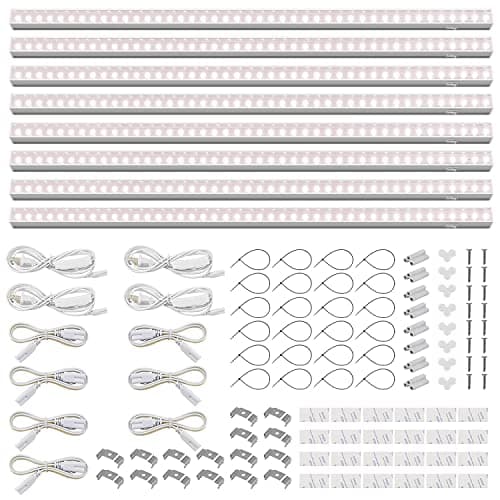
Barrina T5 4ft Grow Light Strips
Reviews
Spider Farmer SF1000 vs AC Infinity IONBOARD S22
249.21 umol/s published against about 311 derived. One brand's figures check out; the other's headline number is unusable.
Top pick
AC Infinity IONBOARD S22
Where this sits
This page belongs to Fixture Reviews and Roundups. Every figure on it is either quoted from a named published source or derived in view — the full method is on our methodology page, and how the site is funded is on the affiliate disclosure.