Spider Farmer SF1000
The fixture we point at when someone asks what good disclosure looks like: two published figures that agree with each other when you divide them.
By Scooter M. — An enthusiast who's genuinely into this. I read the manuals, compile the published specs, and do the math. No lab coat.
Published · How we pick
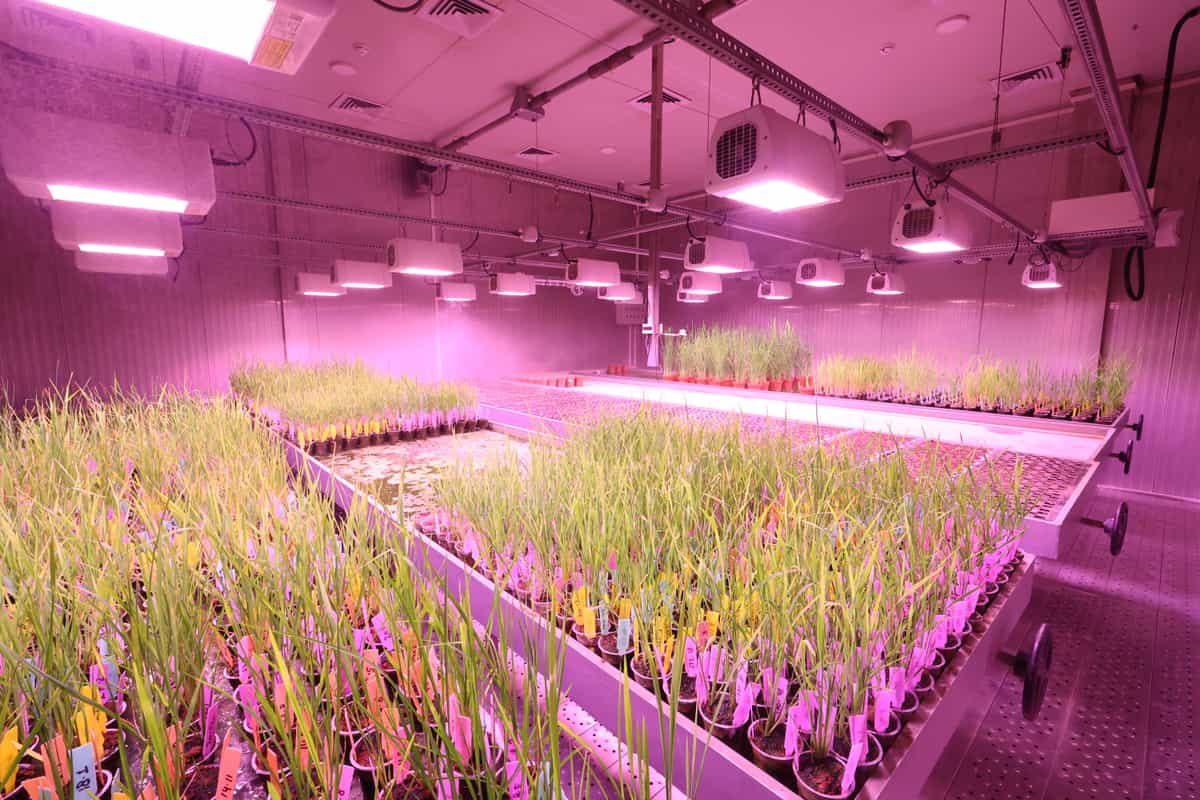
Photographs on this site are licensed stock and are illustrative of the fixture type. We do not own the units we write about.
How this page is funded: the buy links here are Amazon Associates links, and we earn a commission on qualifying purchases at no extra cost to you. We have not been paid to feature anything on this page, we accept no free product, and commission plays no part in the ranking. Full disclosure.
We have not tested these units. Everything below comes from the manufacturer’s own published specifications, or from arithmetic we have shown our working for. Where a figure is not published, we say so instead of estimating one. Read the method.
The reasoning
We have not tested this fixture and do not own one. What we can do is something we cannot do for most of this category: check Spider Farmer’s claims against each other.
The check
Spider Farmer publishes 249.21 µmol/s and 100 W ±5%.
249.21 ÷ 100 = 2.4921 µmol/J.
Spider Farmer publishes 2.5 µmol/J. That is 2.4921 rounded to two significant figures.
The numbers agree. That is what we mean by a spec sheet you can check: the brand has published enough for the claim to be falsifiable, and it survives the test.
Compare that with VIVOSUN, which publishes a higher 2.75 µmol/J and no PPF at all. The higher number may well be accurate; there is simply no way to tell from what is published. We would rather have 2.5 confirmed than 2.75 asserted.
What it delivers
2 × 2 ft = 4 sq ft = 0.372 m².
249.21 ÷ 0.372 = 670 µmol/m²/s at perfect uniformity; at 0.8, about 536 µmol/m²/s.
Over the stated 3 × 3 ft maximum footprint (0.836 m²): 249.21 ÷ 0.836 × 0.8 = 238 µmol/m²/s, which lands neatly at the top of Minnesota Extension’s medium band and is close to ideal for seedlings at 14 hours.
That second figure is the interesting one. The SF1000 at its maximum footprint is a near-perfect seedling light: 238 µmol/m²/s at 14 hours gives a DLI of 12.0 mol/m²/day, which is the University of New Hampshire Extension target essentially exactly.
Per square meter per day, computed from its published 249.21 µmol/s over 3 × 3 ft at 0.8 uniformity. The published seedling target is about 12.
Running cost and lifespan
100 W at 14 hours is 1.4 kWh a day, 42 kWh a month, about $7.70 at the US residential average. Spider Farmer publishes a 55,000-hour rated life, which at 14 hours a day is roughly 10.8 years of continuous seasonal use — long enough that lifespan is not a purchasing consideration.
Where it loses
To the Mars Hydro TS 1000 on raw output: 343 µmol/s against 249.21, 38% more photons for 50 W more draw. If your area is large enough to need them, the TS 1000 is the better tool.
To the AC Infinity IONBOARD on efficiency: 2.7 µmol/J against 2.5, which over a five-month winter at equivalent output is a difference of roughly $4. Small, but real, and it compounds.
What is not published
PPFD at a stated distance, same as almost everyone else in this class. The spectrum line — 650–665 nm, 730–740 nm, 2800–3000 K, 4800–5000 K — tells you which emitters are present but not their proportions, which would require a spectral distribution chart nobody in this segment publishes.
Who should buy it
Anyone lighting roughly 2 × 2 to 3 × 3 ft who wants to know what they are getting before it arrives. It is the fixture we would pick if the criterion were “the manufacturer told me enough to check its claims,” and that is a criterion we think should matter more than it does.
Size it for your own space in the coverage calculator, or see how it ranks against the rest in the best grow light panels.
The fixture in full
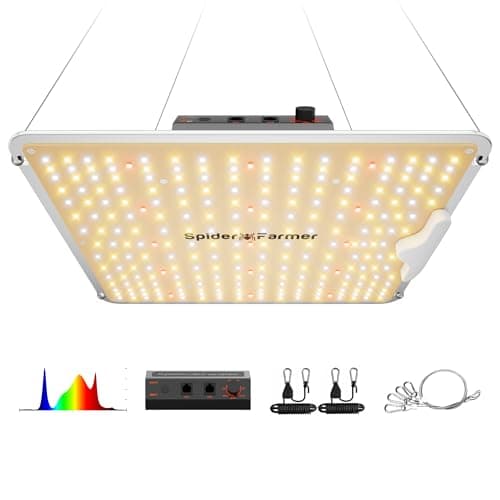
Spider Farmer SF1000
LED panelPublishes PPF to two decimal places and an efficacy figure that actually divides out of it. That internal consistency is rarer in this category than it should be.
What Spider Farmer publishes
- Power draw
- 100 W +/-5% at 100-277 V AC (source)
- PPF (photon output)
- 249.21 umol/s (source)
- Efficacy
- 2.5 umol/J (source)
- Stated coverage
- 2 x 2 ft core, 3 x 3 ft maximum (source)
- Spectrum
- 650-665 nm, 730-740 nm, 2800-3000 K, 4800-5000 K (source)
- Diodes
- Bridgelux (source)
- Dimming
- Yes, dimming knob (source)
- Dimensions
- 32.5 x 29.0 x 5.9 cm (source)
- Rated life
- 55,000 hours (source)
Our arithmetic
- Does the published efficacy check out against the published PPF?: Yes — 2.49 umol/J computed against 2.5 umol/J published
249.21 umol/s / 100 W = 2.4921 umol/J. The published 2.5 umol/J is that number rounded. Not every brand's two figures agree like this, which is exactly why we divide them. - Average PPFD across its 2 x 2 ft core footprint: about 536 umol/m2/s
2 ft x 2 ft = 4 sq ft = 0.372 m2. 249.21 / 0.372 = 670 umol/m2/s at perfect uniformity; at a 0.8 uniformity factor, about 536 umol/m2/s.
Who should skip it
Skip it if raw output is what you are buying — the TS 1000 delivers 38% more photons per second, at the cost of 50 W more draw.
Questions people actually ask
+Is the Spider Farmer SF1000 good for seedlings?
+How much does the SF1000 cost to run?
+Is the SF1000 better than the Mars Hydro TS 1000?
+Have you tested the SF1000?
Sources
- Spider Farmer — SF1000 published specification table — consulted September 2, 2026
- Mars Hydro — TS 1000 published specification table — consulted September 2, 2026
- AC Infinity — IONBOARD S22 published specifications — consulted September 2, 2026
- VIVOSUN — VS1000 product page — consulted September 2, 2026
- University of New Hampshire Extension — Growing Seedlings Under Lights — consulted September 2, 2026
- University of Minnesota Extension — Lighting for indoor plants and starting seeds — consulted September 2, 2026
- US Energy Information Administration — Electric Power Monthly, Table 5.3 (US residential average, June 2026) — consulted September 2, 2026
Read next
Reviews
Mars Hydro TS 1000 vs Spider Farmer SF1000
343 vs 249 µmol/s, 2.3 vs 2.5 µmol/J, 150 vs 100 W — coverage, cost and the gaps, computed.
Top pick
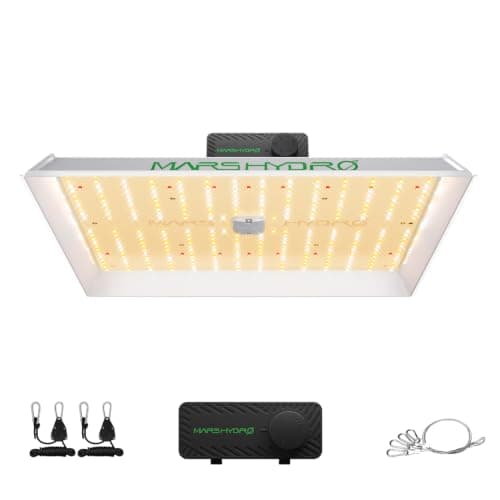
Mars Hydro TS 1000
Reviews
The Best LED Grow Light Panels
The 100 W panel class compared on published output, efficacy and internal consistency.
Top pick
Spider Farmer SF1000
Reviews
The Best Grow Lights
The main ranking: nine fixtures sorted on published data, with every gap named.
Top pick
Spider Farmer SF1000

Coverage & Sizing
Grow Light Coverage Calculator
Put in PPF, area and hours; get PPFD and DLI scored against published extension bands.
Top pick
Mars Hydro TS 1000
Spectrum & PPFD
PAR, PPFD and DLI, Explained
The three photon units, what each measures, and the conversions between them, shown.
Top pick
Spider Farmer SF1000
Reviews
Spider Farmer SF1000 vs AC Infinity IONBOARD S22
249.21 umol/s published against about 311 derived. One brand's figures check out; the other's headline number is unusable.
Top pick
AC Infinity IONBOARD S22
Where this sits
This page belongs to Fixture Reviews and Roundups. Every figure on it is either quoted from a named published source or derived in view — the full method is on our methodology page, and how the site is funded is on the affiliate disclosure.