Grow Lights for Alocasia
Alocasia are the plants most often described as wanting bright indirect light, which is a phrase with no number in it. Here is the number.
By Scooter M. — An enthusiast who's genuinely into this. I read the manuals, compile the published specs, and do the math. No lab coat.
Published · How we pick
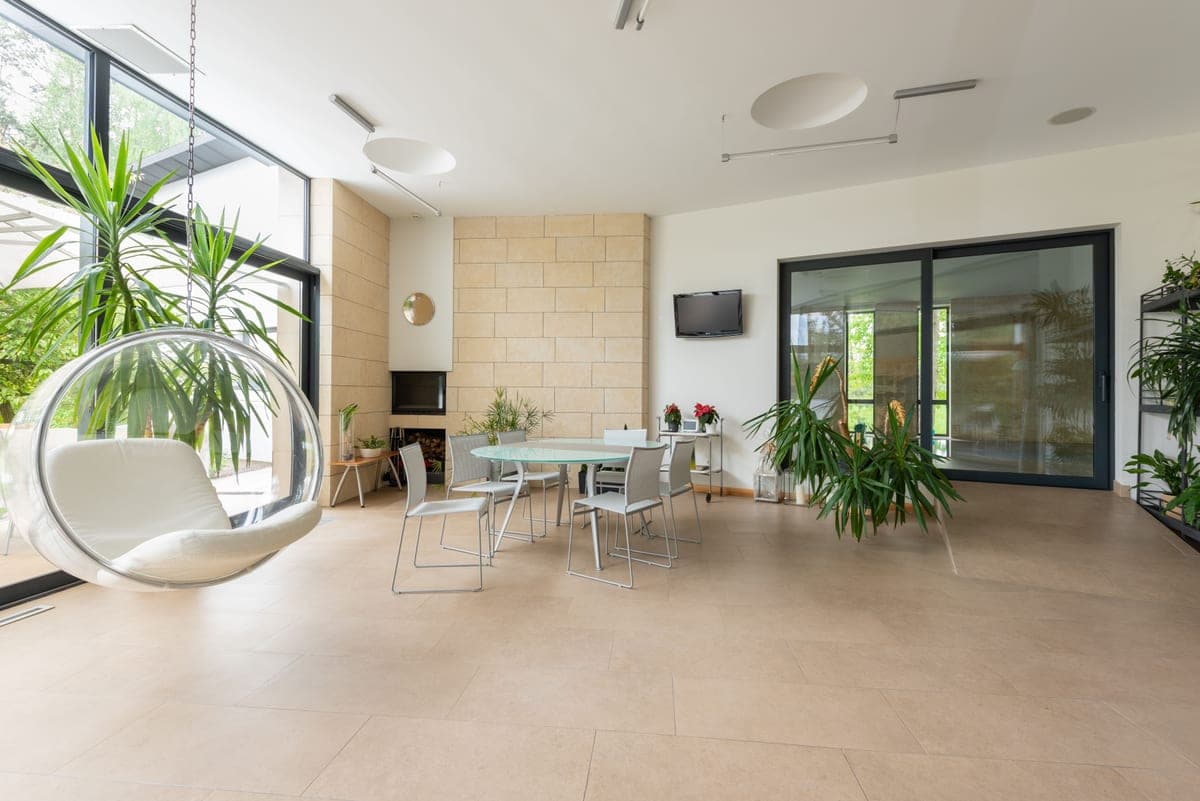
Photographs on this site are licensed stock and are illustrative of the fixture type. We do not own the units we write about.
How this page is funded: the buy links here are Amazon Associates links, and we earn a commission on qualifying purchases at no extra cost to you. We have not been paid to feature anything on this page, we accept no free product, and commission plays no part in the ranking. Full disclosure.
We have not tested these units. Everything below comes from the manufacturer’s own published specifications, or from arithmetic we have shown our working for. Where a figure is not published, we say so instead of estimating one. Read the method.
Quick picks
Efficacy is photons out per joule in. Where a manufacturer publishes it we quote theirs; where they publish photon output and wattage but not efficacy, we divide and label it as ours; where they publish neither, the cell says so rather than guessing. Tap a row for the full write-up.
| # | Product | Best for | Efficacy | Price |
|---|---|---|---|---|
| 1 | 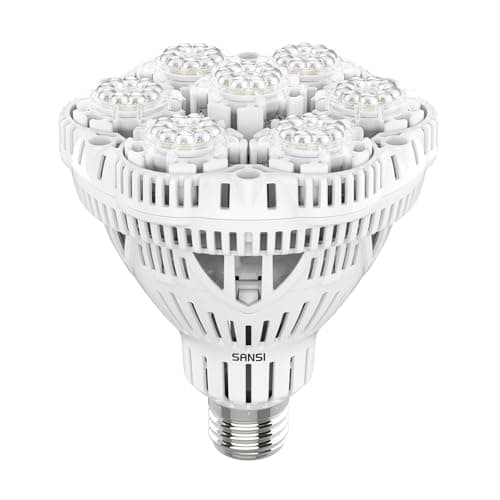 SANSI 36W BR30 Grow Light Bulb The rare grow bulb that publishes both PPF and a PPFD figure with the measurement distance attached, which is the only reason it can be sized honestly. | One alocasia, placed by numbers | 1.82 umol/J (ours) | |
| 2 | 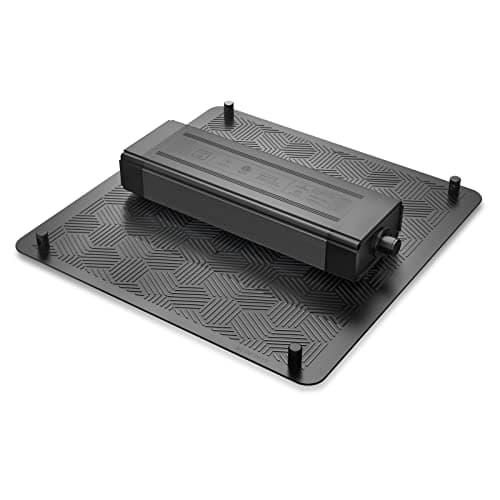 AC Infinity IONBOARD S22 The highest published efficacy of any fixture here at 2.7 umol/J, on Samsung LM301H diodes, with dimming in real 20% steps rather than a vague knob. | A shelf, dimmed down | 2.7 umol/J | |
| 3 | 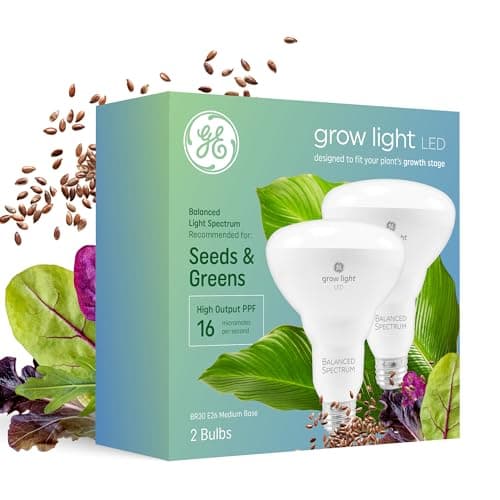 GE Grow Light BR30 Bulb, Seeds and Greens (2-pack) A mainstream-brand grow bulb that prints its photon output on the box: 16 umol/s from 9 W, which is enough for one low- or medium-light plant under a lamp you already own, and not much more. | A small plant, cheaply | Not published |
The reasoning
We have not tested these fixtures. What follows is published specification, Extension guidance, and our arithmetic joining the two, with the working shown.
“Bright indirect light” is the phrase attached to alocasia everywhere, and it is the least actionable advice in houseplant care. It contains no quantity and no distance. This page replaces it with a band, a fixture size and a hanging height.
The target
Iowa State University Extension puts foliage and flowering houseplants at 6 to 10 mol/m²/day. Alocasia belong at the upper half of that band: they are understory aroids, but large-leaved ones that put real energy into each new leaf, and they are noticeably more demanding than a pothos or a heartleaf philodendron.
What “indirect” is actually warning about is not intensity so much as exposure — direct midday sun through glass scorches those thin leaves. A grow light at a sensible distance is diffuse by comparison, which is why alocasia often do better under a fixture than on a south sill.
8 mol/m²/day at 12 hours = 8,000,000 ÷ (12 × 3600) = 185 µmol/m²/s.
A mature alocasia canopy of about 1.5 sq ft = 0.139 m². Delivering 185 across it at 0.8 uniformity needs 185 × 0.139 ÷ 0.8 = about 32 µmol/s.
For 8 mol/m²/day at 12 hours with a 0.8 uniformity factor, derived from Iowa State University Extension's 6-10 mol/m²/day band for foliage houseplants. A 9 W grow bulb publishes 14-16 µmol/s; a 36 W bulb publishes 65.6.
1. SANSI 36W BR30 — one alocasia, placed by numbers
65.6 µmol/s published, with a PPFD of 265.58 µmol/m²/s at a stated one foot. The stated distance is the reason this is first: alocasia are sensitive to getting this wrong in both directions, and a bulb you can place by arithmetic removes the guesswork.
265.58 µmol/m²/s at 1 ft is 11.5 mol/m²/day at 12 hours — above the band and into territory that will bleach thin leaves.
At 15 in, by the inverse-square relationship: 265.58 × (12 ÷ 15)² = 170 µmol/m²/s, or 7.3 mol/m²/day. At 18 in: 118 µmol/m²/s and 5.1 mol/m²/day.
So 15 to 18 inches above the top leaves puts an alocasia in its band, and you move the fixture up as the plant grows rather than leaving it.
The downside: one bulb lights one plant, and alocasia are collected in groups more often than most. It also runs 36 W, which is four times the draw of the 9 W bulbs and about $2.38 a month at 12 hours.
2. AC Infinity IONBOARD S22 — a shelf, dimmed down
A 115 W board publishing 2.7 µmol/J, which implies about 311 µmol/s, over a stated 2 ft by 2 ft coverage. On its own that is far too much light for this plant — and it dims in 20% increments, which is what makes it the right answer for a group.
At full output over 2 × 2 ft: 311 ÷ 0.3716 × 0.8 = about 670 µmol/m²/s — three times what an alocasia wants.
At 40%: about 268 µmol/m²/s, or 11.6 mol/m²/day at 12 hours. At 20%: about 134 µmol/m²/s, or 5.8 mol/m²/day.
So a shelf of alocasia sits at 20 to 40% output, and the board spends most of its life turned down.
The downside: you are buying a fixture and then using a third of it, which is a strange purchase unless you also grow higher-light plants or plan to. AC Infinity also publishes a “1098 PPFD” figure with no measurement distance attached, which makes that particular number unusable — we derive from the wattage and efficacy instead.
3. GE Grow BR30 — a small plant, cheaply
16 µmol/s per bulb from 9 W, CRI 90, sold in a two-pack. For a young alocasia — a polly, a small zebrina, anything under a foot — 16 µmol/s from a foot away is the right order of magnitude rather than a compromise, and two bulbs cover two plants.
The downside: it will not carry a mature plant. The 32 µmol/s figure above is two of these bulbs’ entire output with nothing lost to spill, and GE publishes no beam angle, so what actually reaches the leaves cannot be computed — only bounded.
Reading the plant
Alocasia are unusually expressive about light, which makes them easier to tune than most plants on this site.
- Too little: long petioles reaching upward and leaning, new leaves arriving smaller than the ones before them, and the plant dropping an old leaf for every new one so the total never increases. That last pattern is the clearest signal, and it is usually read as normal shedding.
- Too much: pale or bleached patches on the upper surfaces facing the fixture, silvering between the veins, and crisp brown margins on the newest leaves. Raise the fixture or dim it.
- Not a light problem: yellowing lower leaves with damp soil, which is watering; small brown spots with yellow halos, which is not something a fixture fixes; and a dormancy in winter where the plant dies back to the corm, which is normal for several species and not a sign the light failed.
Hours
Iowa State University Extension gives 12 to 14 hours as the general range for indoor plants, with 10 as a floor and 16 as a ceiling. Twelve is what every calculation on this page assumes, and it is the right default here.
If an alocasia is short of light, lengthening the day to 14 hours adds about 17% to the daily total without raising the intensity the leaves see — which for a plant that scorches is the safer of the two levers. The other lever, moving the fixture closer, works but should be done in steps of a few inches with a week between them.
Running cost
GE 9 W bulb: 3.24 kWh a month = $0.59.
SANSI 36 W bulb: 12.96 kWh = $2.38.
IONBOARD S22 at 40% of 115 W: about 16.6 kWh = $3.04.
Sizing by the plant you actually have
“An alocasia” ranges from a four-inch polly to a five-foot zebrina, and the fixture that suits one is wrong for the other. The target band does not change; the area it has to cover does.
| Plant | Canopy area | PPF needed | Realistic fixture |
|---|---|---|---|
| Small (polly, young zebrina) | 0.5 sq ft | about 11 µmol/s | One 9 W bulb |
| Medium | 1.5 sq ft | about 32 µmol/s | One 36 W bulb, 15-18 in up |
| Large (mature zebrina, macrorrhiza) | 3 sq ft | about 64 µmol/s | A 36 W bulb close, or a board dimmed |
| A shelf of three | 4 sq ft | about 86 µmol/s | Two 4 ft bars, or a board at 40% |
The pattern worth noticing is that a single 36 W bulb publishing 65.6 µmol/s covers everything up to a large plant, and stops there. Beyond that the answer changes shape rather than getting bigger: a board or a pair of bars, not a brighter bulb.
Supplementing a window instead of replacing it
Most alocasia live near a window and need help for part of the year rather than a full artificial day. That changes what you should buy.
A supplement has a smaller job than a replacement, so the bulb that would be marginal as a sole source is often exactly right alongside an east or north window. It also changes the schedule: run the fixture during the darkest hours at each end of the day rather than through the middle, when the window is already doing the work.
The one arrangement to avoid is a fixture directly opposite a bright window with the plant between them. Alocasia lean hard toward the strongest source, and two competing sources at similar strength produce a plant that twists between them. Put the fixture above the plant and let the window come from the side.
Winter, and why the plant may stop
Several alocasia species slow dramatically or die back entirely to the corm in winter. This is normal, and it is the single most common reason people conclude their new grow light has failed.
A grow light holds the daily light integral steady through a dark season, which genuinely helps a plant that would otherwise decline. It does not override dormancy, because dormancy in these species responds to temperature as well as light. A plant in a 60 °F room in January will slow whatever the fixture does.
The practical approach is to keep the light on its normal schedule, reduce watering to match the reduced growth, and wait. A corm that looks firm is alive. Increasing the light to force growth through a dormancy wastes electricity and risks scorching leaves the plant is already withdrawing resources from. The wider winter case is in how much light houseplants need in winter.
Moving a plant under a light without shocking it
An alocasia bought from a shop has been grown under whatever that shop had, usually far less light than a grow light delivers. Its existing leaves are built for that level and cannot rebuild themselves.
Putting such a plant straight under a fixture at its final height produces bleaching within days, which is read as proof that alocasia hate grow lights. It is not: it is a transition injury, and new leaves grown under the new level arrive adapted to it.
Week 1: fixture at roughly double the intended height — about a quarter of the final intensity by the inverse-square relationship.
Week 2: about 1.4 times the final height, which is roughly half the final intensity.
Week 3: the 15 to 18 inches this page recommends.
If you only buy one fixture
Most people reading this own one alocasia and will buy one light, so the honest single answer matters more than the ranked list.
Buy the 36 W bulb with the published one-foot PPFD, and hang it 15 to 18 inches above the plant. It is the only pick here that can be placed by arithmetic rather than guesswork, it covers every plant size up to a large mature specimen, and at about $2.38 a month it is cheap to run. The board is the better purchase only if you already know you are building a shelf, and the 9 W bulbs are the better purchase only for a plant that is genuinely small and likely to stay that way.
Corms, offsets and lighting the young plants
Alocasia multiply by corms, and anyone who keeps one for a year ends up with small offsets to grow on. They want different treatment from the parent, and getting it wrong is the commonest way people lose them.
A potted corm with no leaves has no way to use light at all, and no way to replace water lost to it. Until the first leaf unfurls, the corm needs warmth and moisture rather than intensity, and putting it under the fixture that suits the parent plant dries the medium out faster than the corm can root into it.
A single small leaf covers perhaps 0.2 sq ft = 0.0186 m². At the lower end of the band, 6 mol/m²/day at 12 hours = 139 µmol/m²/s, so 139 × 0.0186 ÷ 0.8 = about 3 µmol/s.
Three micromoles per second is almost nothing — the spill from a bulb lighting the parent plant two feet away. Young alocasia do not need their own fixture; they need to be on the edge of an existing one.
The practical arrangement is a shelf where the parent sits directly under the bulb and the offsets sit at the perimeter, moving inward as they put out their second and third leaves. That uses the falloff you are usually fighting as a feature.
Every pick in full
SANSI 36W BR30 Grow Light Bulb
Grow bulbOne alocasia, placed by numbers
The rare grow bulb that publishes both PPF and a PPFD figure with the measurement distance attached, which is the only reason it can be sized honestly.
What SANSI publishes
- Power draw
- 36 W (source)
- PPF (photon output)
- 65.6 umol/s (source)
- PPFD
- 265.58 umol/m2/s at 1 ft (source)
- Spectrum
- 4000 K, 400-780 nm, CRI close to 100 (source)
- Rated life
- 25,000 hours (source)
Our arithmetic
- Efficacy, computed from the published figures: 1.82 umol/J
65.6 umol/s / 36 W = 1.82 umol/J. That is roughly a third less efficient than the panels on this page — the price of a screw-in form factor. - Electricity used at 12 hours a day for 30 days: 12.96 kWh a month
36 W x 12 h x 30 d / 1000 = 12.96 kWh.
What SANSI does not publish
- Beam angle
- Fixture dimensions
Who should skip it
Skip it if you are lighting more than one plant. 65.6 umol/s is a small amount of light spread over a cone — it lights a single specimen, not a shelf.
AC Infinity IONBOARD S22
LED panelA shelf, dimmed down
The highest published efficacy of any fixture here at 2.7 umol/J, on Samsung LM301H diodes, with dimming in real 20% steps rather than a vague knob.
What AC Infinity publishes
- Power draw
- 115 W (source)
- Efficacy
- 2.7 umol/J (source)
- PPFD
- 1098 PPFD (no measurement distance published) (source)
- Stated coverage
- 2 x 2 ft (source)
- Spectrum
- Samsung LM301H, plus 660 nm, 730 nm, 3000 K, 6500 K (source)
- Diodes
- 272 diodes (source)
- Dimming
- Yes, 0-100% in 20% increments (source)
- Dimensions
- 30.0 x 30.0 cm board, 1.1 cm thick (source)
- Rated life
- 50,000 hours (source)
Our arithmetic
- Photon output implied by the published wattage and efficacy: about 311 umol/s
115 W x 2.7 umol/J = 310.5 umol/s. AC Infinity does not print PPF directly, so this is our arithmetic from two figures it does print.
What AC Infinity does not publish
- PPF in umol/s — only efficacy is given, so photon output has to be derived
- The measurement distance for the 1098 PPFD figure, without which the number cannot be compared to anything
Who should skip it
Skip it if you want to place it by the numbers. AC Infinity prints 1098 PPFD with no measurement distance attached, which makes that figure impossible to use or compare.
GE Grow Light BR30 Bulb, Seeds and Greens (2-pack)
Grow bulbA small plant, cheaply
A mainstream-brand grow bulb that prints its photon output on the box: 16 umol/s from 9 W, which is enough for one low- or medium-light plant under a lamp you already own, and not much more.
What GE Lighting publishes
- Power draw
- 9 W per bulb at 120 V; medium E26 base (source)
- PPF (photon output)
- 16 umol/s per bulb (source)
- Spectrum
- 500 lumens, CRI 90; described as full spectrum with blue and red, no spectral distribution published (source)
- Dimming
- No (source)
- Rated life
- Up to 25,000 hours; 3-year warranty (source)
Our arithmetic
- Photon efficacy, computed from the published figures: 1.78 umol/J
16 umol/s / 9 W = 1.78 umol/J. Ours, not GE's. Just below the SANSI 36W BR30 at 1.82 umol/J, which puts it with the better grow bulbs on this site. - The ceiling over one square foot: at most 172 umol/m2/s
1 sq ft = 0.0929 m2. 16 umol/s / 0.0929 m2 = 172 umol/m2/s. That average holds only if every photon the bulb emits lands inside that square foot, so the real figure is lower. GE publishes no beam angle, so the actual spread cannot be computed. - The daily light ceiling at GE's recommended 18 hours: at most 11.2 mol/m2/day
172 umol/m2/s x 18 h x 3600 / 1,000,000 = 11.2 mol/m2/day. Under an assumption that flatters the bulb, that is still short of the roughly 12 mol/m2/day the University of New Hampshire Extension gives for seedlings. - Electricity at 16 hours a day for 30 days: $0.79 a month per bulb
9 W x 16 h x 30 d / 1000 = 4.32 kWh. 4.32 x 18.34 cents = $0.79. At GE's 18 hours: 4.86 kWh = $0.89.
What GE Lighting does not publish
- PPFD at any stated distance
- Beam angle
- Color temperature and spectral distribution
- Photon efficacy in umol/J
Who should skip it
Skip it for a seed tray or a plant that wants bright light. Even if every photon it emits landed inside one square foot, which no bulb manages, the average would top out around 172 umol/m2/s.
Questions people actually ask
+How much light does an alocasia need?
+How far should a grow light be from an alocasia?
+Can a grow light burn alocasia leaves?
+Is bright indirect light the same as a grow light?
Sources
- Iowa State University Extension — Important Considerations for Providing Supplemental Light to Indoor Plants — consulted September 2, 2026
- University of Minnesota Extension — Lighting for indoor plants and starting seeds — consulted September 2, 2026
- SANSI — BR30 36W grow light bulb product page — consulted September 2, 2026
- AC Infinity — IONBOARD S22 published specifications — consulted September 2, 2026
- GE Lighting — GE Grow Light BR30 LED bulb for Seeds and Greens, 16 PPF (specifications) — consulted September 17, 2026
- US Energy Information Administration — Electric Power Monthly, Table 5.3 (US residential average, June 2026) — consulted September 2, 2026
Read next
Houseplants
Grow Lights for Monstera
The 6-10 mol/m2/day target for monstera, what it means for fixture size, and the truth about fenestration.
Top pick
SANSI 36W BR30 Grow Light Bulb
Houseplants
Grow Lights for Philodendrons
Why plain and variegated philodendrons need different light, with placement for each.
Top pick
AC Infinity IONBOARD S22
Houseplants
The Best Grow Lights for Indoor Plants
Sized to a 3-10 mol/m2/day houseplant target rather than a grow-tent target, with running cost for each.
Top pick
SANSI 36W BR30 Grow Light Bulb
Coverage & Sizing
PPFD Targets by Plant Type
Published light bands mapped to common indoor plants, with the DLI each implies.
Top pick
GooingTop Clip Grow Light
Where this sits
This page belongs to Grow Lights for Houseplants and Winter. Every figure on it is either quoted from a named published source or derived in view — the full method is on our methodology page, and how the site is funded is on the affiliate disclosure.