VIVOSUN VS1000
The best efficacy number on this site, published without the second figure that would let anyone verify it.
By Scooter M. — An enthusiast who's genuinely into this. I read the manuals, compile the published specs, and do the math. No lab coat.
Published · How we pick
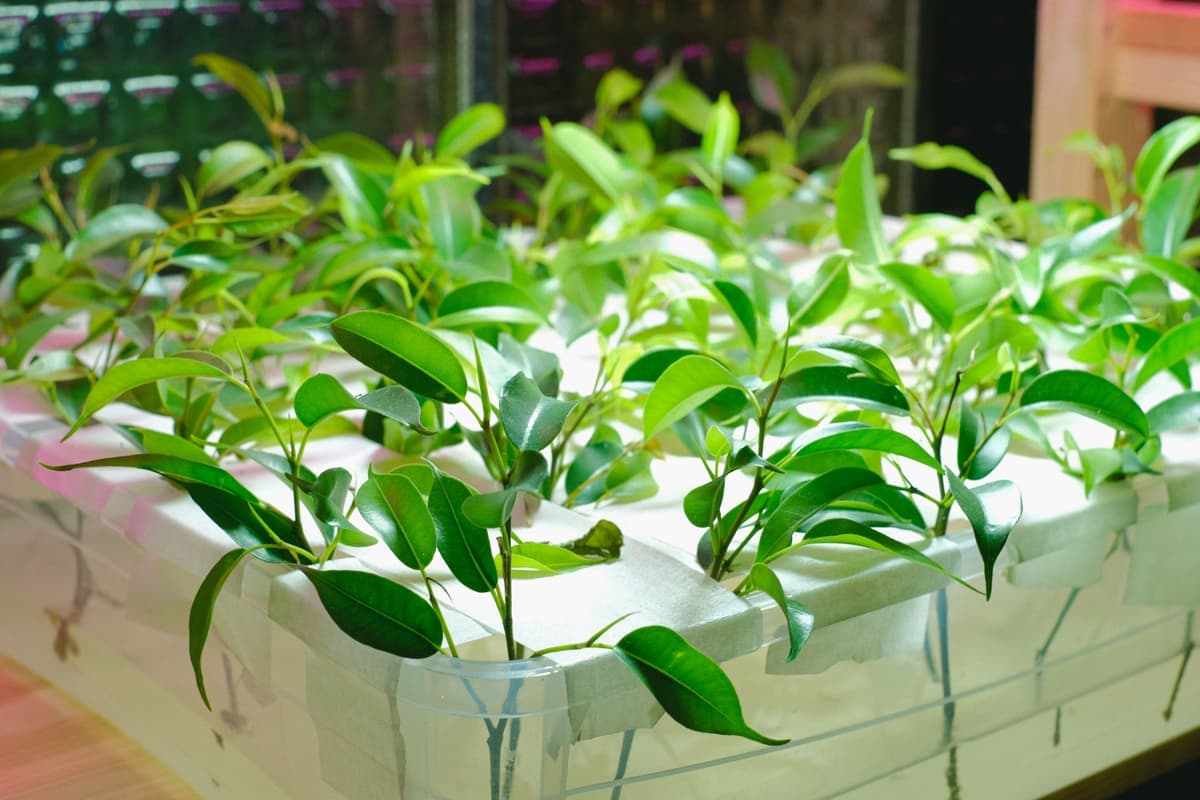
Photographs on this site are licensed stock and are illustrative of the fixture type. We do not own the units we write about.
How this page is funded: the buy links here are Amazon Associates links, and we earn a commission on qualifying purchases at no extra cost to you. We have not been paid to feature anything on this page, we accept no free product, and commission plays no part in the ranking. Full disclosure.
We have not tested these units. Everything below comes from the manufacturer’s own published specifications, or from arithmetic we have shown our working for. Where a figure is not published, we say so instead of estimating one. Read the method.
The reasoning
We have not tested this fixture. VIVOSUN publishes the highest efficacy figure of anything we cover — 2.75 µmol/J — and that number is worth taking seriously and worth being precise about.
The claim, and what would confirm it
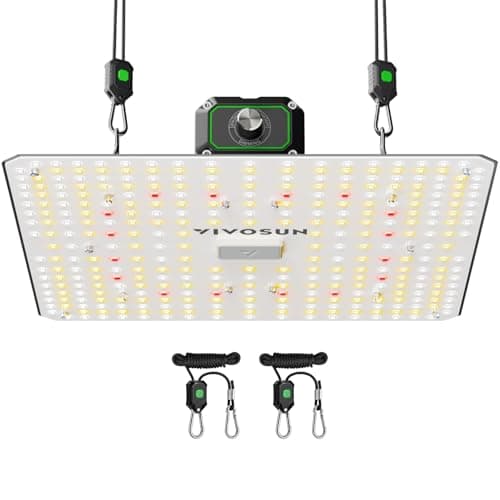
VIVOSUN publishes 100 W, 2.75 µmol/J, Samsung LM301 diodes, a 380–780 nm range including 660 nm and 730 nm, 3000 K and 5000 K whites, four dimming levels and a daisy chain.
What it does not publish is PPF. That single omission is what separates this spec sheet from Spider Farmer’s.
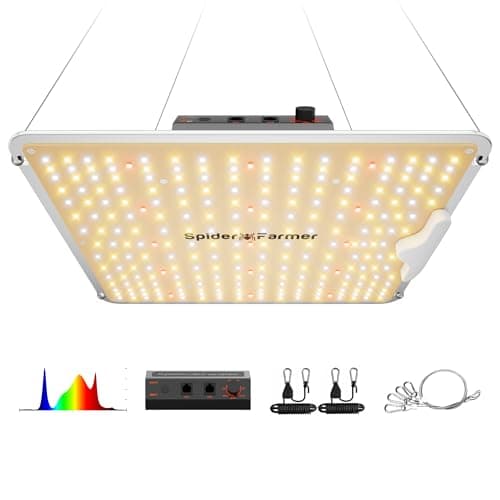
Spider Farmer publishes 249.21 µmol/s and 2.5 µmol/J at 100 W. Dividing: 249.21 ÷ 100 = 2.49, which matches. The claim is falsifiable and it survives.
VIVOSUN publishes 2.75 µmol/J at 100 W and no output figure. Multiplying gives an implied 275 µmol/s, but that is our arithmetic on their claim, not a second independent figure. It cannot contradict the first, because it is derived from it.
A claim you can check and a claim you cannot are different kinds of object, even when the uncheckable one is the higher number.
100 W × 2.75 µmol/J. Our arithmetic on their claim, not a VIVOSUN measurement — which is precisely the limitation this page is about.
The spectrum range is worth noting
VIVOSUN publishes 380–780 nm, which is the widest stated range of anything we cover and dips just below 400 nm into the edge of UV-A. They do not characterize that portion further — no intensity figure, no separate UV diode claim — so all we can report is the stated range. We go through what every fixture publishes on this front in do grow lights emit UV.
What it would deliver, if the claim holds
Over its stated 2 × 2 ft footprint (0.372 m²): 275 ÷ 0.372 × 0.8 = about 591 µmol/m²/s — well above the high-light band, so dimming or spreading is appropriate.
At a seedling-appropriate 250 µmol/m²/s it would cover 275 ÷ 250 × 0.8 = 0.88 m², which is 9.5 sq ft.
Both figures inherit the uncertainty of the implied output. They are arithmetic on a claim, and we would rather label that clearly than present them as specifications.
Running cost
100 W at 14 hours is 42 kWh a month, about $7.70 at the US residential average — identical to the SF1000 and the P1000, because draw is draw. The efficacy advantage shows up as more light for that same money, not as a lower bill.
Who should buy it
- Yes if you want the highest published efficiency in this class and are content to take the figure on the brand’s word.
- Yes for a daisy-chained multi-shelf build with four-step dimming.
- No if you want to compute your coverage from a figure the manufacturer actually measured, in which case the SF1000 is the fixture in this class that gives you one.
The fixture in full
VIVOSUN VS1000
LED panelSamsung LM301 diodes and a published 2.75 umol/J — the highest efficacy claim on this list, though the photon output it implies is never printed anywhere.
What VIVOSUN publishes
- Power draw
- 100 W (source)
- Efficacy
- 2.75 umol/J (source)
- Stated coverage
- 2 x 2 ft (source)
- Spectrum
- 380-780 nm, including 660 nm and 730 nm; 3000 K and 5000 K (source)
- Diodes
- Samsung LM301 (source)
- Dimming
- Yes, four dimming levels, daisy chain (source)
Our arithmetic
- Photon output implied by the published wattage and efficacy: about 275 umol/s
100 W x 2.75 umol/J = 275 umol/s. Our arithmetic from VIVOSUN's two published figures, not a VIVOSUN figure.
What VIVOSUN does not publish
- PPF in umol/s
- PPFD at any stated distance
- Rated lifespan
Who should skip it
Skip it if you want the efficacy claim independently checkable. With no published PPF there is no second figure to divide against, so the number has to be taken on trust.
Questions people actually ask
+What is the VIVOSUN VS1000's PPF?
+Is the VS1000 the most efficient grow light?
+Does the VS1000 emit UV?
+VS1000 or Spider Farmer SF1000?
Sources
- VIVOSUN — VS1000 product page — consulted September 2, 2026
- Spider Farmer — SF1000 published specification table — consulted September 2, 2026
- University of Minnesota Extension — Lighting for indoor plants and starting seeds — consulted September 2, 2026
- US Energy Information Administration — Electric Power Monthly, Table 5.3 (US residential average, June 2026) — consulted September 2, 2026
Read next
Reviews
The Best LED Grow Light Panels
The 100 W panel class compared on published output, efficacy and internal consistency.
Top pick
Spider Farmer SF1000
Running Cost
The Most Efficient Grow Lights by µmol/J
Every fixture we cover ranked on published photon efficacy, with derivations shown.
Reviews
The Best Grow Lights
The main ranking: nine fixtures sorted on published data, with every gap named.
Top pick
Spider Farmer SF1000
Spectrum & PPFD
Do Grow Lights Emit UV?
What the published spectral ranges say about UV, fixture by fixture, with the gaps named.
Reviews
VIVOSUN LumaLight 100W
521 µmol/m2/s at a stated 12 in, no PPF and no efficacy. Placeable, but impossible to rank.
Top pick
VIVOSUN LumaLight 100W
Where this sits
This page belongs to Fixture Reviews and Roundups. Every figure on it is either quoted from a named published source or derived in view — the full method is on our methodology page, and how the site is funded is on the affiliate disclosure.