Grow Light Lifespan and Replacement Cost
Four of the nine fixtures we cover publish a rated life. Here is what those hours mean in years, and the thing none of the ratings actually tell you.
By Scooter M. — An enthusiast who's genuinely into this. I read the manuals, compile the published specs, and do the math. No lab coat.
Published · How we pick
Photographs on this site are licensed stock and are illustrative of the fixture type. We do not own the units we write about.
How this page is funded: the buy links here are Amazon Associates links, and we earn a commission on qualifying purchases at no extra cost to you. We have not been paid to feature anything on this page, we accept no free product, and commission plays no part in the ranking. Full disclosure.
We have not tested these units. Everything below comes from the manufacturer’s own published specifications, or from arithmetic we have shown our working for. Where a figure is not published, we say so instead of estimating one. Read the method.
Quick picks
Efficacy is photons out per joule in. Where a manufacturer publishes it we quote theirs; where they publish photon output and wattage but not efficacy, we divide and label it as ours; where they publish neither, the cell says so rather than guessing. Tap a row for the full write-up.
| # | Product | Best for | Efficacy | Price |
|---|---|---|---|---|
| 1 | 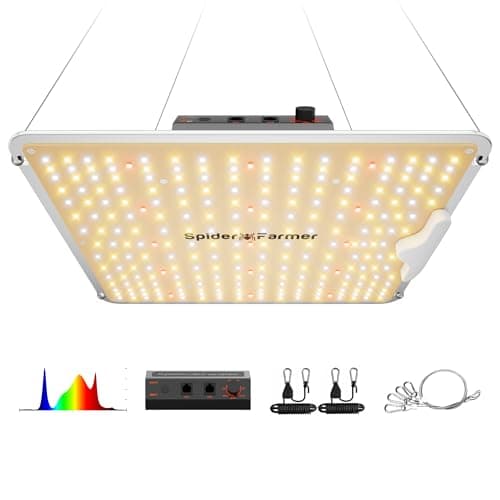 Spider Farmer SF1000 Publishes PPF to two decimal places and an efficacy figure that actually divides out of it. That internal consistency is rarer in this category than it should be. | Longest published life | 2.5 umol/J | |
| 2 | 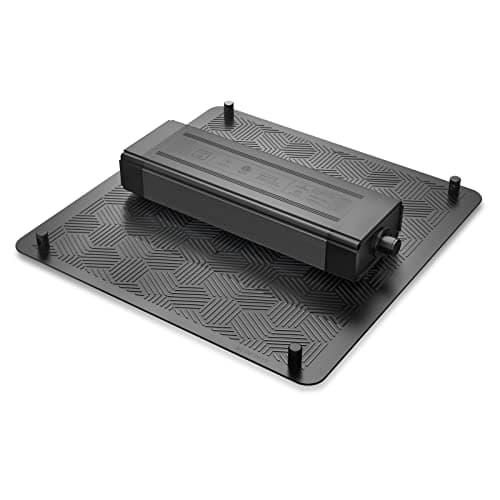 AC Infinity IONBOARD S22 The highest published efficacy of any fixture here at 2.7 umol/J, on Samsung LM301H diodes, with dimming in real 20% steps rather than a vague knob. | 50,000 h, no fan to fail | 2.7 umol/J | |
| 3 | 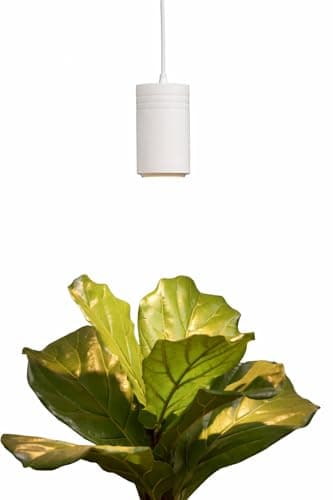 Soltech Aspect Gen 2 The only fixture here you would willingly hang in a living room, and the only one publishing PPFD at three separate distances so it can actually be placed by the numbers. | 50,000 h in a living room | 1.39 umol/J (ours) |
The reasoning
Lifespan is the specification people worry about most and need to worry about least. The published figures are long enough that, at home schedules, most of these fixtures will outlast your interest in the shelf they are mounted on.
What is worth attention is not the headline number but what it omits — and the fact that five of the nine fixtures we cover do not publish one at all.
What is actually published
| Fixture | Rated life | Also published |
|---|---|---|
| Spider Farmer SF1000 | 55,000 hours | Bridgelux diodes, 100 W ±5% |
| AC Infinity IONBOARD S22 | 50,000 hours | 272 diodes, Samsung LM301H, passively cooled |
| Soltech Aspect Gen 2 | 50,000 hours | 36 W, in-line dimmer 10–100% |
| SANSI 36W BR30 | 25,000 hours | 36 W, 4000 K, CRI close to 100 |
| Mars Hydro TS 1000 | Not published | 343 µmol/s, 2.3 µmol/J |
| VIVOSUN VS1000 | Not published | 2.75 µmol/J, Samsung LM301 |
| ViparSpectra P1000 | Not published | 100 W, no photon data either |
| Barrina T5 4ft | Not published | 20 W per strip, 5000 K |
| GooingTop clip light | Not published | No manufacturer spec sheet at all |
And not one of the four states what threshold the rating represents — the gap this page is really about.
Hours into years, at your schedule
A rated-hours figure is meaningless until you divide it by how you actually run the fixture. Two schedules cover most people: year-round houseplant use, and seasonal use for a winter or a seed-starting run.
| Fixture | At 14 h/day, year-round | At 12 h/day, year-round | Seasonal (12 h × 182 days) |
|---|---|---|---|
| Spider Farmer SF1000 (55,000 h) | 10.8 years | 12.6 years | 25.2 years |
| AC Infinity IONBOARD S22 (50,000 h) | 9.8 years | 11.4 years | 22.9 years |
| Soltech Aspect Gen 2 (50,000 h) | 9.8 years | 11.4 years | 22.9 years |
| SANSI 36W BR30 (25,000 h) | 4.9 years | 5.7 years | 11.4 years |
Spider Farmer publishes 55,000 hours. Run 14 hours a day, every day:
14 × 365 = 5,110 hours a year.
55,000 ÷ 5,110 = 10.8 years.
Run it only through an October-to-March season instead — 12 hours a day for 182 days — and that is 2,184 hours a year, so 55,000 ÷ 2,184 = 25.2 years.
The seasonal column is the honest one for most readers of this site. If you run a light for winter supplementation or a seed-starting season, rated life is not a purchasing consideration at all.
What the rating does not tell you
This is the part worth knowing. None of the four manufacturers states what their rated-hours figure represents. LEDs do not typically fail outright; they dim gradually, and the industry convention is to quote the point at which output has fallen to some percentage of the original. Which percentage — and whether the figure refers to the diodes alone or to the whole fixture including its driver — is not stated on any of the product pages we consulted.
So “55,000 hours” should be read as “a long time, on a basis the manufacturer has not defined.” That is not an accusation; it is the same disclosure gap that runs through this whole category, and it is why we treat the number as a rough ordering rather than a promise.
One practical consequence: a fixture losing output slowly is invisible. You will not notice a 15% decline over five years, and your plants will adjust to it before you do.
What actually fails first
Rarely the diodes. In practice the failure points are the supporting parts, which is worth knowing because it changes what you look for:
- The driver. The power supply is the most common failure in an LED fixture. Persistent flickering with the light plugged straight into a wall outlet points here.
- Fans, where fitted. A moving part in a warm enclosure. Both passively cooled fixtures we cover — the AC Infinity board and the ViparSpectra panel — avoid this failure mode entirely.
- Connectors on linked runs. On a series of strips, an unseated connector kills everything downstream and looks exactly like a dead fixture. The swap test is in grow light troubleshooting.
- The timer, if it is external. Cheap mechanical timers fail more often than lights do, and it is the first thing to bypass when something stops working.
Replacement cost is dwarfed by electricity
This is the finding that should actually shape a purchase. Compare what a fixture costs to own against what it costs to run over the same period.
Electricity: 100 W × 12 h ÷ 1000 = 1.2 kWh a day, over 182 days = 218.4 kWh a year.
At 18.34 cents per kWh: $40.05 a year.
Across five years: $200.25 in electricity — for a fixture that, at that schedule, has used about a fifth of its published rated life.
The electricity spent in five years comfortably exceeds what this class of fixture costs to buy, and the fixture is nowhere near needing replacement.
The conclusion follows directly: buy on efficacy, not on rated life. A fixture at 2.7 µmol/J against one at 1.39 delivers the same light for roughly half the electricity, and over five years that difference is real money. Rated life, at home schedules, is not. The full efficiency ranking is in the most efficient grow lights by µmol/J.
Replacement bulbs and parts
A common search, and mostly a category error. Integrated LED fixtures — panels, boards, strips — have no user-replaceable light source. When the diodes or driver fail, the fixture is replaced, not repaired.
The exception is the screw-in form factor. A SANSI BR30 sits in an ordinary E26 socket, so replacing it is replacing a bulb, and the lamp it sits in is unaffected. That is a genuine if modest advantage of the bulb form factor, alongside the efficiency penalty it carries.
Getting the published hours
Nothing exotic, and all of it matters more than the rating does:
- Leave airflow behind a passively cooled fixture. A board 1.1 cm thick sheds its heat backwards; pressed flush against a solid shelf it cannot.
- Keep the heat sink clear of dust. A slow failure mode nobody inspects for.
- Do not run it on a wall dimmer. These fixtures have their own dimming circuits and are not designed for one.
- Keep water away from connections. You are watering directly beneath a powered fixture; route cables so nothing runs under a tray.
Every pick in full
Spider Farmer SF1000
LED panelLongest published life
Publishes PPF to two decimal places and an efficacy figure that actually divides out of it. That internal consistency is rarer in this category than it should be.
What Spider Farmer publishes
- Power draw
- 100 W +/-5% at 100-277 V AC (source)
- PPF (photon output)
- 249.21 umol/s (source)
- Efficacy
- 2.5 umol/J (source)
- Stated coverage
- 2 x 2 ft core, 3 x 3 ft maximum (source)
- Spectrum
- 650-665 nm, 730-740 nm, 2800-3000 K, 4800-5000 K (source)
- Diodes
- Bridgelux (source)
- Dimming
- Yes, dimming knob (source)
- Dimensions
- 32.5 x 29.0 x 5.9 cm (source)
- Rated life
- 55,000 hours (source)
Our arithmetic
- Does the published efficacy check out against the published PPF?: Yes — 2.49 umol/J computed against 2.5 umol/J published
249.21 umol/s / 100 W = 2.4921 umol/J. The published 2.5 umol/J is that number rounded. Not every brand's two figures agree like this, which is exactly why we divide them. - Average PPFD across its 2 x 2 ft core footprint: about 536 umol/m2/s
2 ft x 2 ft = 4 sq ft = 0.372 m2. 249.21 / 0.372 = 670 umol/m2/s at perfect uniformity; at a 0.8 uniformity factor, about 536 umol/m2/s.
Who should skip it
Skip it if raw output is what you are buying — the TS 1000 delivers 38% more photons per second, at the cost of 50 W more draw.
AC Infinity IONBOARD S22
LED panel50,000 h, no fan to fail
The highest published efficacy of any fixture here at 2.7 umol/J, on Samsung LM301H diodes, with dimming in real 20% steps rather than a vague knob.
What AC Infinity publishes
- Power draw
- 115 W (source)
- Efficacy
- 2.7 umol/J (source)
- PPFD
- 1098 PPFD (no measurement distance published) (source)
- Stated coverage
- 2 x 2 ft (source)
- Spectrum
- Samsung LM301H, plus 660 nm, 730 nm, 3000 K, 6500 K (source)
- Diodes
- 272 diodes (source)
- Dimming
- Yes, 0-100% in 20% increments (source)
- Dimensions
- 30.0 x 30.0 cm board, 1.1 cm thick (source)
- Rated life
- 50,000 hours (source)
Our arithmetic
- Photon output implied by the published wattage and efficacy: about 311 umol/s
115 W x 2.7 umol/J = 310.5 umol/s. AC Infinity does not print PPF directly, so this is our arithmetic from two figures it does print.
What AC Infinity does not publish
- PPF in umol/s — only efficacy is given, so photon output has to be derived
- The measurement distance for the 1098 PPFD figure, without which the number cannot be compared to anything
Who should skip it
Skip it if you want to place it by the numbers. AC Infinity prints 1098 PPFD with no measurement distance attached, which makes that figure impossible to use or compare.
Soltech Aspect Gen 2
Pendant50,000 h in a living room
The only fixture here you would willingly hang in a living room, and the only one publishing PPFD at three separate distances so it can actually be placed by the numbers.
What Soltech publishes
- Power draw
- 36 W (source)
- PPF (photon output)
- 50 umol/s (source)
- PPFD
- about 50 umol/m2/s at 1 m, 34.9 at 4 ft, 15.5 at 6 ft (source)
- Spectrum
- 3000 K warm white, CRI 98 (source)
- Dimming
- Yes, in-line dimmer 10-100% (source)
- Dimensions
- 3.5 x 3.5 x 6.2 inches (source)
- Rated life
- 50,000 hours (source)
Our arithmetic
- Efficacy, computed from the published figures: 1.39 umol/J
50 umol/s / 36 W = 1.39 umol/J. Roughly half the efficacy of a 2.7 umol/J board — the design premium is paid twice, once at purchase and again every month on the meter.
Who should skip it
Skip it if photons per watt is the metric that matters. At 50 umol/s from 36 W it is the least efficient fixture on this page, and much of the price is industrial design.
Questions people actually ask
+How long do LED grow lights last?
+What does a 50,000 hour rating actually mean?
+What fails first on a grow light?
+Can you replace the bulbs in an LED grow light?
+Should I buy a grow light with a longer rated life?
Sources
- Spider Farmer — SF1000 published specification table — consulted September 2, 2026
- AC Infinity — IONBOARD S22 published specifications — consulted September 2, 2026
- Soltech — Aspect Gen 2 published specifications — consulted September 2, 2026
- SANSI — BR30 36W grow light bulb product page — consulted September 2, 2026
- Mars Hydro — TS 1000 published specification table — consulted September 2, 2026
- ViparSpectra — P1000 product page — consulted September 2, 2026
- Barrina — T5 ML20 4ft 20W product page — consulted September 2, 2026
- US Energy Information Administration — Electric Power Monthly, Table 5.3 (US residential average, June 2026) — consulted September 2, 2026
Read next
Running Cost
The Most Efficient Grow Lights by µmol/J
Every fixture we cover ranked on published photon efficacy, with derivations shown.
Running Cost
How Much Electricity Do Grow Lights Use?
Monthly kWh and cost per fixture, and how that compares with household appliances.
Top pick
Barrina T5 4ft Grow Light Strips
Reviews
Grow Light Troubleshooting
A diagnostic checklist for failing fixtures and for plants that say something is wrong.
Running Cost
LED vs Fluorescent Running Cost
The draw difference between T5 fluorescent and LED replacements, priced over a season.
Top pick
Barrina T5 4ft Grow Light Strips
Where this sits
This page belongs to Running Cost and Efficiency. Every figure on it is either quoted from a named published source or derived in view — the full method is on our methodology page, and how the site is funded is on the affiliate disclosure.